
The University of Chicago has a museum that holds 350,000 ancient artifacts, including the largest ancient Egyptian statue in the Western Hemisphere, the original Pazuzu figurine that inspired The Exorcist, and a 40-ton Assyrian winged bull from the palace of King Sargon II.
Most locals have never been inside.
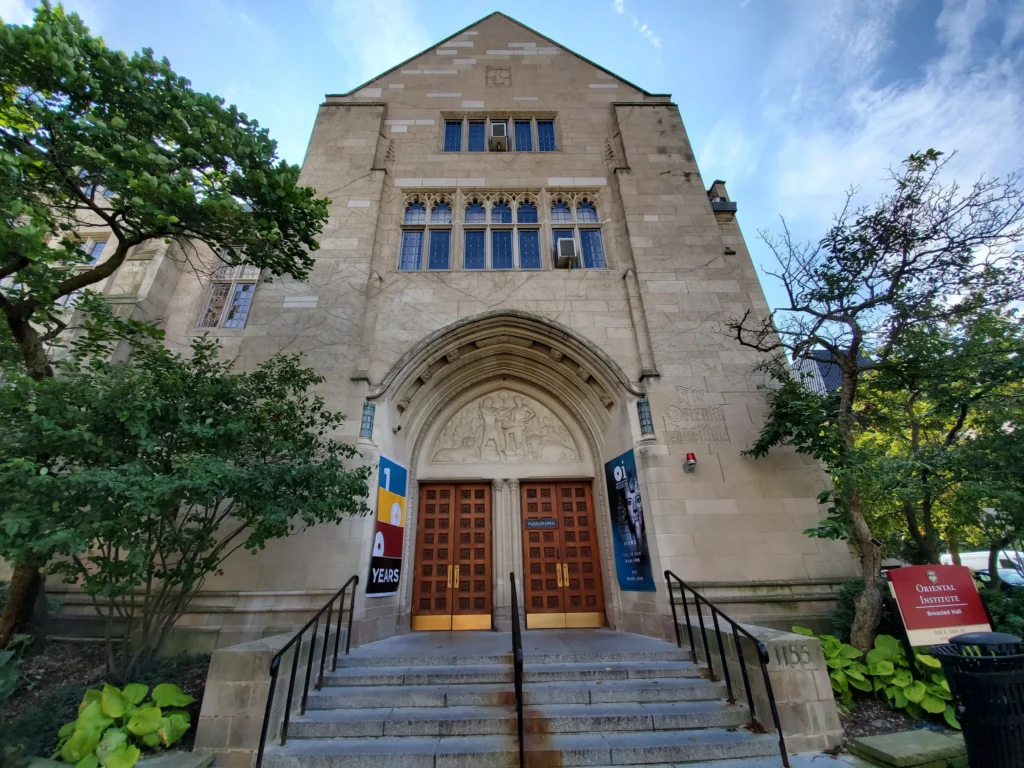
The Institute for the Study of Ancient Cultures, formerly known as the Oriental Institute, sits on the University of Chicago campus in Hyde Park.
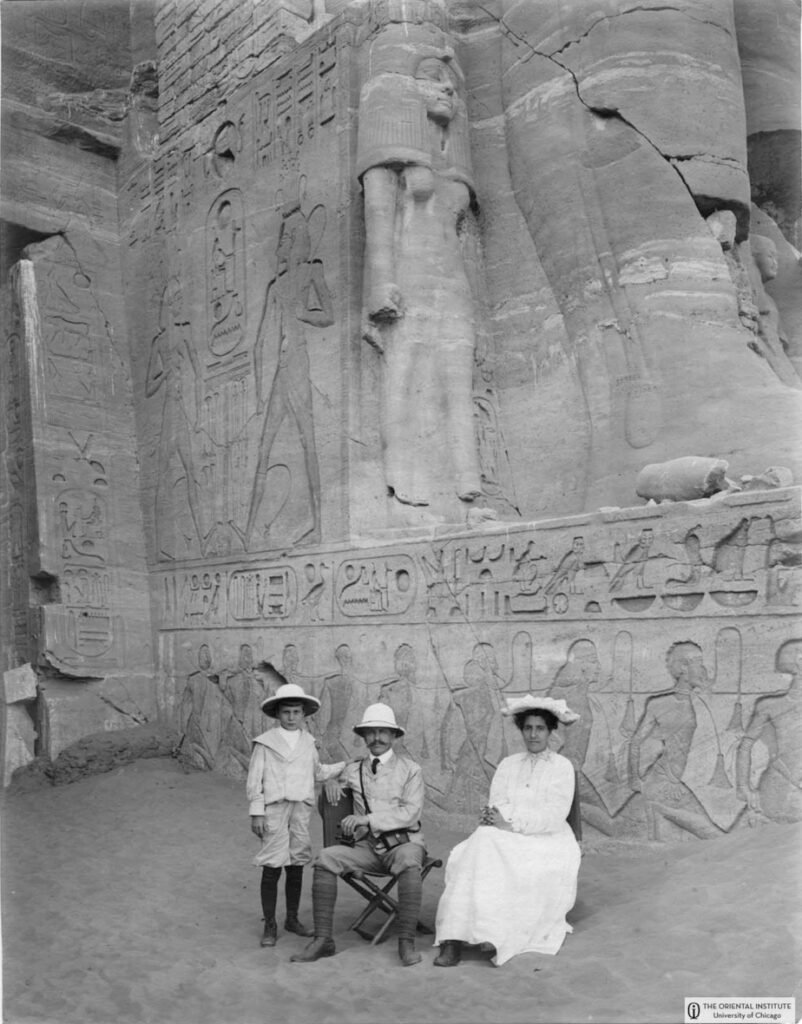
It was founded in 1919 by archaeologist James Henry Breasted, widely considered one of the primary real-life inspirations for Indiana Jones.
The museum’s collection is unlike almost anywhere else in the world because most of the artifacts were excavated by the institute itself, dug out of the ground in Egypt, Iraq, Iran, and Israel by University of Chicago archaeologists.
Locals call it the best free museum in the city. Suggested donation is $10. The artifacts inside are extraordinary.
Here are 8 of them, and the stories behind each.
1. The Colossal Statue of King Tutankhamun
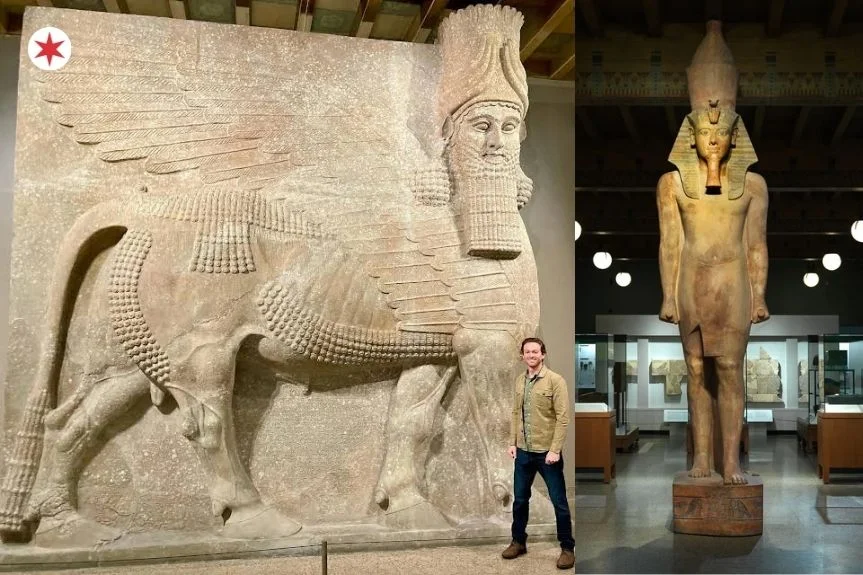
Lamassu, Neo-Assyrian Empire, c. 721–705 BC. Institute for the Study of Ancient Cultures, University of Chicago
📍Egyptian Gallery
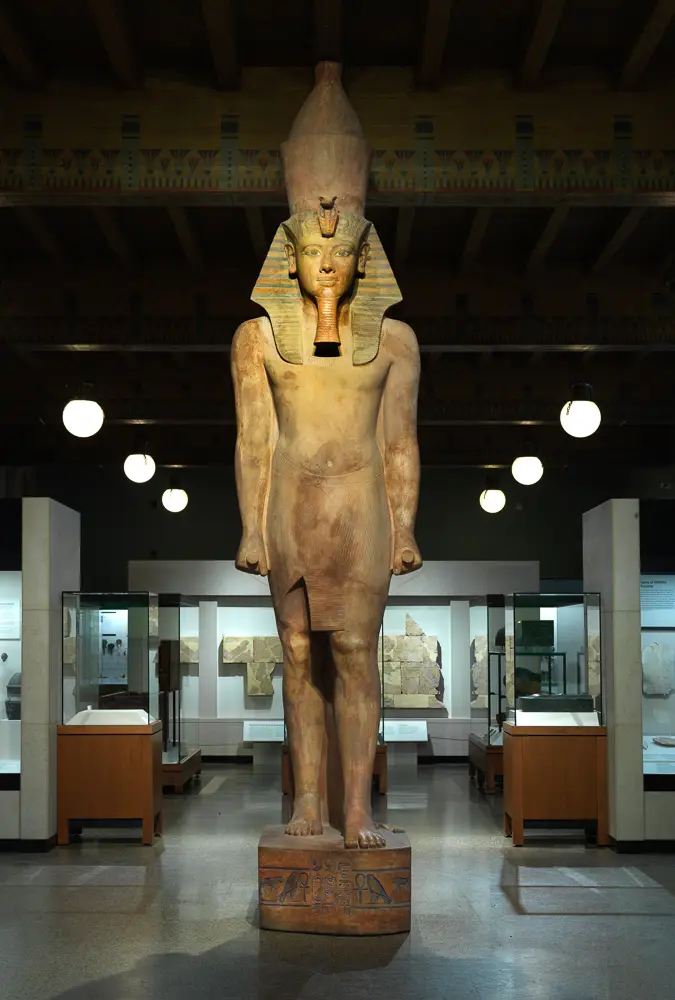
The largest ancient Egyptian statue in the Western Hemisphere lives in Hyde Park.
It stands 17 feet tall, weighs roughly 6 tons, and is carved from a single block of red quartzite. The figure depicts King Tutankhamun, the boy pharaoh who has fascinated the world since his tomb was discovered in 1922. ISAC’s statue isn’t from his tomb. It was excavated in the 1930s from Medinet Habu, the mortuary temple of Ramses III on the west bank of the Nile near Luxor. Tutankhamun’s image had been placed there by later pharaohs as a way of associating themselves with his legitimacy.
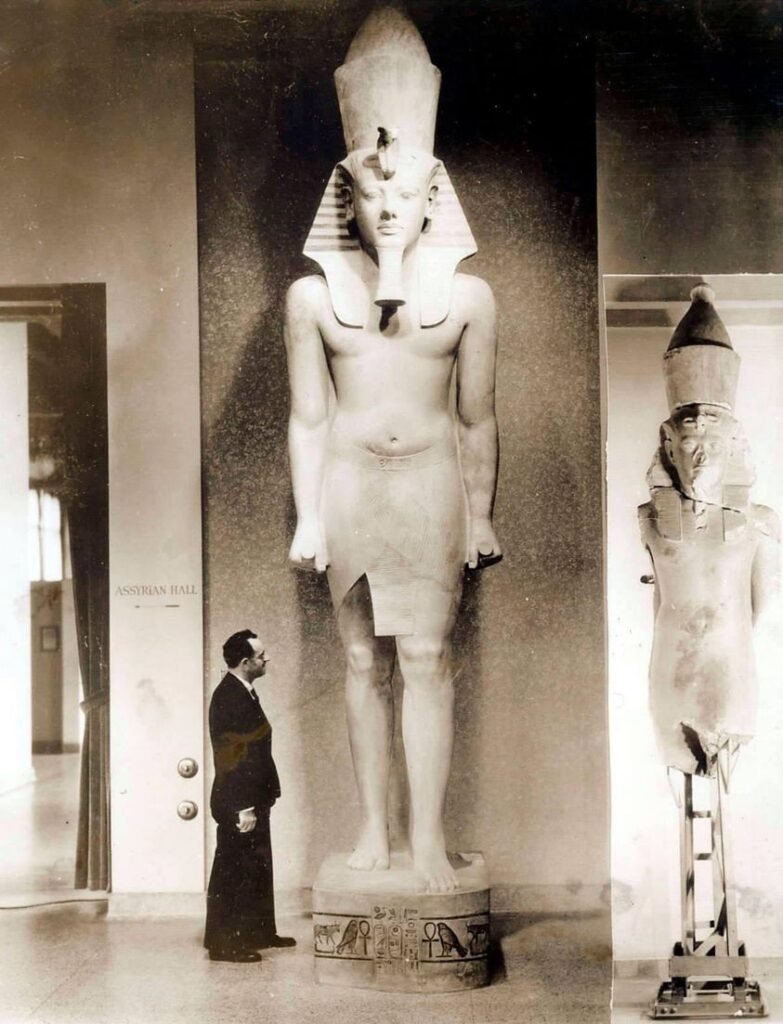
The statue was originally one of a pair flanking a gateway. Most Egyptian colossal statues that ended up outside Egypt were cut down for transport, but ISAC’s Tut is intact. The detail is extraordinary at close range. The wide stylized eyes, the false beard, the carefully sculpted folds of the kilt, and the curved cobra at the brow that marked royal Egyptian status. The original paint is long gone but you can still see traces of red pigment in the recessed areas of the carving.
Look for this: the cartouche on the belt buckle. Cartouches were oval frames containing a pharaoh’s name in hieroglyphs, and Tut’s name reads “Nebkheperure” (his throne name) on the buckle. After his death, later pharaohs scratched out his name from many of his statues, but this one was preserved. Stand close and you can read it.
2. The Lamassu (Human-Headed Winged Bull)
📍Mesopotamian Gallery
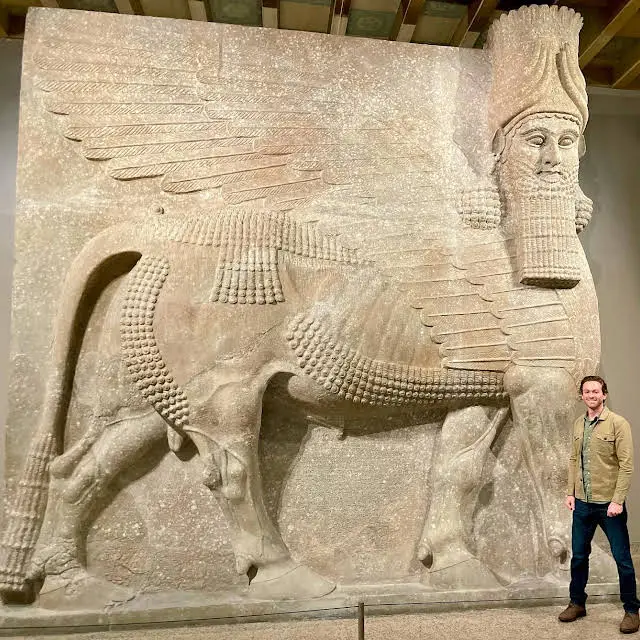
The most photographed object in the museum, and the most imposing. A 40-ton, 16-foot-tall human-headed winged bull carved from a single block of gypsum. It came from the palace of the Assyrian king Sargon II in the ancient city of Khorsabad (now in northern Iraq), built around 715 BC.
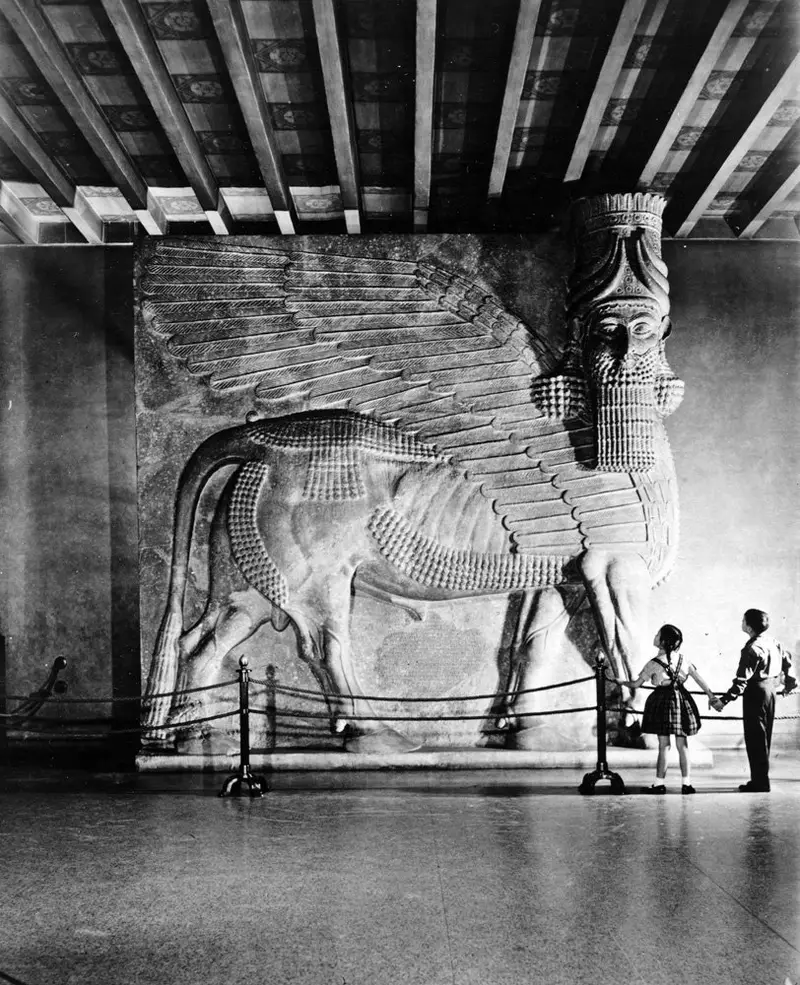
Lamassu were protective spirits stationed at palace gateways to ward off evil. Their hybrid bodies (bull’s torso, eagle’s wings, human head with elaborate beard) symbolized strength, intelligence, and divine protection. ISAC’s specimen has the most famous quirk of Lamassu sculpture: it has five legs. Look at it from the front and you see two legs standing still. Look at it from the side and you see four legs in motion. The Assyrian sculptor wanted the figure to appear stationary when approached head-on (a guardian standing watch) and walking when seen in profile (a powerful animal in motion). The optical illusion has been recognized as one of the earliest examples of multiple-perspective art in human history.
ISAC’s Lamassu was excavated by the institute itself in the 1920s and 30s. The team cut it into manageable sections, shipped it from Iraq to Chicago, and reassembled it inside the building. Most Mesopotamian artifacts of this scale are at the Louvre or the British Museum. ISAC has one of the only intact Lamassu of this size in the United States.
Look for this: the cuneiform inscription carved across the bull’s body. It’s a royal inscription naming Sargon II, listing his military campaigns, and threatening curses on anyone who damages the statue. The threat didn’t entirely work (the original palace was destroyed) but the bull itself survived.



3. The Persian Bull Head
📍Persian Gallery
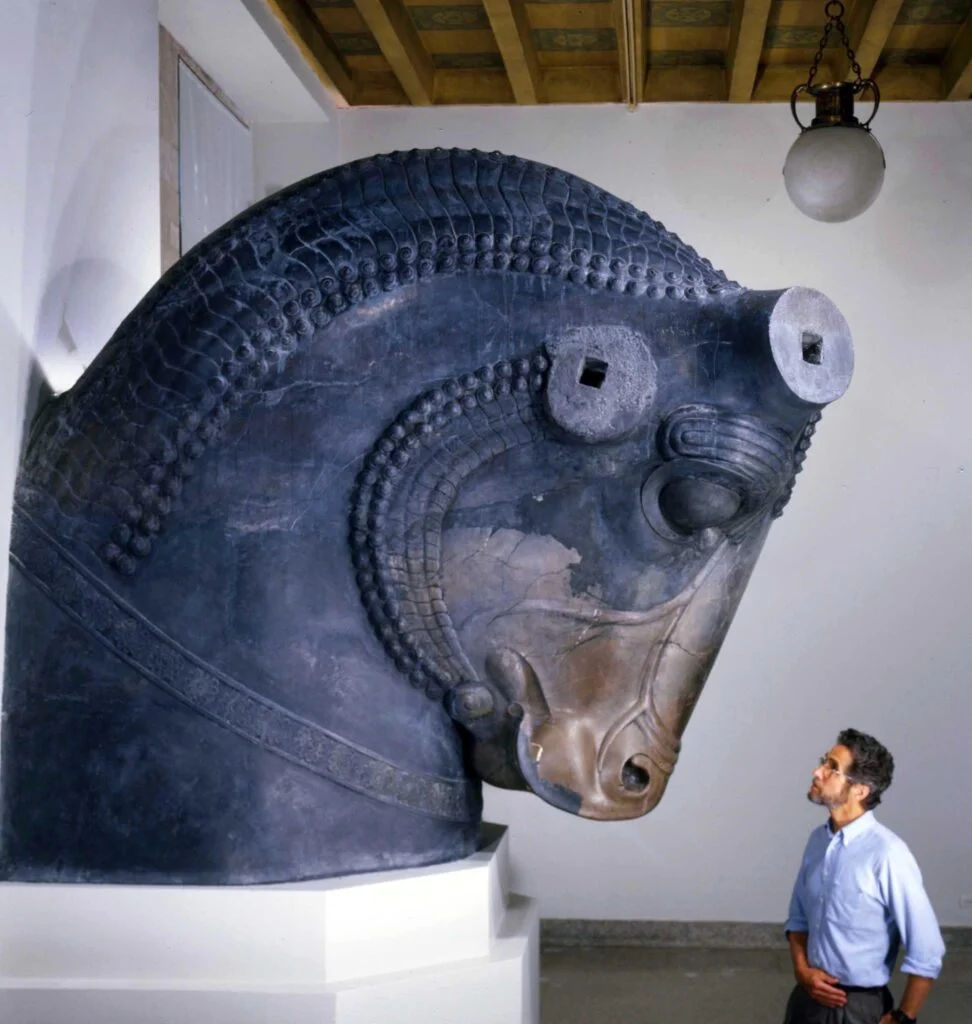
A massive dark stone bull head once guarded the entrance to the Hundred-Column Hall at Persepolis, the ceremonial capital of the Persian Empire under Darius I and Xerxes. The hall held a thousand attendees during royal audiences. Two of these bull heads stood on monumental columns at the entrance, with a counterpart facing them across the doorway. ISAC has one. The other is at the Louvre.
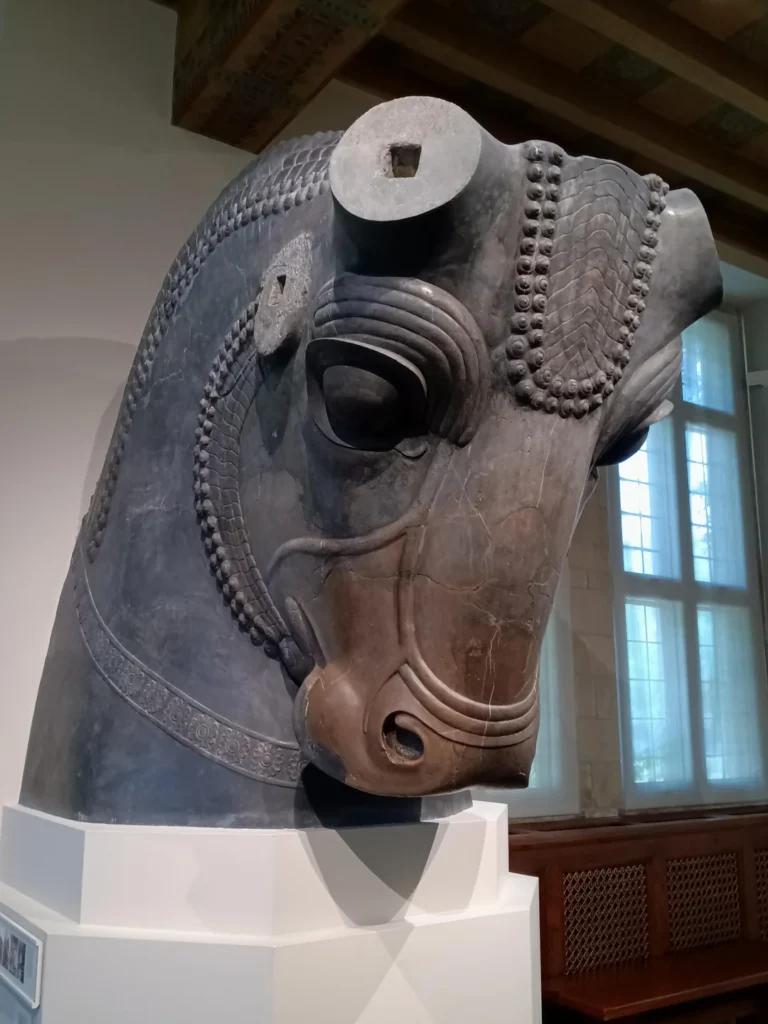
The bull’s expression is what most visitors remember. The eyes are deep-set and slightly downturned, giving it a contemplative, almost sad look that feels more emotionally complex than most monumental sculpture. The mane is rendered in tight curls. The horns are stylized but anatomically accurate. The whole piece is carved from a dense black stone that polishes to a near-mirror finish in good light.
Persepolis was destroyed in 330 BC when Alexander the Great’s army burned the palace complex. Whether the burning was a calculated political act or a drunken celebration is still debated by historians. The Hundred-Column Hall collapsed in the fire, the columns toppled, and the bull heads fell. The German archaeologist Ernst Herzfeld led excavations in the 1930s that recovered ISAC’s bull head, which was then transported to Chicago.
Look for this: the small drilled holes on the bull’s head where bronze inlay once decorated the eyes and ears. The metal was looted in antiquity, but the holes are still visible. Stand on the right side of the head and look at the eye socket.
4. The Code of Hammurabi (Cast)
📍Mesopotamian Gallery
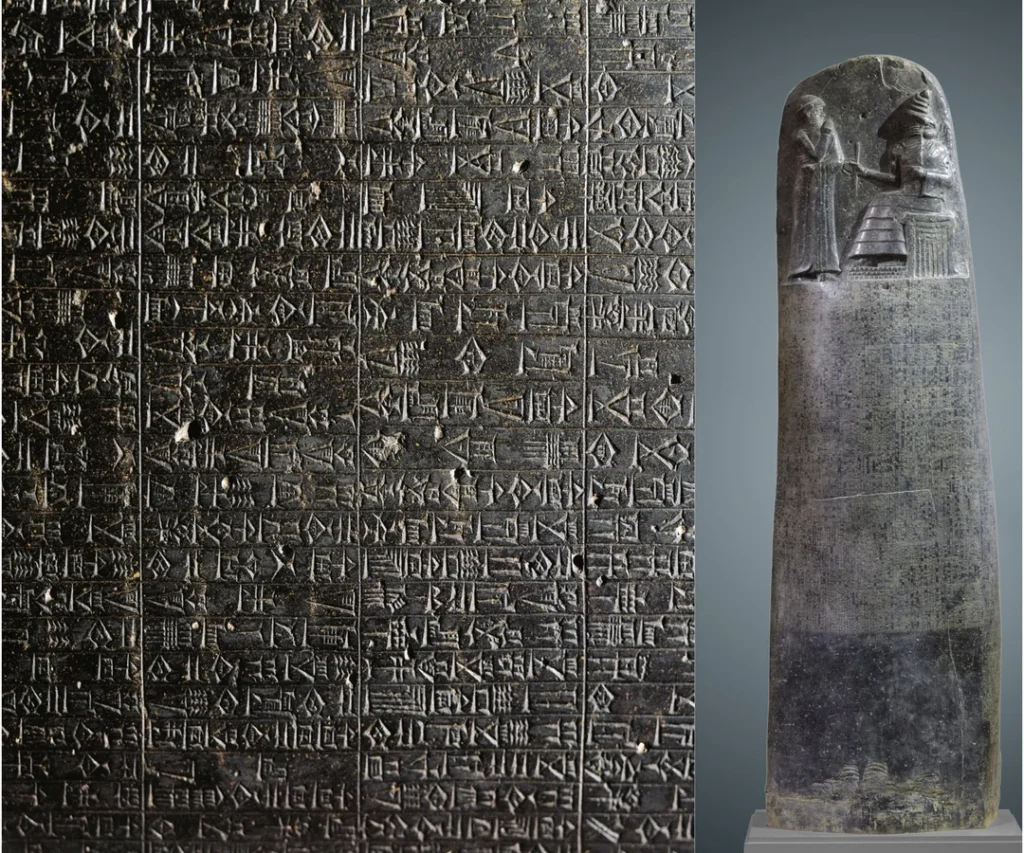
Not the original (the original is in the Louvre) but a perfect cast of the famous black diorite stele inscribed with Hammurabi’s law code. The stele dates to around 1754 BC and is one of the earliest surviving sets of written laws in human history.
The original was discovered in 1901 in Susa, the Persian city in modern Iran where it had been taken as war booty by Elamite king Shutruk-Nahhunte centuries after Hammurabi’s death. The French archaeologists who found it sent it to the Louvre, where it became one of the most important artifacts of the ancient world. ISAC’s cast was made directly from the original and is identical in scale and detail. It allows close-up reading of the cuneiform that you’d never get standing in the Louvre’s crowded gallery.
The relief at the top shows Hammurabi standing before Shamash, the Babylonian god of justice. Below, the entire stele is covered in tightly packed columns of cuneiform listing 282 laws governing everything from property disputes to medical malpractice to the price of beer. The laws established the principle of “an eye for an eye” (lex talionis) that would later appear in Hebrew, Greek, and Roman legal traditions.
Look for this: law #196, the famous “if a man destroys the eye of another man, they shall destroy his eye” passage. ISAC labels the stele clearly enough that you can find specific laws if you spend a few minutes reading. The level of detail in the cast is precise enough to read the cuneiform directly, which is impossible at the Louvre.
5. The Clay Prism of Sennacherib
📍Mesopotamian Gallery
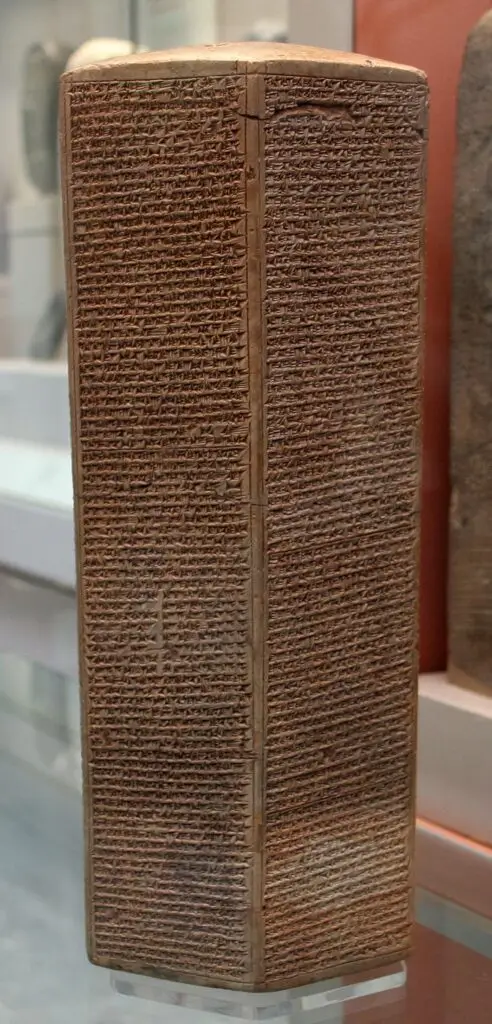
A six-sided clay prism, about 15 inches tall, inscribed in cuneiform with the military campaigns of the Assyrian king Sennacherib who reigned 705 to 681 BC. It’s the kind of object that looks small in the gallery and turns out to be one of the most historically important documents in the museum.
The text describes eight of Sennacherib’s campaigns including the famous siege of Jerusalem in 701 BC, when the Assyrian army surrounded the city of King Hezekiah. The Hebrew Bible describes this siege in detail in 2 Kings 18-19 and Isaiah 36-37, claiming that an angel struck down the Assyrian army outside the walls and forced Sennacherib to retreat. Sennacherib’s prism tells a different version. It claims the king “shut up Hezekiah, the Judean, like a caged bird in his royal city of Jerusalem,” collected enormous tribute, and went home victorious.
The prism is one of the few cases where archaeology gives us two contemporary accounts of the same historical event from opposing sides. Most biblical scholars now accept that Sennacherib didn’t actually take Jerusalem (the city remained in Hezekiah’s hands) but did successfully extract huge tribute. Both accounts have a piece of the truth, told from very different perspectives.
Look for this: the prism is labeled with translation notes. Read the Jerusalem section. It’s one of the few moments in the museum where you’re literally reading a 2,700-year-old propaganda document about an event that’s also recorded in scripture.
Expert Tips For Visiting ISAC
The Sparkle Trick
In the Assyrian Courtyard, the wall reliefs of the eunuchs flanking King Sargon II’s throne are carved from a stone studded with quartz crystals. If you stand at a specific angle relative to the gallery lights, the quartz catches the light and the figures appear to sparkle. This is exactly how the original carvings would have looked in the firelight of a Mesopotamian palace 2,700 years ago. Move slowly along the relief and watch the figures flash. Most visitors walk straight past without noticing.
The Suq Gift Shop
ISAC’s gift shop, called the Suq, is one of the best museum stores in Chicago. It sells genuine replicas of artifacts from the collection, hand-crafted Middle Eastern textiles, scholarly books on ancient cultures, and the kind of quirky souvenirs you can’t find anywhere else. The replica Pazuzu figurines are popular with horror fans. The cuneiform clay tablets sold as paperweights are surprisingly cheap. Worth budgeting 20 minutes at the end of your visit.
The Best Time To Visit
Weekday afternoons are nearly empty. Saturday afternoons get busier but never approach the crowds at the Field Museum or Art Institute. Avoid weekend mornings during University of Chicago move-in weekends or graduation. The galleries are at their quietest about an hour before closing, which is when you can spend uninterrupted time with the Lamassu and the Tut statue.
What To Skip If You’re Short On Time
If you only have 90 minutes, prioritize the Egyptian Gallery (King Tut, the Book of the Dead) and the Mesopotamian Gallery (the Lamassu, the Code of Hammurabi cast, Pazuzu). The Persian Gallery is excellent but smaller. The Assyrian Empire reliefs reward longer attention but can be sampled briefly if you’re rushing.
The Donation Reality
Suggested donation is $10 for adults, $5 for children. The donation is genuinely suggested, not required. If you can pay, pay. The institute’s fieldwork in the Middle East depends on private donations and the museum’s ability to remain accessible to the public. If you can’t pay, you can still walk in. Locals consistently mentioned this as one of the reasons they recommend the museum to visitors on tight budgets.
The Bottom Line
ISAC is the museum locals quietly recommend when they want to send a friend somewhere extraordinary that nobody else will already have visited. The artifacts inside are world-class. The crowds aren’t. The price is whatever you can afford. And the surrounding Hyde Park neighborhood gives you a full day of free or low-cost things to do, all anchored by University of Chicago architecture and history.
If you’ve done the Field Museum and the Art Institute and are looking for the next deep cut, ISAC is the answer.
Walk in. Stand in front of the Lamassu. Read the cuneiform. Find the Pazuzu. Then walk over to the Robie House. Have lunch at the Medici. Browse the Seminary Co-op. Take the Metra back downtown.
That’s the Chicago day most visitors never have.