

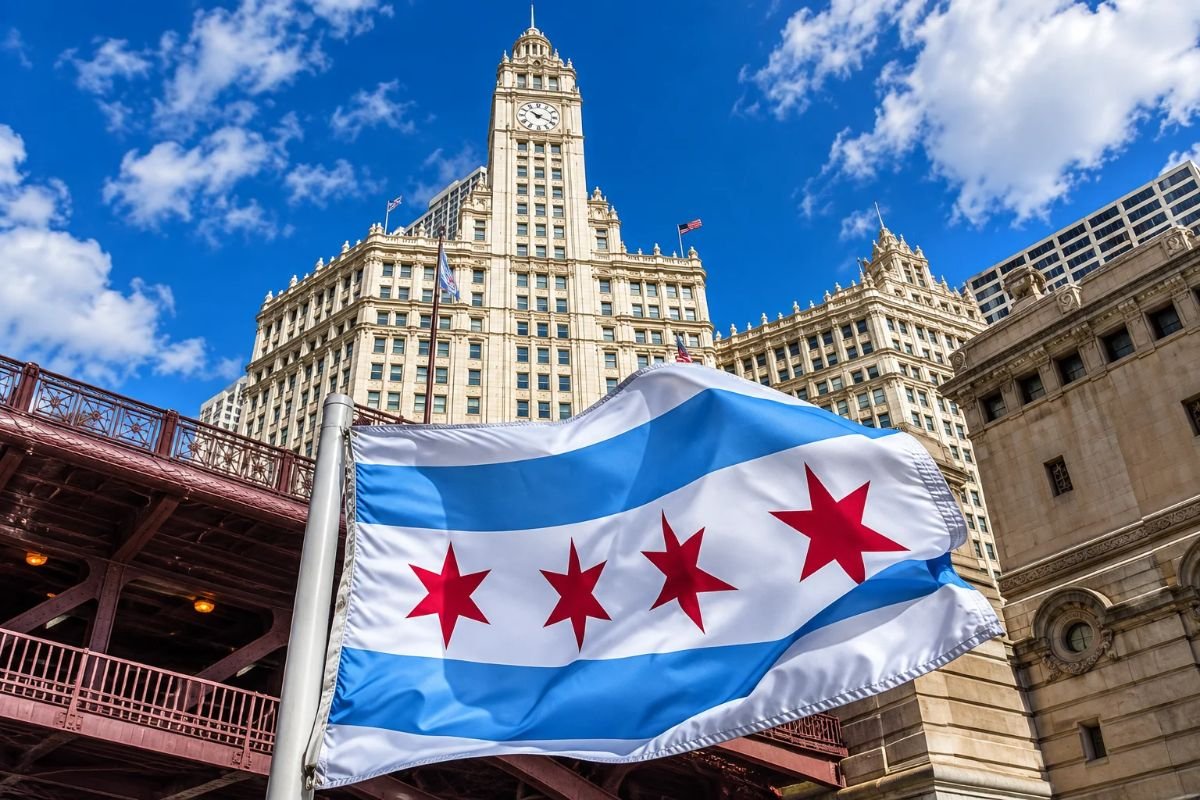
The first red star on the iconic Chicago flag is actually a geographical lie that was added completely out of chronological order.
This timeline paradox is 100% real municipal history, not some forgotten urban legend.
You can find the physical bronze plaque marking this exact historical blunder cemented into the sidewalk at Michigan Avenue and Wacker Drive.
The flag’s original designer died just six days before politicians hijacked his masterpiece to rewrite the city’s bloody origin story.
For generations of Chicagoans, those four six-pointed red stars are a permanent badge of neighborhood pride.
In 2004, the North American Vexillological Association ranked Chicago’s banner second out of 150 American city flags, losing only to Washington, D.C.
This aesthetic perfection has turned the design into a massive local subculture.
Local tattoo artists frequently report that the four red stars are among the most requested local tattoos in the city.
But the original 1917 City Council blueprint reveals a much darker, highly contested political battle.
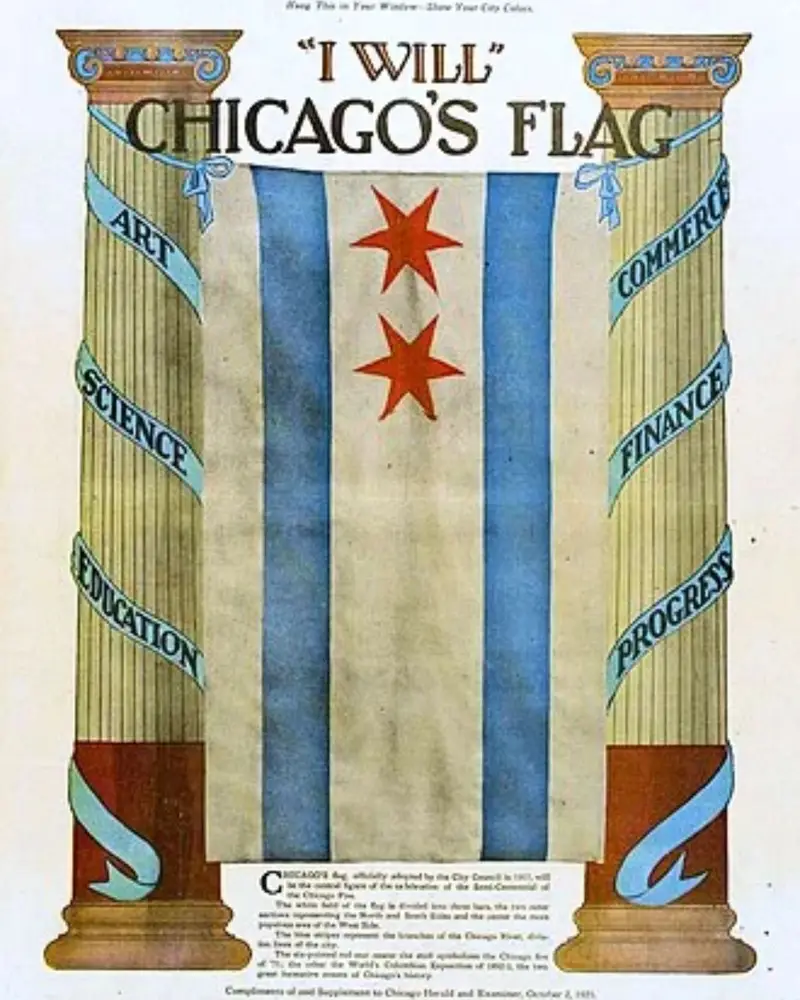
Harvard-educated lawyer and poet Wallace deGroot Cecil Rice won the municipal design contest with a radically different vision.
Rice intentionally shoved the original two stars far to the left side of the flagpole hoist.
He was a pragmatist who knew Chicago’s relentless growth would demand more stars, leaving the right side completely blank for future generations.
The Geometry War and the “British” Paranoia
The flag’s design immediately sparked a vicious political war inside City Hall.
In 1928, Mayor William Hale “Big Bill” Thompson tried to completely erase the six-pointed stars.

Thompson publicly declared that six points were unpatriotic and far too British for an American city.
Rice fiercely rebuked the mayor on the public record.
He explained that five-pointed stars represent sovereign states, while six-pointed stars are strictly municipal.
The designer won the geometry war, engineering the stars with precise 30-degree internal vertex angles to ensure they stood apart from the Star of David or any other global symbol.
Blood, Raw Sewage, and the “Salubrity” Lie
Every single color on the flag was weaponized to tell a specific story.
Rice explicitly stated that the deep red was chosen to evoke two diametrically opposed themes: catastrophe and celebration.
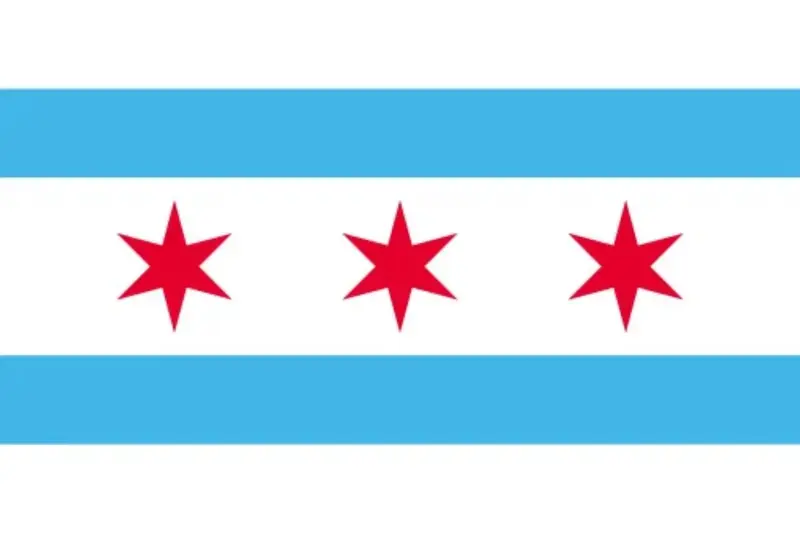
The crimson ink represents the roaring destruction of the 1871 Great Chicago Fire, while simultaneously capturing the festive energy of the 1893 and 1933 World’s Fairs.
But the real secrets are hiding inside the 24 individual star points.
Governed by Chicago Municipal Code 1-8-030, each point encodes a specific civic virtue, historical governing body, or municipal boast.
One specific point on the 1871 Fire Star stands out for its absolute historical absurdity: “Salubrity,” which translates to healthfulness.
This was a massive, laughable civic brag during an era when the Chicago River was notoriously choked with raw sewage.
The waterways were heavily polluted with toxic packinghouse waste pouring directly out of the Union Stock Yards.


The Great Canal and the Timeline Paradox
Most locals assume the two blue stripes simply represent the branches of the Chicago River and Lake Michigan.
However, the exact legislative definition honors a heavy industrial powerhouse: the Illinois and Michigan Canal.
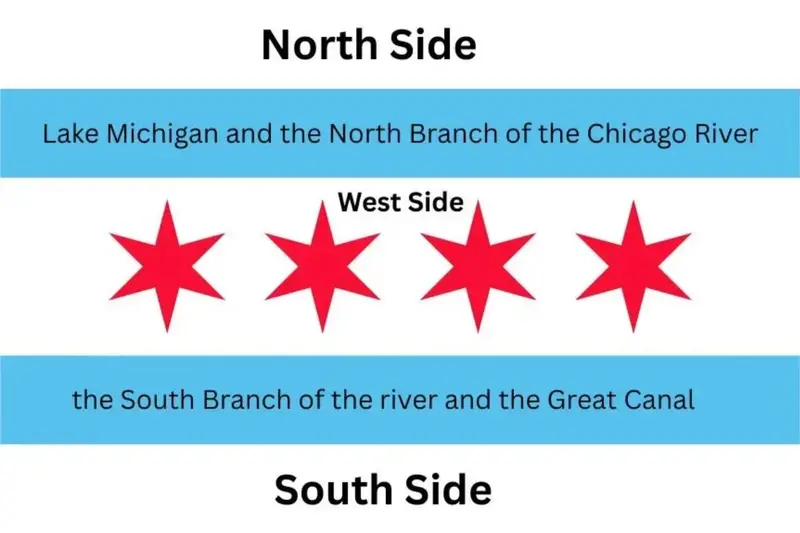
This forgotten waterway physically connected the Great Lakes to the Mississippi River basin, cementing Chicago’s supremacy as a continental transport hub.
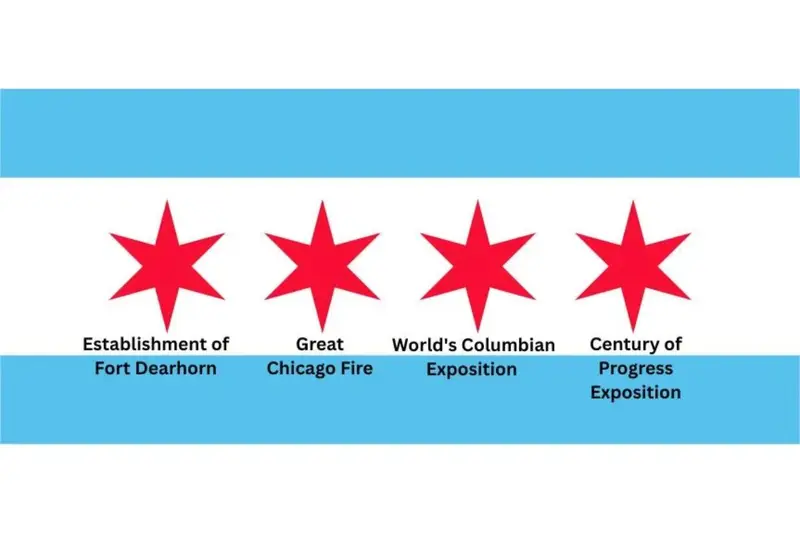
But the most glaring error on the flag is the timeline paradox of the stars themselves.
The stars are meant to be read chronologically from left to right.
Yet, the star honoring the 1803 Fort Dearborn was actually the final star added on December 21, 1939.
Instead of placing it at the end, the city forcefully slotted it into the first hoist position, destroying Rice’s original timeline.
The points on this star honor Captain Nathan Heald and Captain William Wells, the Army officers central to the bloody 1812 Battle of Fort Dearborn.
In a brutal twist of posthumous irony, Rice died just six days before this ordinance passed.
The Fifth Star Graveyard
Because the flag was originally designed to expand, politicians have repeatedly tried to add a fifth star.
Mayor Richard M. Daley attempted to add one for the 2016 Olympic Bid, a dream that died when Rio de Janeiro won the games.
In 1987, a campaign launched to honor Harold Washington, Chicago’s first Black mayor, after his sudden death in office.
That proposal was ultimately dropped due to deep political fears of altering the flag’s strict historic criteria.
Another massive push attempted to mark the December 2, 1942 creation of the first self-sustaining nuclear chain reaction under Stagg Field at the University of Chicago.
That star was ultimately shelved due to the dark, destructive legacy of the atomic bomb.
Today, grassroots movements still lobby for a star honoring the Great Migration.
This modern proposal aims to recognize the millions of African Americans who reshaped the city’s cultural landscape.
The Flag Star Field Guide
Skip the Wikipedia dive and track down the physical history of the four stars yourself. Here is exactly where the city’s foundational milestones are hiding in plain sight.
Star 1 (Fort Dearborn): Walk to the southwest corner of Michigan Avenue and Wacker Drive. Look down near the DuSable Bridge to find the bronze sidewalk plaques marking the original fort.
Star 2 (The Great Chicago Fire): Head to the South Loop at 558 W. DeKoven Street. This is the exact site of the infamous O’Leary barn, which is now fittingly home to the Chicago Fire Academy.
Star 3 (1893 World’s Columbian Exposition): Take the Metra Electric line down to Jackson Park. The sprawling green space and the Museum of Science and Industry are the last surviving physical remnants of the legendary White City.
Star 4 (1933 Century of Progress): Drive down to the Museum Campus and walk out to Northerly Island and Burnham Park. This is the man-made peninsula built specifically for the city’s second massive world’s fair.