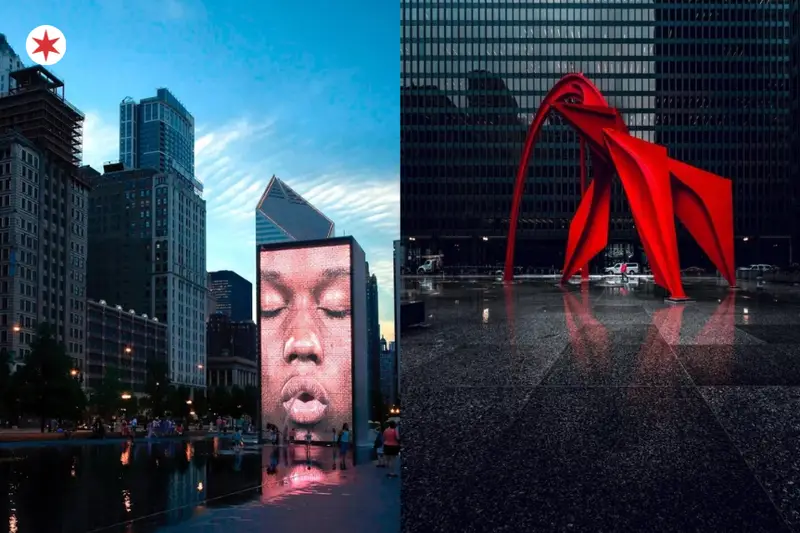
Chicago has some of the finest public sculpture of any city in the world. The collection spans a century of art history, from gilded Gilded Age monuments to immersive contemporary installations, and the best of it is free, permanent, and scattered across the city’s parks, plazas, riverbanks, and neighbourhoods.
Here’s the local’s guide to the pieces worth going out of your way for.
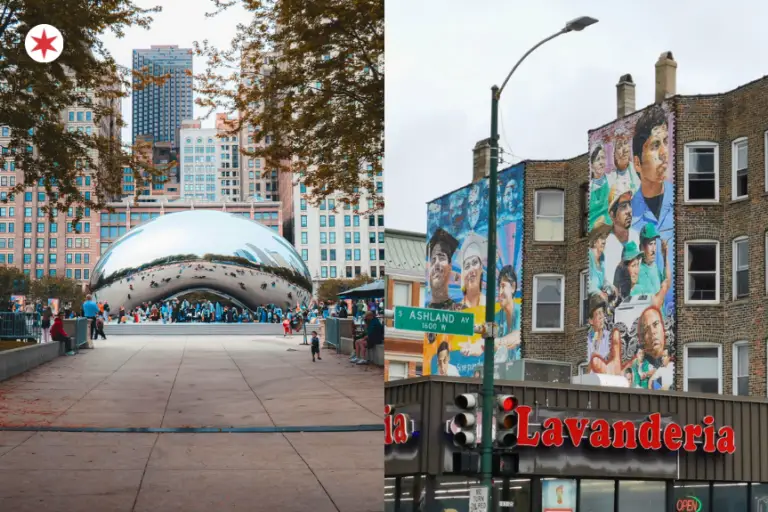
1. Cloud Gate (aka The Bean) by Anish Kapoor
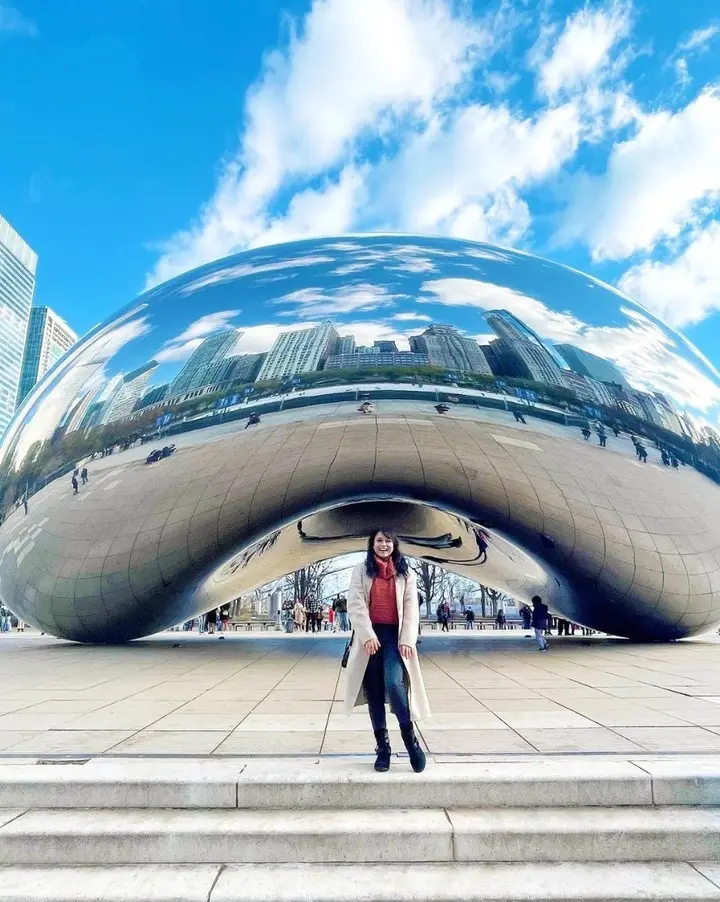
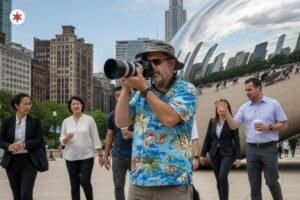
There’s a reason every visitor to Chicago ends up here — and it’s not just the Instagram opportunities. Anish Kapoor’s 168-panel stainless steel sculpture does something genuinely remarkable: it makes an enormous object feel weightless. The surface is polished to a mirror sheen, and depending on the light and your position, you’ll see the skyline warped and pulled in directions that don’t quite make geometric sense. Kapoor named it Cloud Gate. Chicago called it The Bean. Even Kapoor eventually gave up the fight.
The sculpture opened in 2004 and has become, without question, the city’s defining image. Go early on a weekday morning in spring or fall if you want it to yourself. Go at night in winter when the park is quiet and the surrounding towers are lit up. Any version is worth seeing.
📍 Getting there: Millennium Park, 201 E Randolph St. Free and open daily. Red/Blue/Green/Orange/Pink/Purple Lines to Washington or Madison/Wabash. Buses 3, 4, 19, 20, 56, 66, 151, 157.
See photos and reviews on TripAdvisor →
2. Crown Fountain by Jaume Plensa
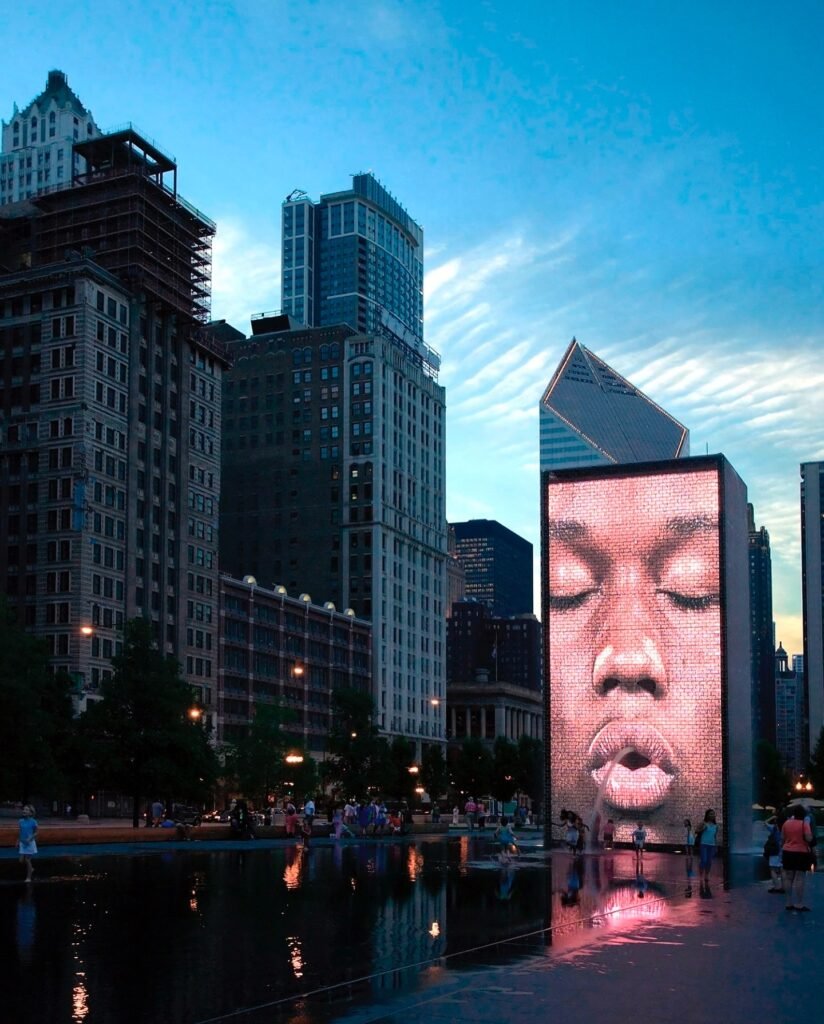
Two 50-foot glass towers, a shallow black granite pool, and the rotating faces of 1,000 Chicagoans — Crown Fountain has been one of the best places in the city to spend a hot afternoon for over twenty years, and it still doesn’t feel tired. Spanish artist Jaume Plensa designed it as a public portrait of Chicago’s diversity: the faces projected onto the LED towers were gathered from residents across the city’s neighbourhoods. When a face purses its lips and a stream of water shoots into the pool below, the kids go absolutely feral. That part never gets old either.
The water runs from late spring through mid-fall. In winter the faces keep projecting and the empty basin has a quiet, contemplative quality that the summer version entirely lacks.
📍 Getting there: Millennium Park, 55 N Michigan Ave (between Monroe and Madison). Free. Red/Brown/Green/Orange/Pink/Purple Lines to Monroe or Washington.
Local tip: On sweltering July days this is one of the few spots in the Loop where you can actually cool off without paying for it.
See photos and reviews on TripAdvisor →
❤️ Recommended Articles
3. The Picasso by Pablo Picasso
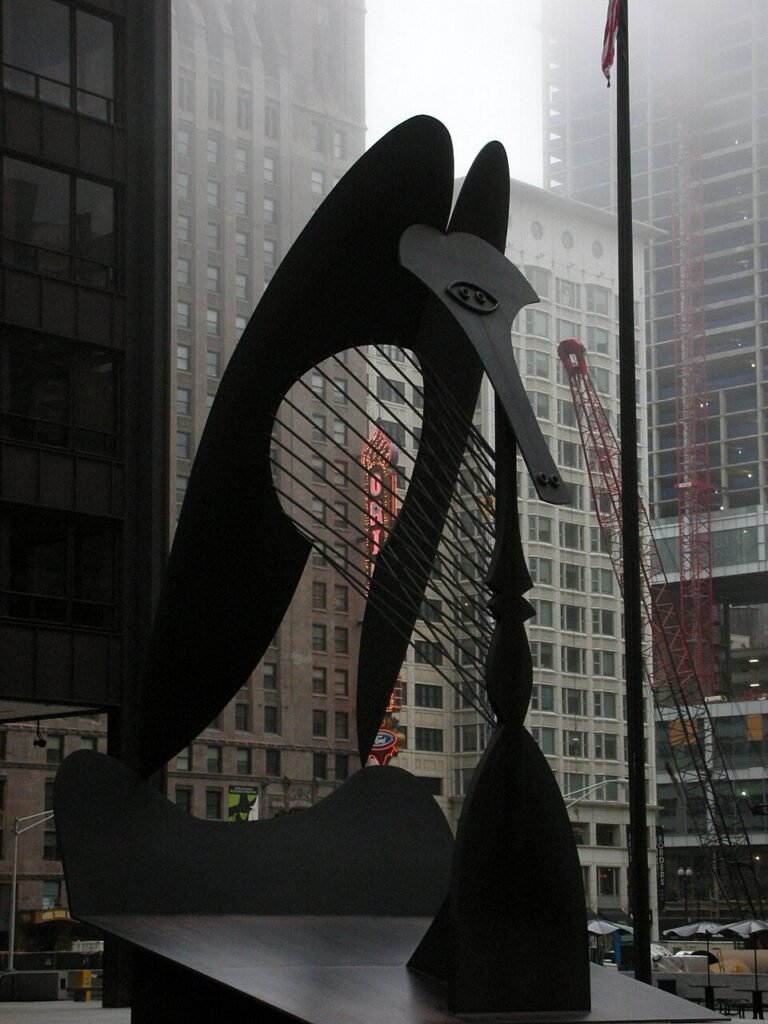
Few pieces of public art have had a more contentious debut. When Pablo Picasso’s untitled 50-foot, 162-ton Cor-Ten steel sculpture was unveiled in Daley Plaza in 1967, the reaction ranged from bafflement to outrage. Decades of debate about what it depicts have produced a rich range of theories: a woman, a dog, a baboon, the head of Picasso’s Afghan hound Kabul. Picasso himself never said. What he did say was that it was a gift to the people of Chicago — and he turned down $100,000 to prove it.
Today The Picasso is beloved and indestructible in the local imagination. Visitors climb on it. It’s used as a slide. In summer the plaza fills with food trucks and farmers markets. Whatever Picasso meant it to be, Chicago has made it completely its own.
📍 Getting there: Daley Plaza, 50 W Washington St. Free and always accessible. Blue Line to Washington; Brown/Orange/Purple/Pink/Green Lines to Randolph/Wabash.
See photos and reviews on TripAdvisor →
4. Calder’s Flamingo by Alexander Calder
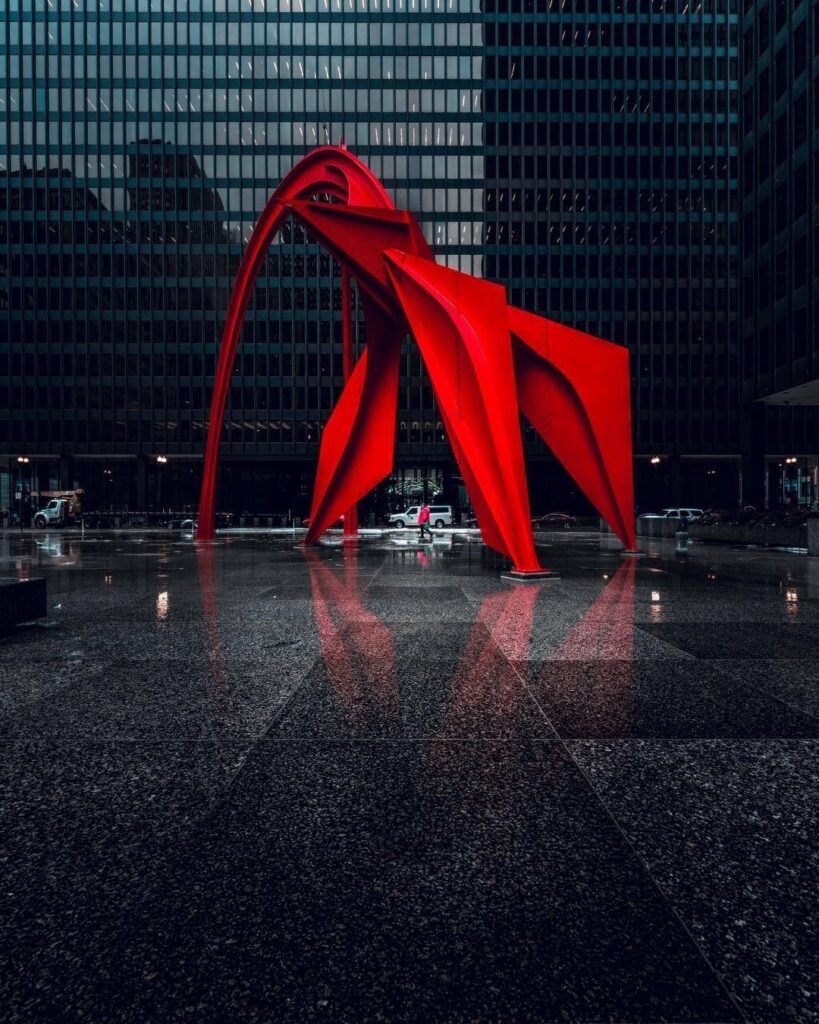
Alexander Calder’s Flamingo is one of those sculptures that gets more interesting the longer you stand with it. The 53-foot stabile in Federal Plaza is painted in Calder’s signature vermillion — a specific shade the artist mixed himself — and it arcs and balances against the severe black steel grid of Mies van der Rohe’s federal buildings behind it. The contrast isn’t accidental. Calder designed the piece knowing exactly where it would live, and the tension between the organic curves of the sculpture and the rectilinear architecture surrounding it is the whole point.
Unveiled in 1974, it was the first artwork commissioned under the federal government’s Percent for Art program. Walk underneath it and the scale changes completely — the legs rise above you like an archway and the body seems to float.
📍 Getting there: Federal Plaza, 50 W Adams St. Free and always accessible. Blue Line to Jackson; Red Line to Jackson.
See photos and reviews on TripAdvisor →
5. Chevron by John Henry
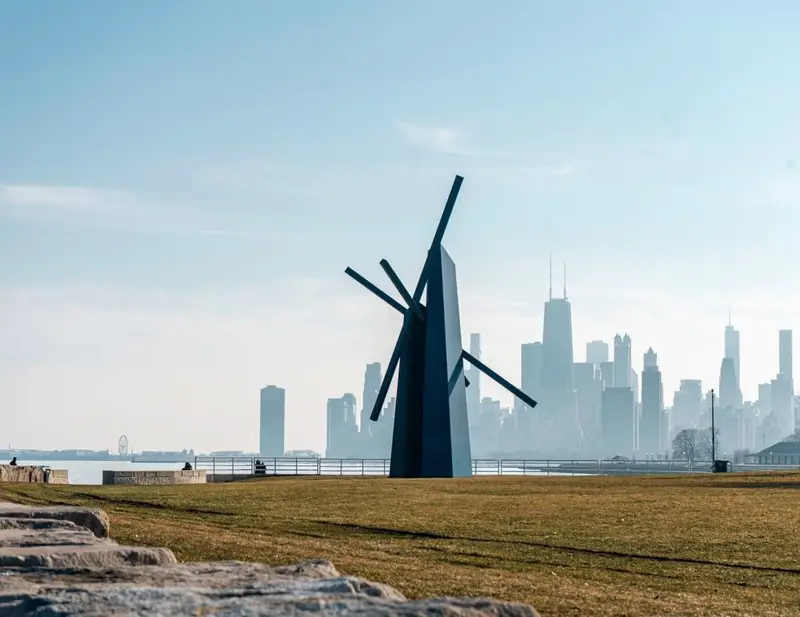
If you’ve cycled the lakefront trail near Diversey Harbor and wondered about the massive blue geometric structure rising above the trees, that’s Chevron. John Henry’s 50-foot-tall, 30-foot-wide sculpture has a way of stopping people mid-stride — two colossal slabs lean into each other while intersecting beams seem to balance on each side with the barely-controlled confidence of something that should have toppled over years ago. It’s abstract, it’s bold, and it looks genuinely different depending on the angle and the light.
Henry unveiled it in 2006 and the piece has spent time at various Chicago locations before finding its current home near the Diversey Harbor inlet. The locals who know it know it well. The ones who don’t stumble across it with a mix of confusion and delight that is entirely appropriate.
📍 Getting there: Lincoln Park, near the Diversey Harbor inlet at the lakefront. Free. Take the lakefront trail or drive to Diversey Harbor. Bus 151 to Diversey/Sheridan.
6. Agora by Magdalena Abakanowicz
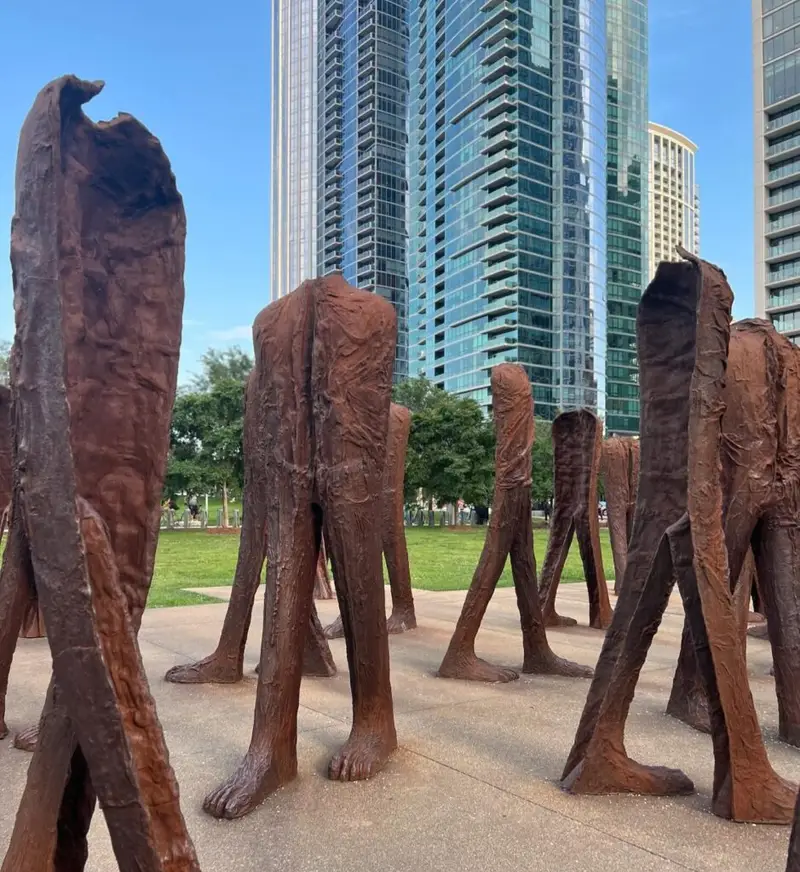
One hundred and six headless, armless cast iron figures, each nine feet tall, standing in the south end of Grant Park. Some appear to be walking. Some look frozen mid-step. None of them have faces. Magdalena Abakanowicz’s Agora — the Greek word for a public meeting place — is one of the most quietly unsettling and deeply human pieces of public art anywhere in the city, which is saying something in a city with this much public art.
The Polish artist installed the piece in 2006 as a permanent loan from the Polish Ministry of Culture. Walk through the figures and the scale does something to you — you become part of the assembly, one more anonymous figure moving among the crowd. Whether that feels melancholy or hopeful probably depends on the day.
📍 Getting there: South end of Grant Park, 1135 S Michigan Ave. Free and always accessible. Red Line to Roosevelt; Green/Orange Lines to Roosevelt.
Local tip: This is one of the most underrated public art experiences in Chicago. Many visitors walk through Millennium Park without ever venturing a mile south to find it.
See photos and reviews on TripAdvisor →
7. The Four Seasons by Marc Chagall
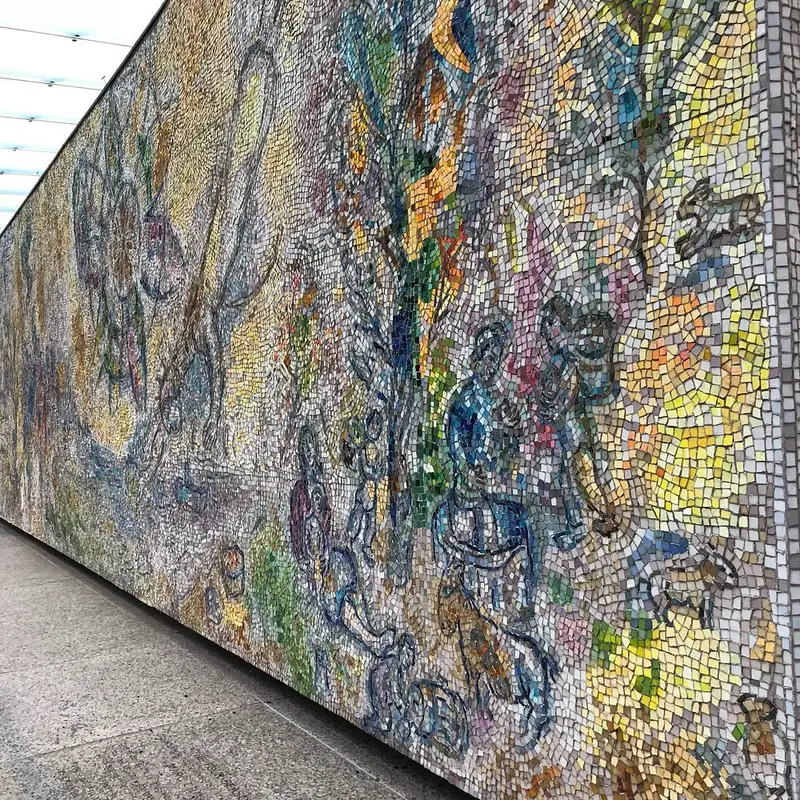
Marc Chagall’s enormous mosaic at Chase Tower Plaza is a gift in both senses of the word: it was literally gifted to the city by American stockbroker Frederick H. Prince in 1974, and it’s the kind of thing that feels like a present every time you walk past it. Thousands of inlaid chips in more than 250 colors depict six scenes of Chicago — the skyline, the lake, the seasons, the life of the city — in Chagall’s unmistakable dreamlike palette. It’s 70 feet long, 14 feet high, and wraps around all four sides of a rectangular base beneath a glass canopy.
Chagall kept revising it over the years, adding pieces of native Chicago brick and updating certain elements as the city changed. The surrounding plaza is currently undergoing a major renovation by JPMorgan Chase specifically designed to improve public access to the mosaic. The artwork itself is visible and accessible throughout.
📍 Getting there: Chase Tower Plaza, 21 S Dearborn St. Free and always accessible. Blue Line to Washington; Brown/Orange/Purple/Pink/Green Lines to Madison/Wabash.
See photos and reviews on TripAdvisor →
8. The Crossing by Hubertus von der Goltz
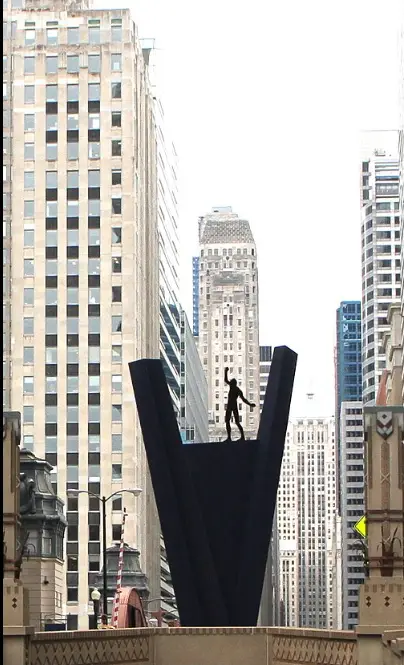
Stand at the right angle on LaSalle Street and you’ll see the silhouette of a man balanced on the apex of a 25-foot V-shaped steel structure, arms slightly raised, poised at the exact mid-point between two worlds. German artist Hubertus von der Goltz installed The Crossing in 1998 as a gateway between the Loop and River North, and the symbolism is deliberate: the figure teeters at the junction where Chicago’s commercial and cultural lives converge, where old money meets new ideas, where the grid of finance gives way to the art galleries and restaurants further north.
It’s the only permanent artwork to survive from the 17th International Sculpture Conference Chicago hosted that year, which gives it an additional layer of civic history that most people walking under it have no idea about.
📍 Getting there: LaSalle Gateway Plaza, 334 N LaSalle St (just north of the Chicago River). Free and always accessible. Brown/Orange/Purple/Pink Lines to Merchandise Mart.
9. Magdalene by Dessa Kirk
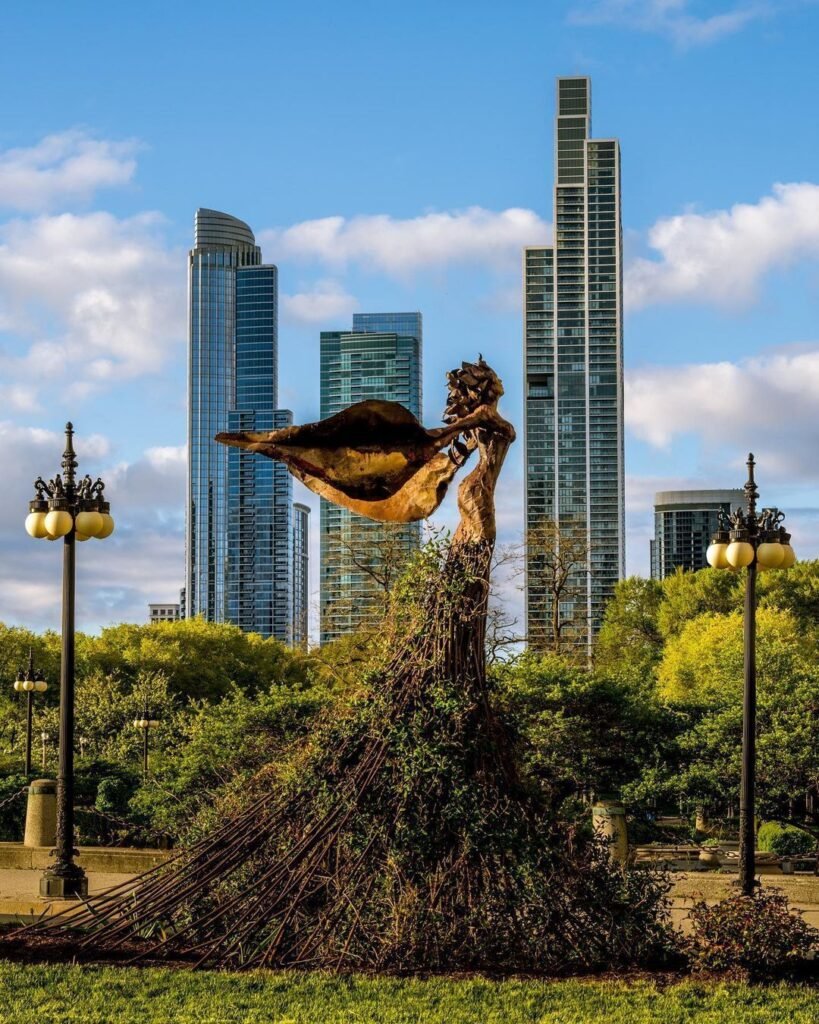
There’s a small triangular garden at the intersection of Congress Parkway and Michigan Avenue that most people walk past without slowing down. That’s a shame, because Dessa Kirk’s Magdalene — a female figure rising from the ground with an outstretched, upturned face — is one of the more quietly affecting sculptures in the city. Kirk designed it specifically for this site, and the sculpture changes with the seasons: tulips border her feet in spring, and by summer vines and flowers have crept up the folds of her skirt until she’s half-consumed by the garden. Come back in July when she’s disappeared into the green.
📍 Getting there: Congress Plaza, intersection of S Michigan Ave and E Ida B. Wells Drive. Free and always accessible. Red/Orange/Green Lines to Roosevelt or Library/State-Van Buren.
10. Gentlemen by Ju Ming
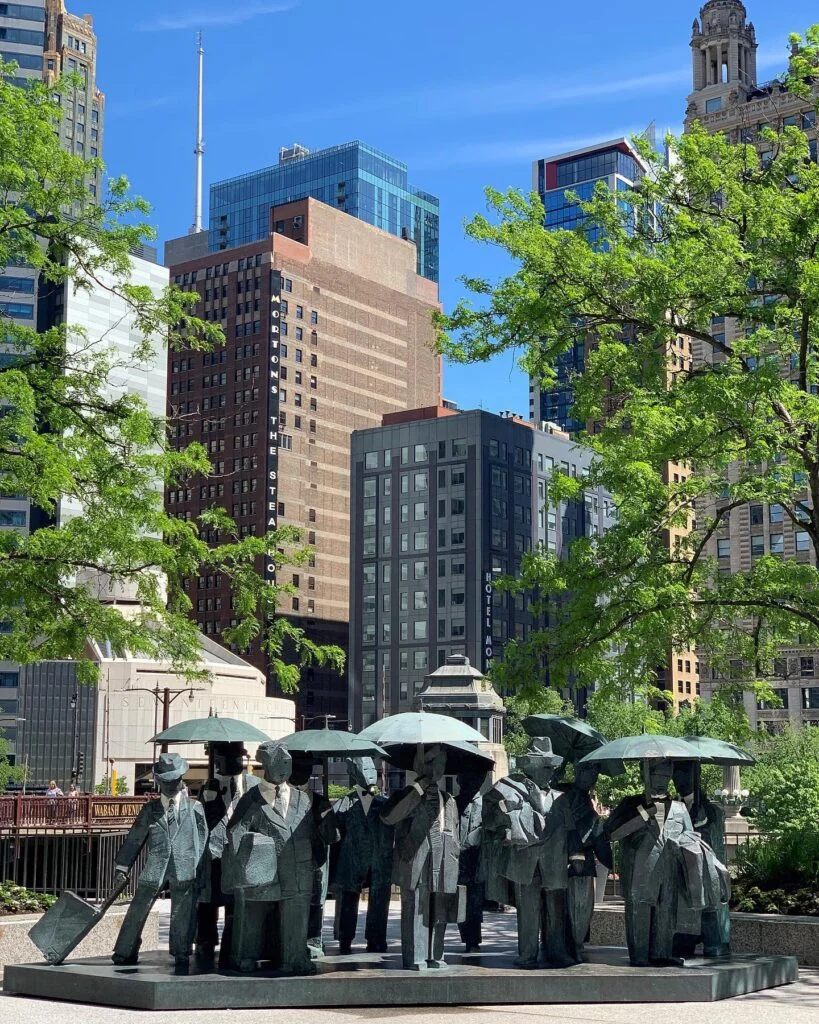
Eleven bronze-plated figures stand in the plaza at AMA Plaza on North Wabash, each dressed in a trench coat and carrying an umbrella or pulling luggage — the universal uniform of the business traveller. Taiwanese sculptor Ju Ming created them for the Langham Hotel Chicago in 2015, and they’re part of his “Living World Series,” which reduces human figures to their most essential geometric forms. No faces, no distinguishing features, just the archetypal shapes of people moving through the world with purpose.
There’s something both funny and a little poignant about them — an army of perfectly dressed nobody-in-particulars occupying one of Chicago’s busiest commercial addresses. They fit the neighbourhood completely, which might be the point.
📍 Getting there: AMA Plaza, 330 N Wabash Ave. Free and always accessible. Red Line to Grand; Brown/Orange/Purple/Pink/Green Lines to State/Lake. Bus 65.
See photos and reviews on TripAdvisor →
11. Sky Landing by Yoko Ono
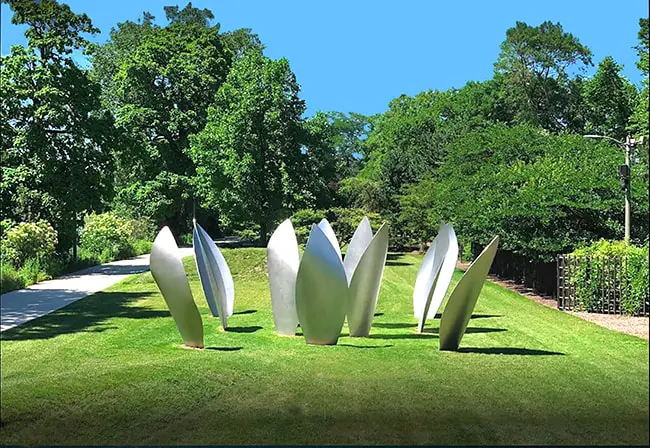
Jackson Park’s Wooded Island is already one of the most serene spots in Chicago — a narrow strip of land between two lagoons that was originally the Japanese Pavilion site for the 1893 World’s Columbian Exposition. Yoko Ono chose it deliberately in 2016 when she gifted Sky Landing to the city. A dozen 12-foot-tall lotus petals open toward the sky in polished silver, standing on the very ground where Chicago and Japan first formally met. Ono described it as “the place where the sky and earth meet and create a seed.”
It’s Chicago’s first permanent public artwork by Ono, and it earns its setting. The Wooded Island requires a short walk from the nearest entrance to Jackson Park, which means you’ll almost always have it to yourself.
📍 Getting there: Jackson Park, Wooded Island, 6401 S Stony Island Ave. Free. Take the Metra Electric to 59th St-U of C and walk east, or drive to the park’s east entrance. Bus 6 or 28 to 59th/Stony Island.
Local tip: Pair this with the Statue of the Republic and the Museum of Science and Industry for a full Jackson Park afternoon.
12. Atmospheric Wave Wall by Olafur Eliasson
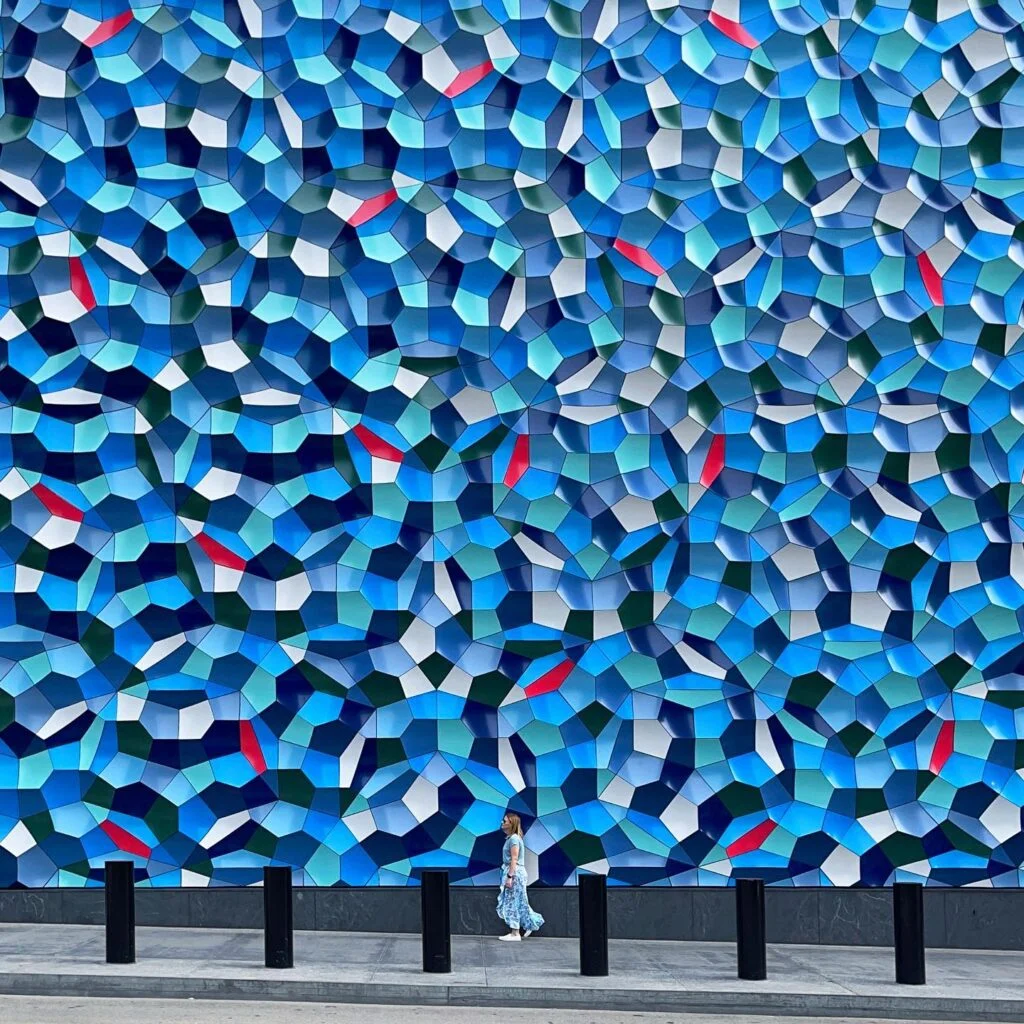
You’ve almost certainly already seen it without knowing what it was. Olafur Eliasson’s 30-by-60-foot mosaic wall at the base of Willis Tower, unveiled in 2021, is made up of 1,963 enameled steel tiles in blues, deep greens, and whites — colors the Danish-Icelandic artist chose deliberately to echo Lake Michigan and the Chicago River a few blocks away. From certain angles the pattern forms a vortex that appears to spin and accelerate as you move past it. From others it’s simply a surface of shifting light.
The piece sits at the corner of Jackson Boulevard and Wacker Drive and faces the street directly, which means you don’t need to enter Willis Tower to experience it. Eliasson noted that it looks dramatically different at different times of day — he wasn’t wrong, and if you pass it at golden hour on a clear day you’ll understand why.
📍 Getting there: Base of Willis Tower, corner of Jackson Blvd and S Wacker Dr. Free and always accessible. Orange/Pink/Brown Lines to Quincy; Blue Line to Jackson.
13. Nuclear Energy by Henry Moore
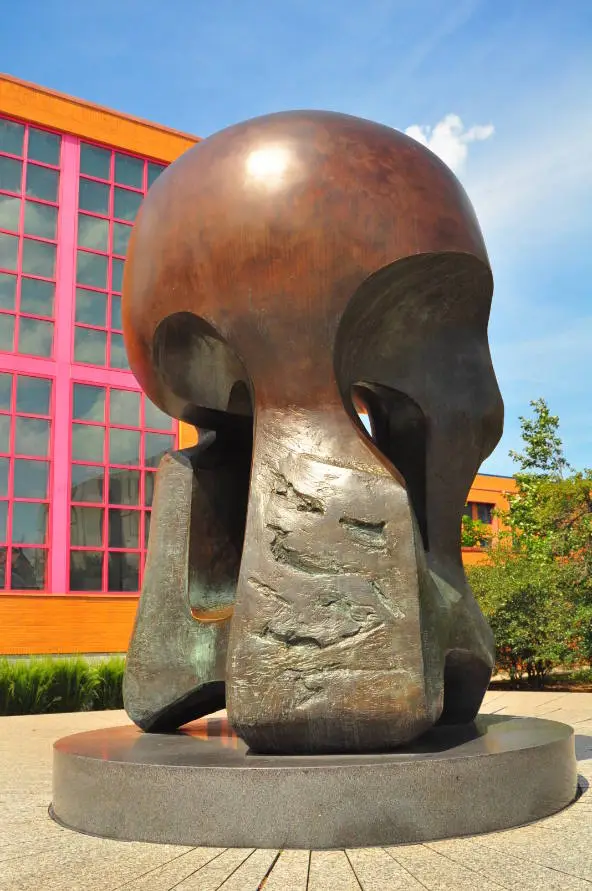
This is one of the most charged pieces of public art in America, and it sits modestly on a corner of the University of Chicago campus where most people walking past have no idea what happened underfoot. On December 2, 1942, directly beneath where you’re standing, the world’s first human-made self-sustaining nuclear chain reaction was created — the moment that made both nuclear power and nuclear weapons possible. Henry Moore unveiled his 12-foot bronze monument on the 25th anniversary in 1967.
The sculpture is a deliberate ambiguity. Moore intended it to look simultaneously like a human skull and a mushroom cloud. He described the lower section as resembling the interior of a cathedral, “with a sort of hopefulness for mankind.” The upper section doesn’t let you forget the other half of that equation. Stand next to it on a quiet afternoon and the weight of what it’s commemorating is fully present.
📍 Getting there: University of Chicago campus, Ellis Ave between 56th and 57th Streets. Free and always accessible. Metra Electric to 55th-56th-57th St. Bus 55 to 56th/Ellis.
See photos and reviews on TripAdvisor →
14. The Constellation by Santiago Calatrava
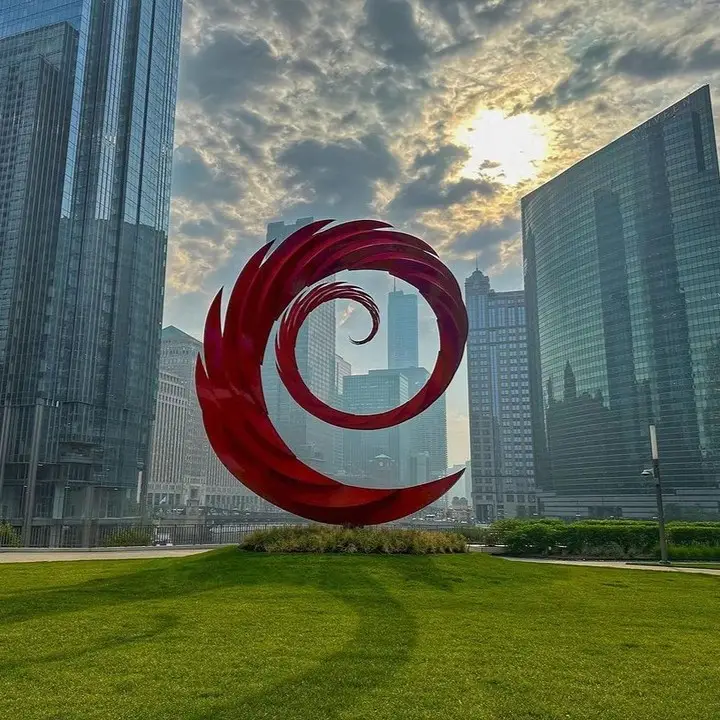
At 29 feet high and 29 feet wide, Santiago Calatrava’s bright red sculpture at River Point Park is exactly the kind of thing you might expect from one of architecture’s great showmen — but it earns the spectacle. Unveiled in late 2020, The Constellation twists upward in overlapping leaf-like elements that spiral from a large base to a fine point, and the mirrored surface of the River Point tower directly behind it bounces the red back at you from multiple angles simultaneously.
The sculpture anchors a 1.5-acre park with 560 feet of new Riverwalk along the Chicago River’s south bank — one of the better public spaces to arrive in the city in recent years. Walk the riverwalk in both directions and you’ll hit this from at least three different angles, each of which looks like a different sculpture entirely.
📍 Getting there: River Point Park, 444 W Lake St (at N Canal St). Free and always accessible. Brown/Orange/Purple/Pink Lines to Washington/Wells; Blue Line to Washington.
15. Miró’s Chicago by Joan Miró
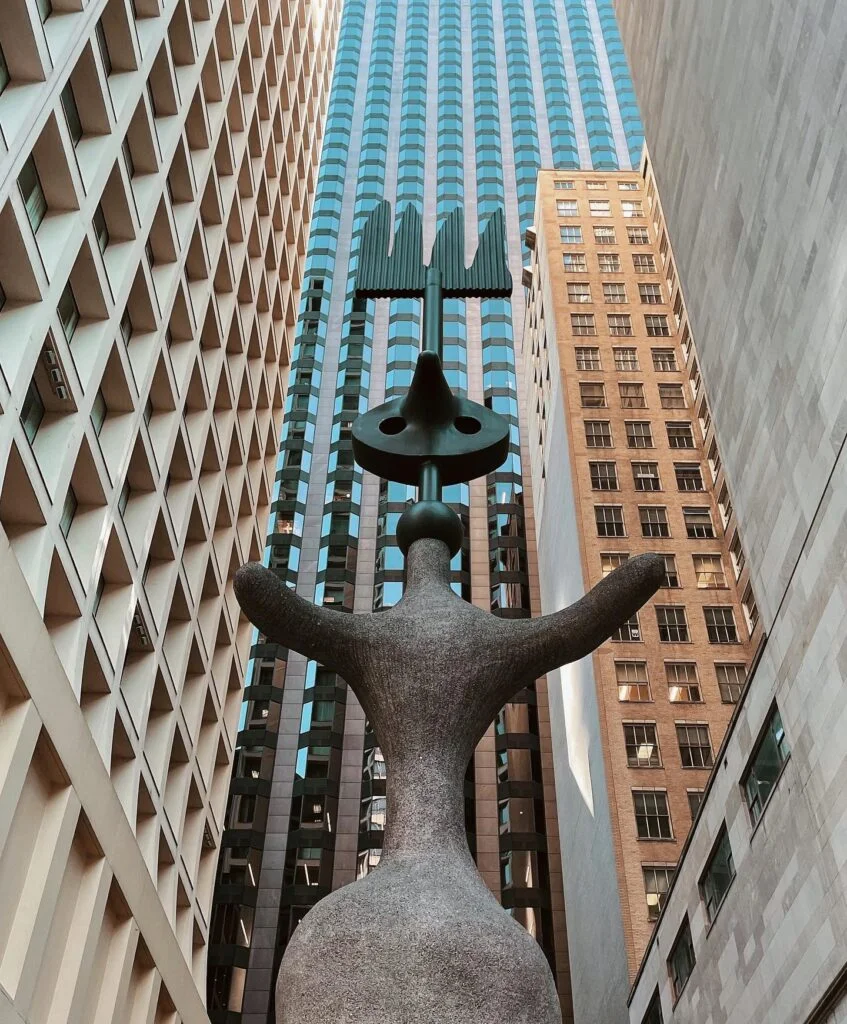
Across the street from The Picasso, mostly overshadowed by its more famous neighbour, Joan Miró’s Chicago has been quietly delighting people who notice it since 1981. Miró himself called it The Sun, the Moon and One Star. Chicago called it Miss Chicago. The 39-foot abstract figure is made from steel, bronze, wire mesh, concrete, and hand-painted ceramic tiles — an intensely physical, colourful presence that feels completely at odds with the corporate seriousness of the surrounding Loop architecture, which is exactly why it works.
It received a hostile reception when it was unveiled and for years lingered in the shadow of the more iconic Picasso. Public taste caught up eventually. Stop in front of it and give it five minutes you wouldn’t otherwise give it.
📍 Getting there: Brunswick Plaza, 69 W Washington St. Free and always accessible. Blue Line to Washington; Brown/Orange/Purple/Pink/Green Lines to Randolph/Wabash.
See photos and reviews on TripAdvisor →
16. Self-Portrait by Keith Haring
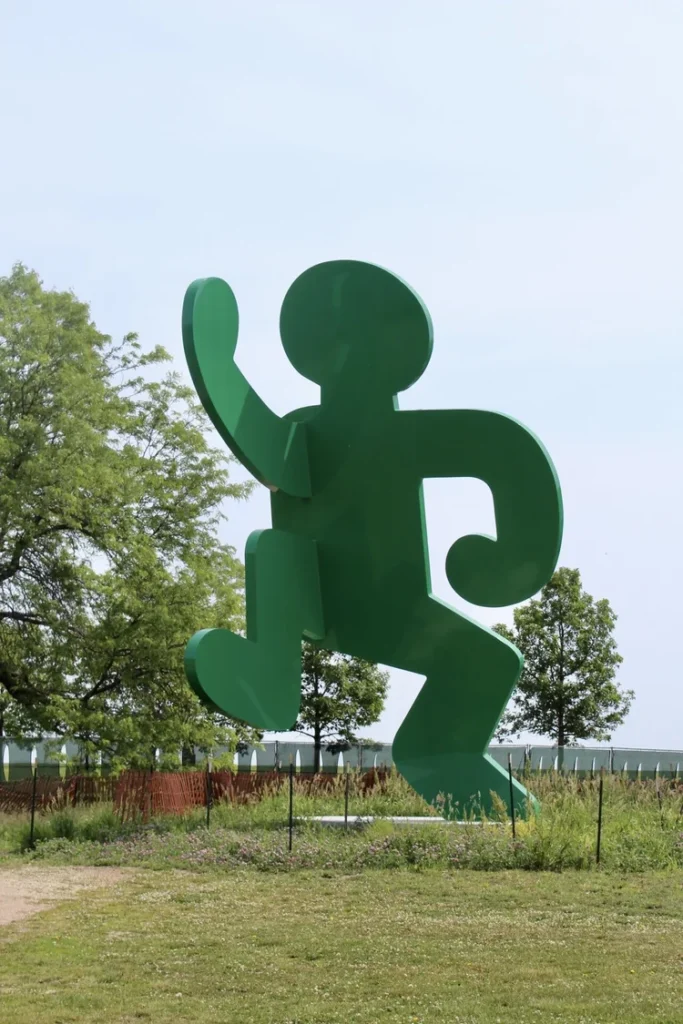
Chicago’s first public monument to the city’s HIV/AIDS epidemic stands in AIDS Garden Chicago, a 2.5-acre lakefront garden just south of Belmont Harbor. At 30 feet tall and painted in that unmistakable Keith Haring green, Self-Portrait is the largest iteration of Haring’s signature figure ever fabricated, and its scale is part of the point: this is a figure refusing to be overlooked, arms raised, presence undeniable. Installed in 2019 and opened fully with the garden in 2022, it marks the site of the original Belmont Rocks, a gathering spot for Chicago’s LGBTQ+ community for decades.
The garden also features numbered QR codes throughout, connecting visitors to a digital archive of personal stories about HIV/AIDS in Chicago. The sculpture alone is worth the trip; the full garden is one of the most meaningful public spaces added to the city in recent memory.
📍 Getting there: AIDS Garden Chicago, lakefront just south of Belmont Harbor, near 3200 N Recreation Drive. Free and open daily dawn to dusk. Red Line to Belmont, then walk east through the underpass to the lakefront. Bus 151 to Belmont/Lake Shore Drive.
17. Light of Truth: Ida B. Wells National Monument by Richard Hunt
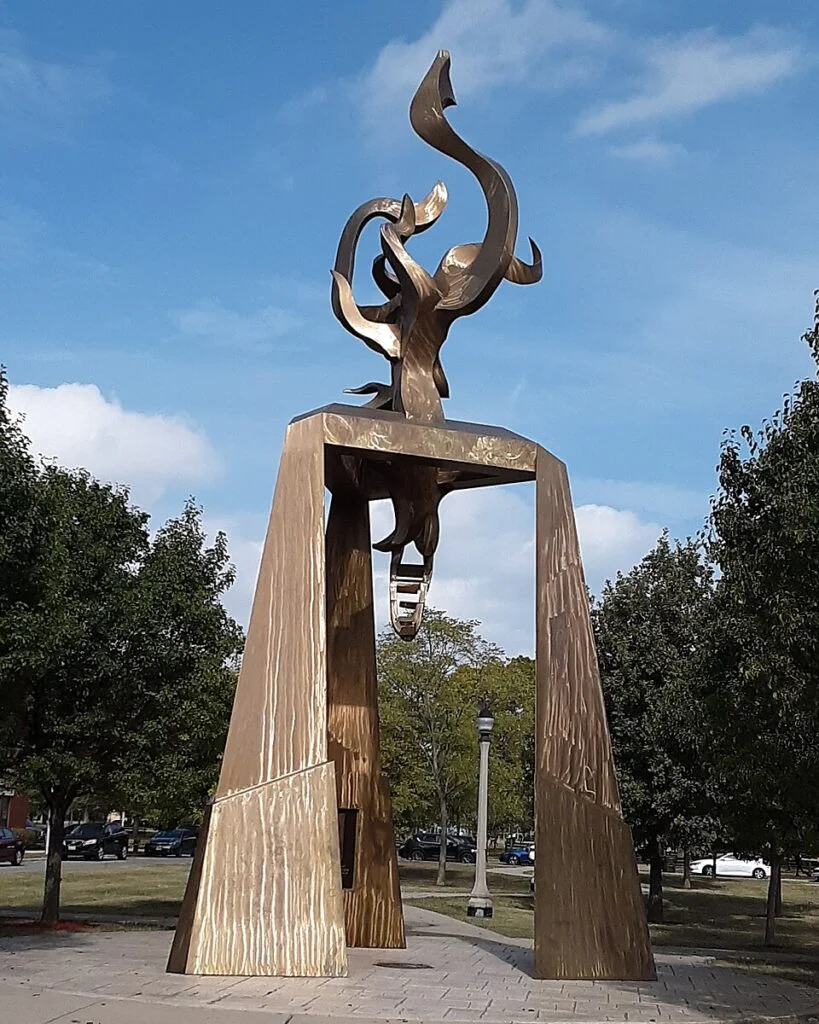
Richard Hunt is Chicago’s greatest living sculptor — a South Side native who has been making large-scale public works since the 1960s and whose pieces are in permanent collections from New York to Tokyo. The Ida B. Wells monument in Bronzeville, unveiled in 2021, is one of his most powerful. Three 35-foot bronze columns rise from the earth and twist into coils and spirals that bear images and quotes from the suffragette and civil rights movement. It takes its name from a Wells-Barnett quote: “the way to right wrongs is to shine the light of truth on them.”
The monument stands near the site of the Ida B. Wells Homes, demolished in 2011, honouring one of the most consequential figures in American journalism and activism. It’s a piece that demands time. Give it some.
📍 Getting there: Near the corner of S Langley Ave and E 37th St, Bronzeville. Free and always accessible. Green Line to 35th-Bronzeville-IIT and walk south. Bus 3 or 4 to 37th St.
18. Fountain of Time by Lorado Taft
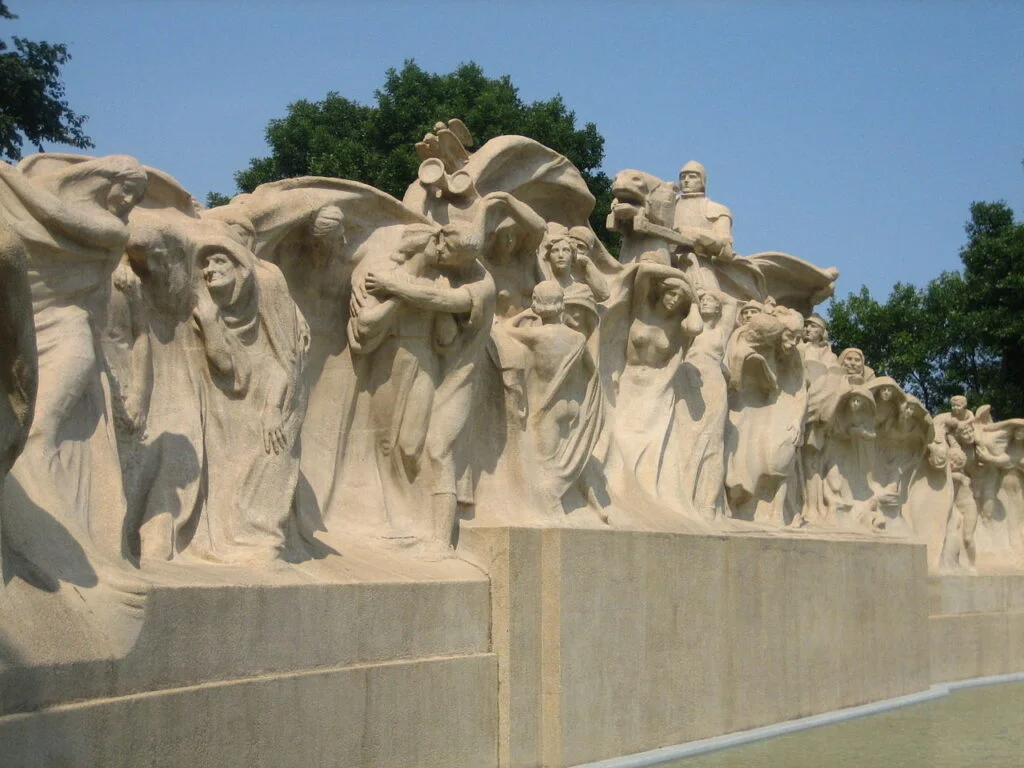
Lorado Taft spent decades on this monument, and it shows — in the best possible way. The Fountain of Time, completed in 1922 at the western edge of the Midway Plaisance in Washington Park, is a 126-foot-long procession of 100 figures — soldiers, lovers, children, the elderly, the dying — moving toward a hooded Father Time who watches from across the reflecting basin with a scythe. Inspired by Austin Dobson’s poem “Paradox of Time,” it commemorates the first century of peace between the United States and Great Britain.
It’s one of the great monuments in Chicago and also one of the most overlooked — most visitors to the South Side don’t venture this far west. The figures are extraordinarily detailed and worth examining one by one. Go in the early morning when the light is coming across the basin and the park is quiet.
📍 Getting there: Washington Park, west end of the Midway Plaisance at Payne Drive, 5900 S Cottage Grove Ave. Free and always accessible. Metra Electric to 59th St-U of C; Bus 55 to 59th/Cottage Grove.
See photos and reviews on TripAdvisor →
19. The Statue of the Republic by Daniel Chester French
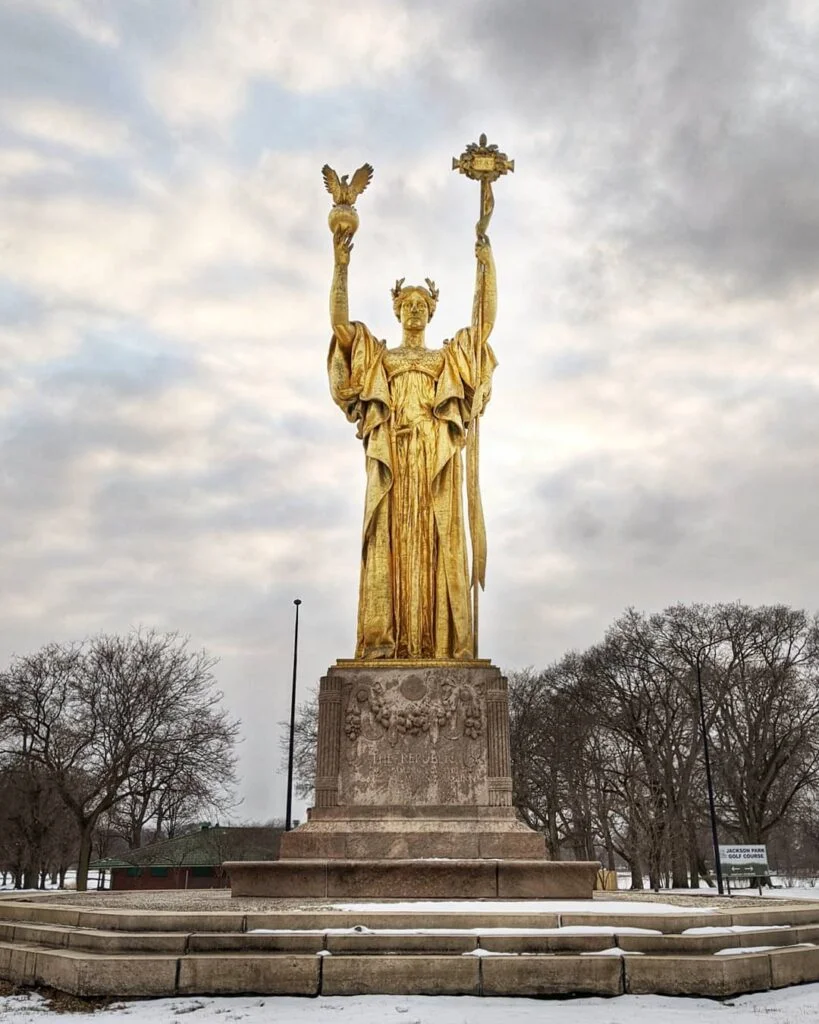
The Statue of the Republic — known locally as the Golden Lady — is a 24-foot gilded bronze figure in Jackson Park that functions as a ghost story about scale. The original version, created by Daniel Chester French for the 1893 World’s Columbian Exposition, was 65 feet tall and the second-tallest statue in the United States at the time, after the Statue of Liberty. It was destroyed by fire. The one standing today, erected in 1918 to mark the Exposition’s 25th anniversary, is a one-third replica — still substantial, still beautiful, and somehow made more poignant by the knowledge of what once stood here.
French went on to design the Lincoln Memorial in Washington. The Golden Lady has the same quality: a piece that earns its grandeur without shouting about it.
📍 Getting there: Jackson Park, intersection of E Hayes Drive and S Richards Drive, south end of the park near the golf course. Free and always accessible. Metra Electric to 59th St-U of C. Bus 6 to 67th/Lake Shore.
See photos and reviews on TripAdvisor →
20. Peoples Gas Education Pavilion by Studio Gang Architects
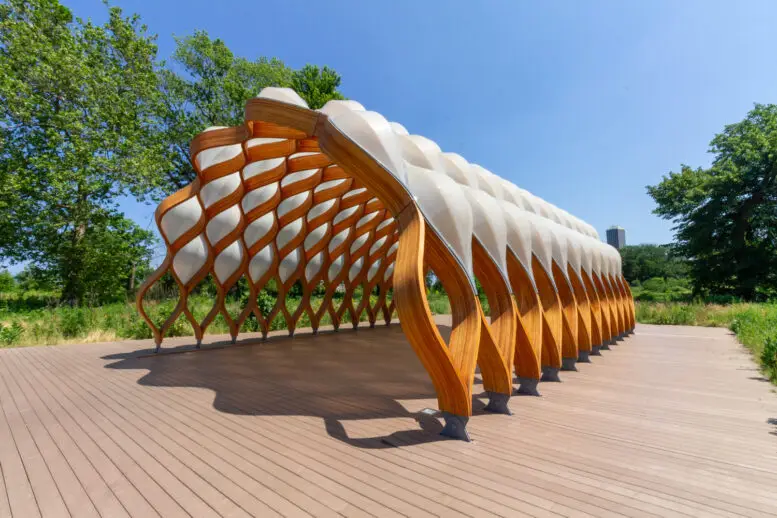
You might argue that a building doesn’t belong on a public art list. You’d be wrong about this one. Studio Gang’s 2010 pavilion on the Nature Boardwalk at Lincoln Park Zoo — also known as the South Pond Pavilion — is one of the most beautiful things built in Chicago in the 21st century. Prefabricated wooden ribs interlock and curve to form a tortoise shell-like structure, with semi-transparent fiberglass pods that filter the light. It was designed for outdoor classes and events but it functions primarily as a thing of joy, something that makes you stop and look twice.
The same firm designed the Aqua Tower and the St. Regis Chicago. The pavilion is proof that you don’t need a $500 million budget to create something extraordinary.
📍 Getting there: Lincoln Park Zoo, Nature Boardwalk, 2001 N Stockton Dr (south end of the zoo, near N Avenue). Free admission to Lincoln Park Zoo. Red Line to Fullerton; Brown/Purple Lines to Fullerton. Bus 151 to Stockton/North.
See photos and reviews on TripAdvisor →
21. Kwanusila by Tony Hunt
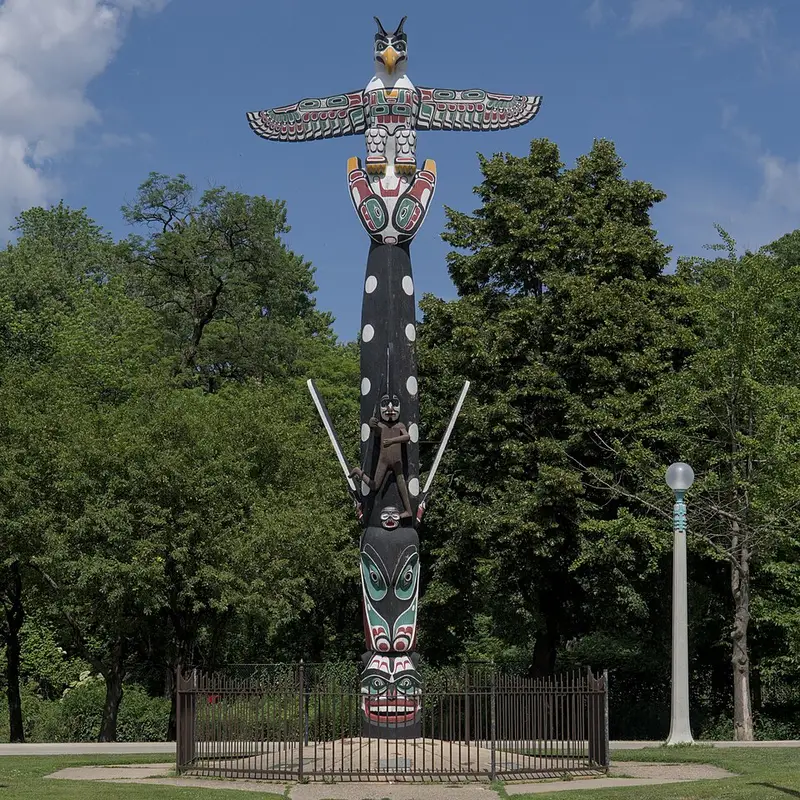
There’s a 40-foot totem pole hidden in plain sight just east of Lake Shore Drive, accessible via the underpass tunnel near Waveland Avenue, and most Chicagoans have never seen it. Kwanusila was carved from red cedar by Tony Hunt, chief of the Kwagu’ł tribe in British Columbia, and installed in 1986 as a replacement for the original totem pole brought to Chicago for the 1893 World’s Columbian Exposition by Hunt’s ancestor George Hunt. At the top: Kwanusila the Thunderbird, protector and symbol of the struggle between light and dark. Below: a man riding a whale, and a sea monster wearing a grimace that could mean anything.
It’s a constant and quietly radical presence — a reminder of Chicago’s connection to the Indigenous peoples of the Pacific Northwest, standing on lakefront parkland that carries its own complicated history.
📍 Getting there: 3510 N Recreation Drive, just east of Lake Shore Drive near Addison St. Access via the Waveland Ave underpass tunnel beneath Lake Shore Drive. Free. Red Line to Addison and walk east (about 15 minutes), or take Bus 151 to Addison/Lake Shore Drive.
See photos and reviews on TripAdvisor →
22. Oz Park Sculptures by John Kearney
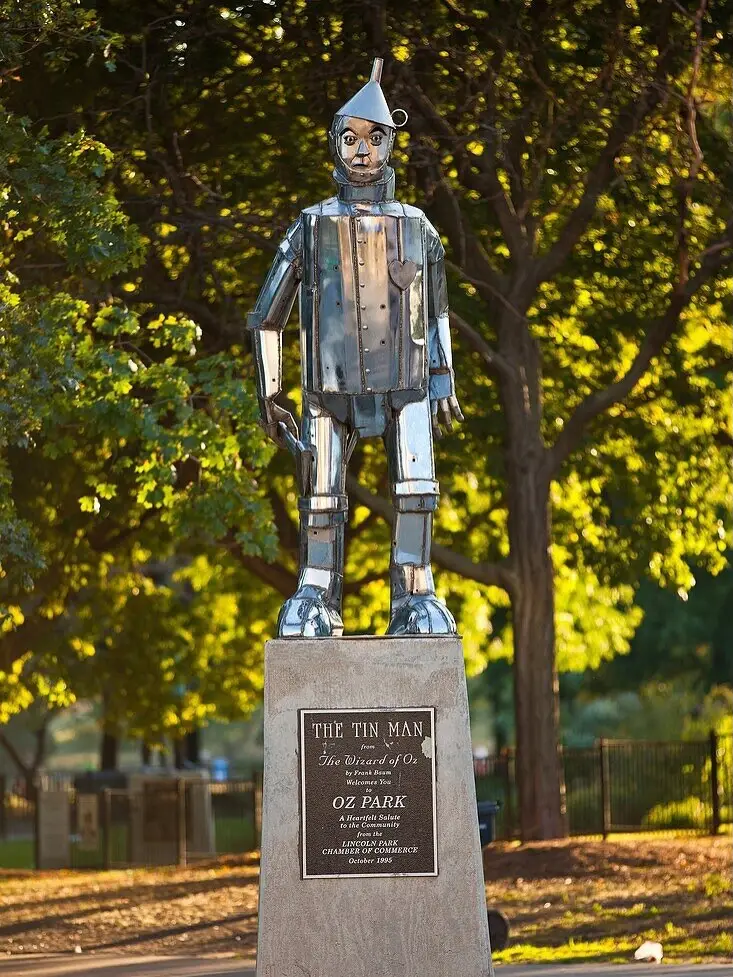
L. Frank Baum wrote The Wonderful Wizard of Oz while living in Chicago’s Humboldt Park neighbourhood in the 1890s, and the city has honoured him with a park in Lincoln Park neighbourhood bearing the book’s name, home to four sculptures of the most beloved characters in American children’s literature. All were made by local sculptor John Kearney between 1995 and 2007. The Tin Man — built from actual salvaged car parts and installed first — is still the one people seek out. The Cowardly Lion and Scarecrow followed, each in bronze, and finally Dorothy and Toto completed the set in 2007.
It’s an easy neighbourhood park with a great dog run and good people-watching, and the sculptures have a warmth that more officially “important” public art sometimes lacks.
📍 Getting there: Oz Park, 2021 N Burling St, Lincoln Park neighbourhood. Free. Brown/Purple Lines to Armitage; Red Line to Fullerton. Bus 37 to Clark/Armitage.
See photos and reviews on TripAdvisor →
23. Art on theMART
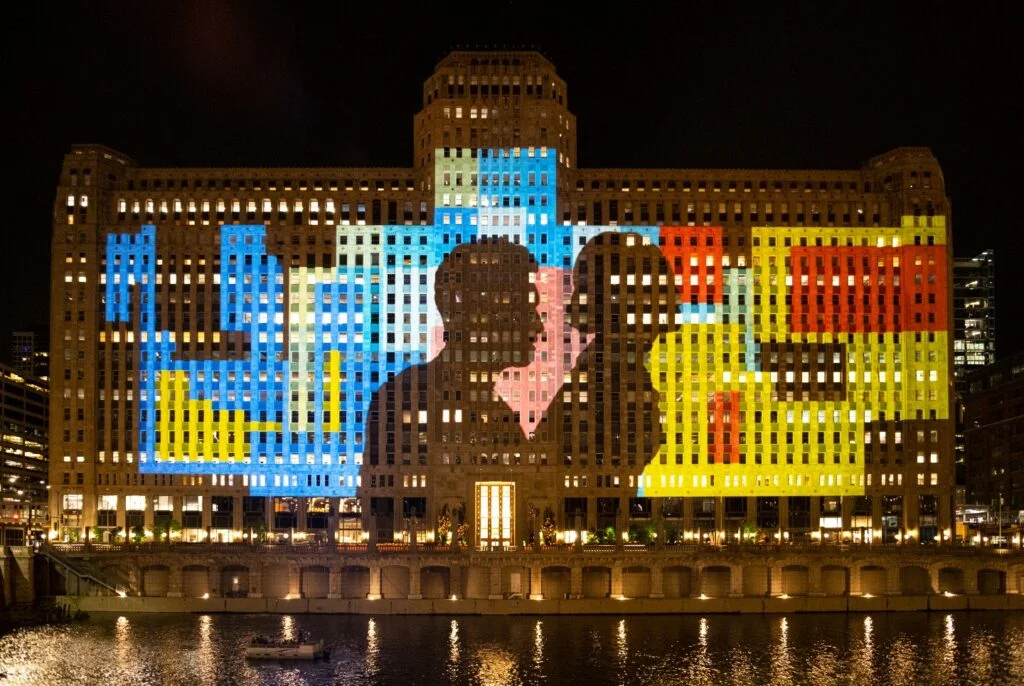
Every evening from spring through fall, the 2.5-acre river façade of the Merchandise Mart becomes the world’s largest permanent digital art projection surface. Thirty-four projectors throw the work of local, national, and international artists across the building’s face at a scale that makes “large” feel like an understatement. The 2026 season opened in April, with new work from School of the Art Institute of Chicago graduates alongside established artists, and runs Thursday through Sunday evenings.
The best viewing spot is the Riverwalk directly across the river, between Wells and Orleans Streets. Get there before the projection starts at around 9pm, grab a spot, and let it run. It’s free, it’s spectacular, and it’s Chicago doing what Chicago does best: treating the city itself as a canvas.
📍 Getting there: River façade of the Merchandise Mart, 222 W Merchandise Mart Plaza. View from the Riverwalk between Wells St and Orleans St. Free. Brown/Purple/Orange/Pink Lines to Merchandise Mart. Bus 65 to Wells/Kinzie.
Local tip: Check the Art on theMART schedule at artonthemart.com before you go — Thursday through Sunday evenings, starting around 30 minutes after sunset.
See photos and reviews on TripAdvisor →
24. Vivid Creatures at the Morton Arboretum
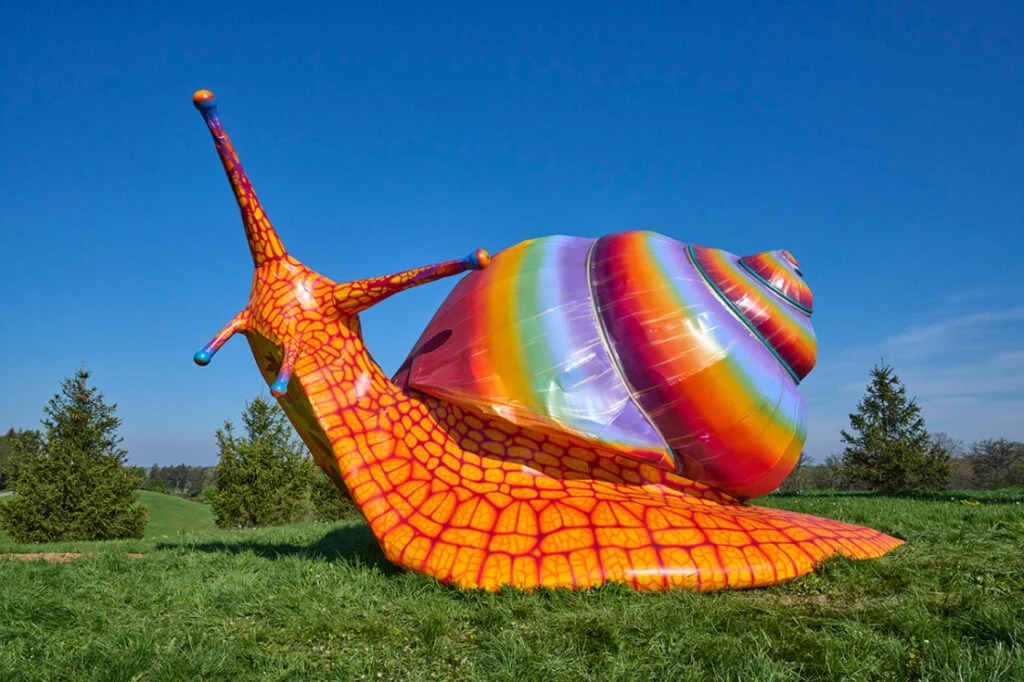
The Morton Arboretum in Lisle — 25 miles west of the city — has established itself as one of the finest venues for large-scale outdoor sculpture in the Midwest, with rotating exhibitions that use 1,700 acres of trees and trails as the setting. The current exhibition, Vivid Creatures by Portland artists Fez and Heather BeGaetz, runs until spring 2027 and features five enormous, brilliantly painted animal sculptures — a sandhill crane, a fox squirrel, a dragonfly, a white-tailed deer, and a brittle button snail — all native to northern Illinois and depicted up to 23 feet tall in saturated colour that makes them visible across entire meadows.
The BeGaetz pair have created the largest exhibition of their career for the Arboretum, and the pieces are placed throughout the grounds to draw visitors through parts of the park they might not otherwise explore. It’s the kind of thing that’s magical for children and genuinely arresting for adults.
📍 Getting there: Morton Arboretum, 4100 Illinois Route 53, Lisle, IL. Admission required (from $16.95/person). Open year-round. Take I-88 West to Exit 19A (Ill. Route 53 North). No direct train service — driving is recommended.
Local tip: The Arboretum hosts different exhibitions seasonally, so check the current schedule at mortonarb.org before you visit.
See photos and reviews on TripAdvisor →
The Game Plan: How to See It All
Chicago’s public art spans the entire city, so a little planning goes a long way. Here’s how to structure your time by neighbourhood.
The Loop in a morning: Start at Cloud Gate and Crown Fountain in Millennium Park, then walk west along Randolph to The Picasso at Daley Plaza and Miró’s Chicago directly across the street. Two minutes south on Dearborn: Chagall’s Four Seasons. From there head south to Federal Plaza for Calder’s Flamingo. The Atmospheric Wave Wall at Willis Tower and The Crossing on LaSalle can be folded in before or after lunch. Art on theMART turns this into an evening as well — come back after dark for the projection.
River North and the lakefront north: The Gentlemen Statues at AMA Plaza and The Constellation at River Point Park are both a short walk from the Loop’s north side. From there, Chevron at Diversey Harbor, the Peoples Gas Education Pavilion at Lincoln Park Zoo, Kwanusila near the Addison underpass, and Oz Park in Lincoln Park neighbourhood make a full north lakefront day. The Keith Haring Self-Portrait at AIDS Garden Chicago (near Belmont Harbor) fits naturally into this route.
Hyde Park and the South Side: The University of Chicago’s Nuclear Energy sculpture, the Fountain of Time in Washington Park, and Jackson Park’s Statue of the Republic and Sky Landing all cluster on the South Side and can be combined into one afternoon. The Agora in Grant Park and Magdalene at Congress Plaza are on the way if you’re driving from the north.
Bronzeville: The Ida B. Wells monument at 37th and Langley stands alone — make it the centrepiece of a Bronzeville visit that takes in the neighbourhood’s historic architecture and the IIT campus designed by Mies van der Rohe.
A day trip: The Morton Arboretum in Lisle is a full half-day or full-day commitment, and worth it. Take the 290 West to the 88, and you’re there in under an hour from the Loop.
Which is your favourite? Drop it in the comments.
—
Planning a trip to Chicago?
Book a Chicago Loop public art walking tour on TripAdvisor →
Find the best hotels near Millennium Park on TripAdvisor →
Browse all top-rated hotels in Downtown Chicago / The Loop on TripAdvisor →