
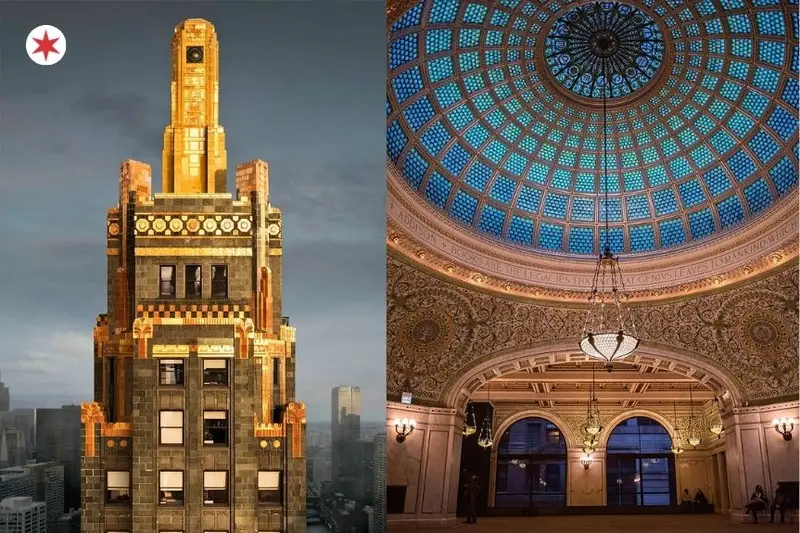
Chicago is the birthplace of the skyscraper, and its skyline is a living museum of architectural innovation. From 19th-century landmarks to bold modern designs, every block has something worth looking up at.
Here are 10 iconic Chicago buildings you need to see – complete with locations, costs, and insider tips.
1. Willis Tower (aka Sears Tower)
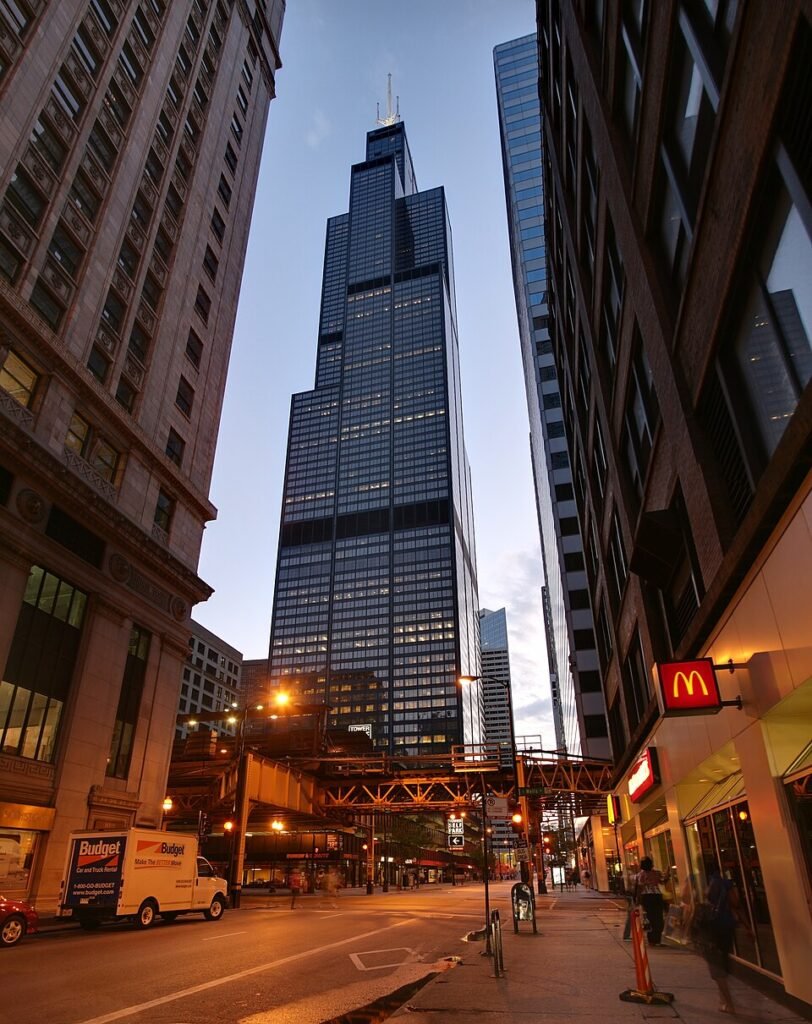
The big one. Let the out-of-towners call it by its new name; to us, those iconic black, staggered tubes will always be the Sears Tower. Even if you haven’t braved the Skydeck since your 8th-grade field trip, stepping back to admire it from Wacker Drive never gets old. It remains the brooding, broad-shouldered anchor of our skyline.
📍 233 S Wacker Dr, Chicago, IL 60606
Tickets: From $32 adults / $24 kids (book online)
Hours: 9 AM – 10 PM daily
Pro tip: Go at sunset for skyline + night views. On clear days, you can spot four states.
2. The John Hancock Center (Officially “875 N. Michigan”)
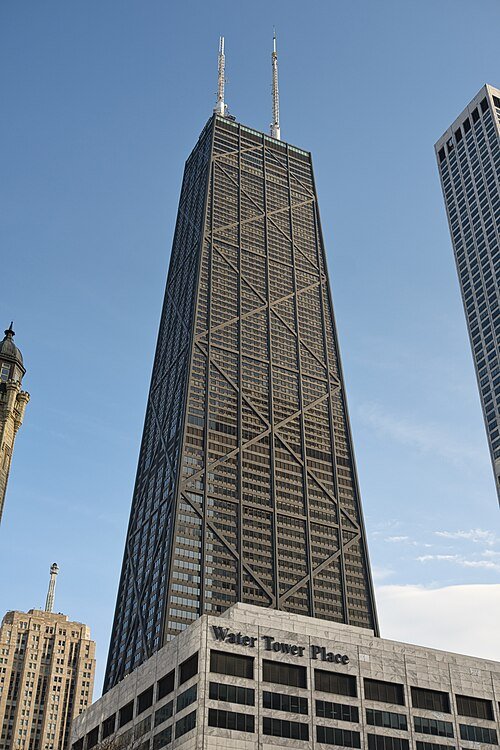
Yes, the corporate overlords renamed it, but it will always be “The Hancock” or “Big John” to anyone with a 312 or 773 area code. While tourists line up to pay top dollar to lean out of the windows on TILT, true Chicagoans know this building is a masterpiece best appreciated from the outside.
Those massive, iconic black X-braces aren’t just for show—they’re structural expressionism at its finest, keeping the tower standing strong against the winter wind whipping off the lake. It is the undisputed, broad-shouldered anchor of the Mag Mile.
📍 Where it’s at: 875 N. Michigan Ave (Streeterville)
The Tourist Tax: If you must go up, tickets for the 360 Chicago deck start around $30.
Insider Tip: RIP to the 96th-floor Signature Lounge (and the greatest women’s restroom view in the city). Since our favorite “buy an overpriced drink to skip the observation deck fee” hack is currently gone, save your money. The absolute best way to appreciate the Hancock is from the ground: head to the curve on the Lakefront Trail right by Oak Street Beach. It offers the ultimate, unobstructed photo of Big John dominating the skyline.
❤️ Recommended Articles


3. The Rookery
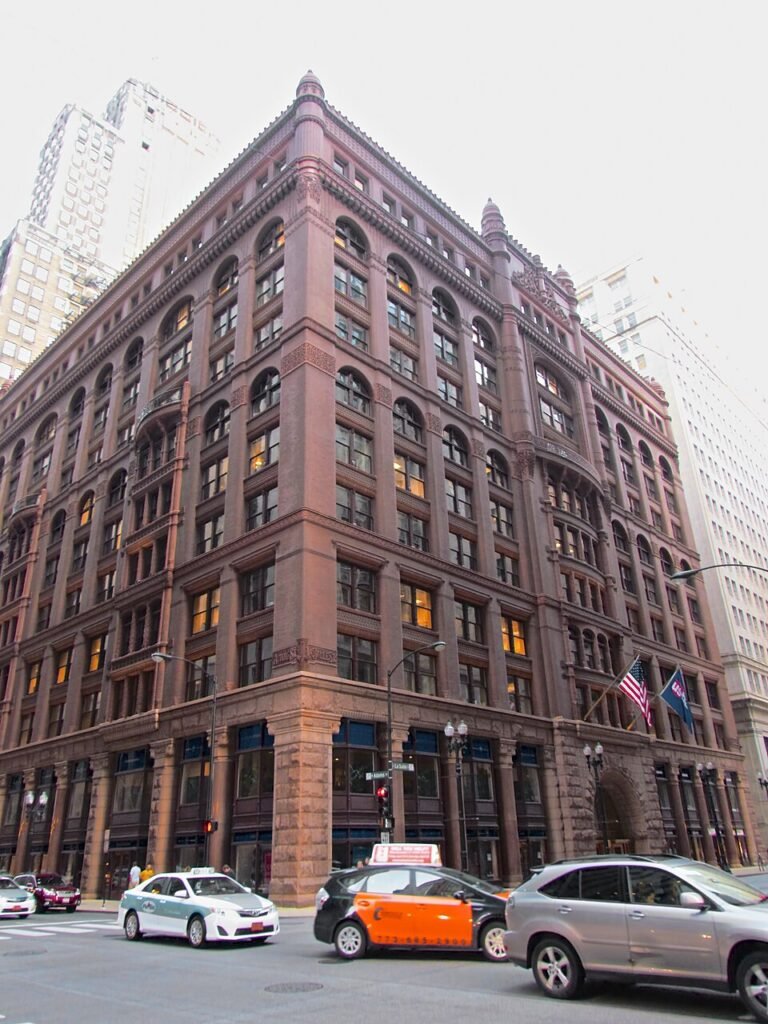
If you work in the Loop, you’ve probably hurried past its heavy, dark red Romanesque exterior a hundred times without a second glance. But walking through the doors of The Rookery is like stepping into a different dimension.
Daniel Burnham and John Root built this imposing fortress in 1888, but it was a young Frank Lloyd Wright who gave the central light court its stunning, gold-leaf, glowing white makeover in 1905. It is, without exaggeration, one of the most breathtaking interior spaces in the entire city—and it’s just sitting there, waiting for you to walk in.
📍 Where it’s at: 209 S. LaSalle St (The heart of the Financial District)
Cost: Strolling into the lobby to get your mind blown is absolutely free. Guided tours run $10-$20
Hours: Mon–Fri, 9 AM – 5 PM (It’s a working office building, so weekend access is usually locked down).
Insider Tip: Treat yourself to a midday mental health break. If you’re downtown on a weekday, grabbing a coffee and sitting in the glowing light court for ten minutes is the ultimate Loop sanctuary. And if you do decide to pay for a Frank Lloyd Wright Trust tour, it’s actually worth it: it’s the only way to get access to the mesmerizing, dizzying Oriel staircase, which is hidden away from the main public lobby.
4. Chicago Cultural Center
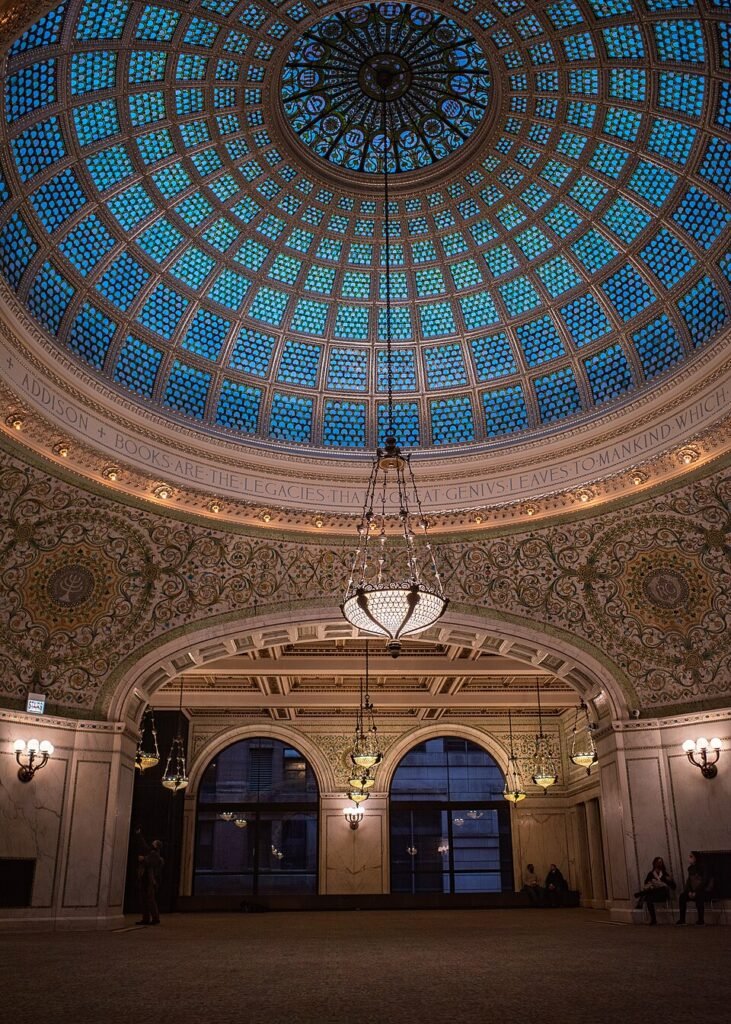
We lovingly call it “The People’s Palace” for a reason. Originally built in 1897 as Chicago’s first central public library, the city spared absolutely no expense to prove we were a cultured metropolis—outfitting the interiors with imported Carrara marble, shimmering mother-of-pearl mosaics, and sweeping staircases.
It is arguably the most opulent, jaw-dropping interior space in the entire city, and the best part? It belongs completely to the public. Whether you’re catching a free concert or just ducking in to warm up, it never fails to impress.
📍 Where it’s at: 78 E. Washington St (Loop)
Cost: Gloriously, 100% Free.
Hours: Daily, 10 AM – 5 PM
Insider Tip: Everyone crowds into the south wing (Preston Bradley Hall) to gawk at the world’s largest Tiffany glass dome. Let them. Head over to the north wing to the Grand Army of the Republic (GAR) Hall. It features a second, massive, recently restored Renaissance-style stained-glass dome. It is equally stunning, but usually much quieter—the perfect downtown escape.
5. Tribune Tower
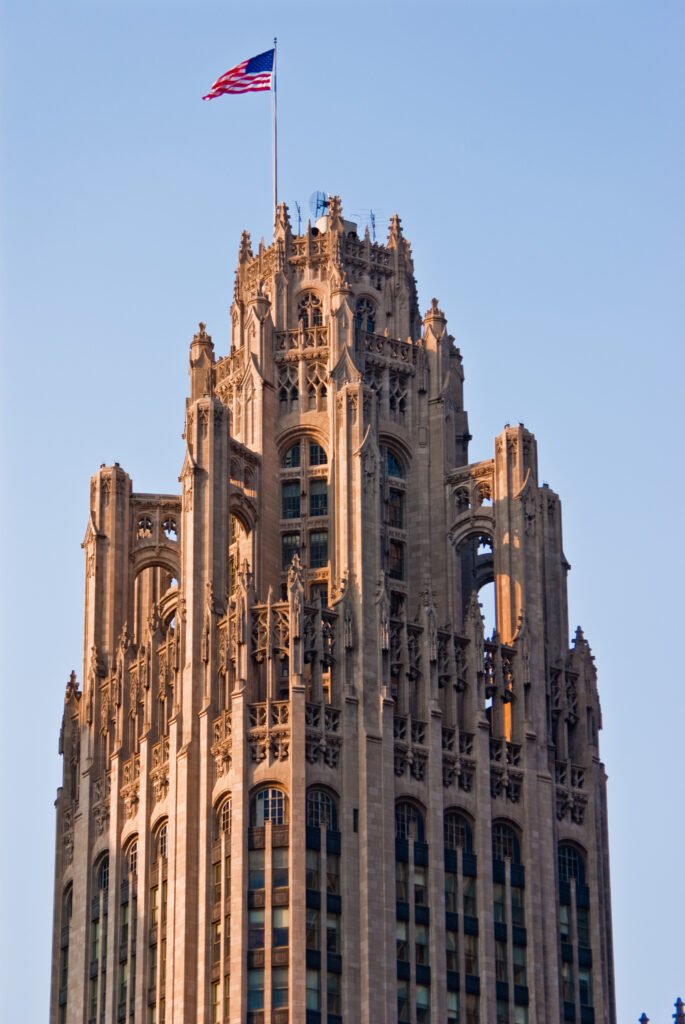
Sure, the Chicago Tribune moved its newsroom out years ago (the building is now filled with ultra-luxury condos), but this Neo-Gothic masterpiece remains the most fascinating facade on the Mag Mile.
Beyond those stunning flying buttresses at the crown, the base of the tower is a literal global scavenger hunt. Eccentric publisher Colonel Robert R. McCormick mandated that his foreign correspondents bring back historical fragments from around the globe. Today, you can walk the perimeter and touch pieces of the Great Pyramid, the Taj Mahal, the Berlin Wall, and the Alamo. It’s a piece of classic, eccentric Chicago history that’s actually fun to examine up close, even if you’ve walked past it a hundred times.
📍 Where it’s at: 435 N. Michigan Ave (Right where the Mag Mile meets the River)
Cost: Free to wander the perimeter.
Hours: 24/7 for exterior viewing.
Insider Tip: Skip the easy stones and hunt for the Moon Rock. Because it’s government property, NASA wouldn’t allow the Tribune to actually cement it into the building—so it sits in a special display window. Once you find it, take the nearby stairs down to Lower Michigan Avenue to grab a cheap beer and a “cheezborger” at the original Billy Goat Tavern. It’s the gritty, subterranean, grease-stained hangout where the Tribune reporters actually spent all their time.
6. Wrigley Building
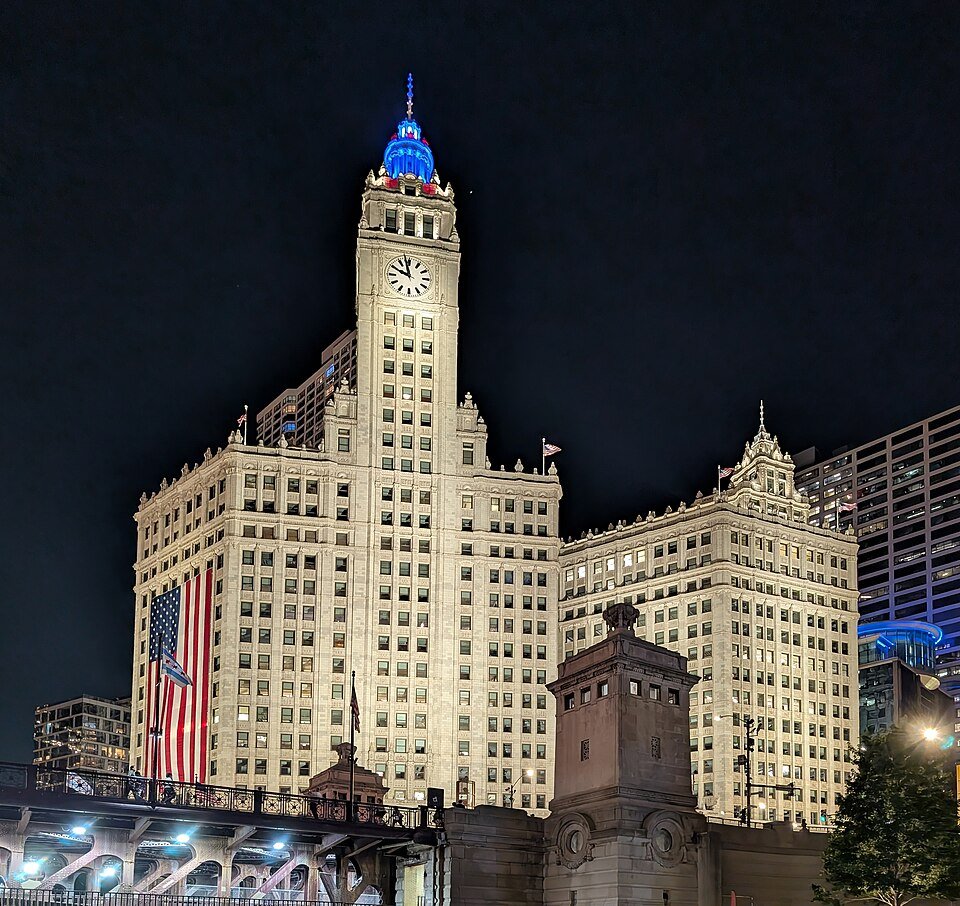
Let the out-of-towners fight for selfie space at The Bean; this is the most effortlessly photogenic building in Chicago. Built by chewing gum magnate William Wrigley Jr. in the 1920s, this gleaming, glazed terra-cotta masterpiece was the pioneer that basically birthed the Magnificent Mile (it was the first major office building north of the river).
It shines blindingly white during the day and glows like a beacon at night, thanks to an iconic bank of floodlights and a famously rigorous power-washing schedule that keeps it looking pristine a century later.
📍 Where it’s at: 400–410 N. Michigan Ave (Just across the river from the Tribune Tower)
Cost: Free to admire.
Hours: The exterior and central plaza are always open.
Insider Tip: Do not stop on the DuSable Bridge to take your photo—you will just get bumped into by a hundred other people doing the exact same thing. Instead, walk right up to the building and stroll through the open-air pedestrian plaza that separates its north and south towers. It feels like a hidden European courtyard right in the middle of downtown, and if you look east, it perfectly frames a unique, ground-level view of the Tribune Tower across the street.
7. Aqua Tower
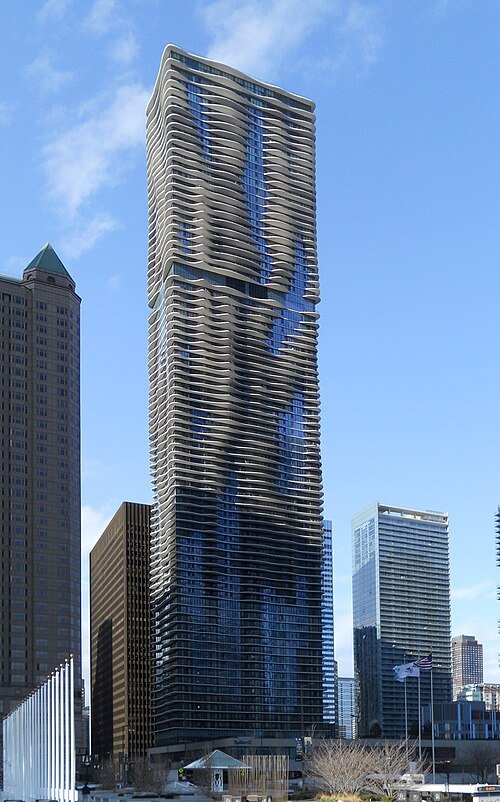
If you think all modern skyscrapers are just boring, flat glass boxes, you haven’t spent enough time staring at Aqua. Designed by local architectural rockstar Jeanne Gang (who later beat her own record for the tallest building designed by a woman with the nearby St. Regis), this tower is a mind-bending optical illusion.
Those undulating, brilliant white balconies aren’t just for aesthetics; they mimic the limestone outcroppings of the Great Lakes and are specifically engineered to break up Chicago’s notorious wind drafts. It looks like a towering wave frozen in mid-air, proving that 21st-century Chicago architecture still has plenty of swagger.
📍 Where it’s at: 225 N. Columbus Dr. (Lakeshore East)
Cost: Free to gawk at.
Hours: 24/7 for the exterior. (It’s mostly a mix of condos, apartments, and the Radisson Blu hotel).
Insider Tip: Don’t just crane your neck from bustling Randolph Street. Navigate your way down into Lakeshore East Park—the “secret” multi-level neighborhood hidden at the base of the tower. Grab a coffee at the multi-story Mariano’s down there, sit on the grass by the fountains in the six-acre park, and look straight up. It is the most peaceful, uncrowded architectural viewing spot in downtown Chicago.
8. Marina City (aka “The Corn Cobs”)
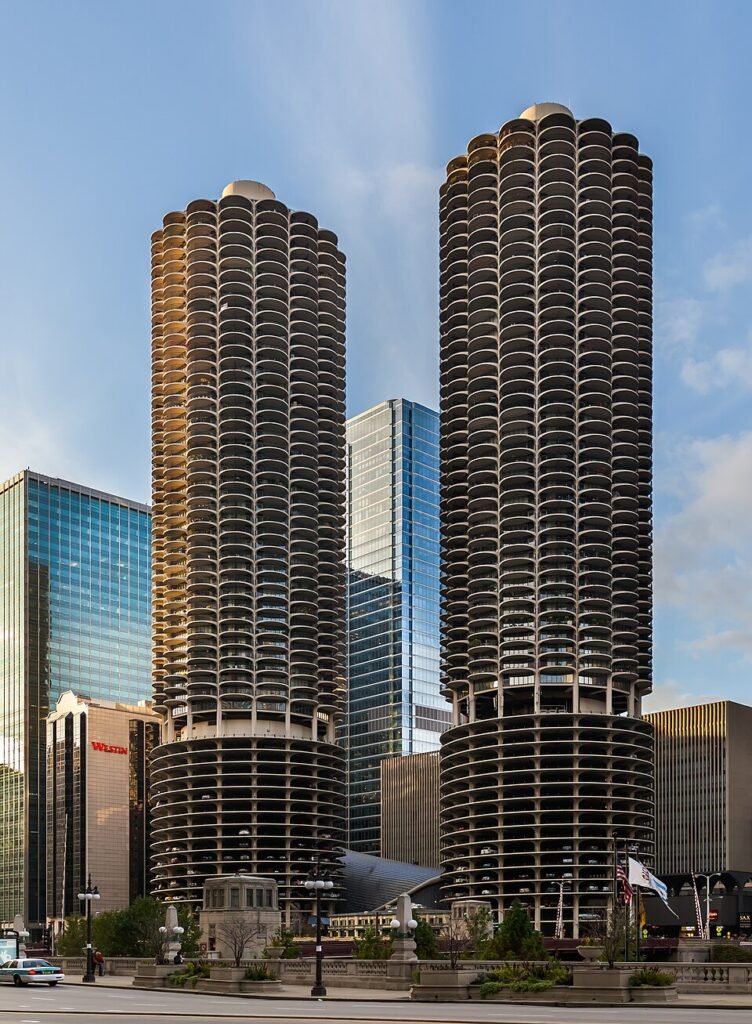
ou know them as the Wilco Yankee Hotel Foxtrot album cover. You know them as “The Corn Cobs.” Architect Bertrand Goldberg designed these twin mid-century marvels in the 1960s to combat the suburban exodus, pitching them as a “city within a city.”
And they really were—complete with a theater (now the House of Blues), a bowling alley (now Spin ping-pong), and a marina at the base. But let’s be honest: the best part about walking past them is looking up at the bottom 19 floors and experiencing a brief moment of sheer terror watching valets back cars right up to the open-air edges of the spiral garage.
📍 Where it’s at: 300 N. State St (River North)
Cost: Free to view from the river.
Hours: 24/7 for the exterior.
Insider Tip: Ever wonder what it’s actually like to live inside a corn cob? There are virtually no right angles in the residential towers. The apartments are shaped like slices of pie radiating out from the center elevator core, and every single unit has a balcony. If you don’t have a friend who lives there to invite you up, skip the rowdy chain restaurants at the base of the towers. Instead, cross over to the south side of the river, grab a drink at the Riverwalk’s City Winery, and look across the water for the perfect, unobstructed view of the honeycomb balconies.
9. Chicago Board of Trade
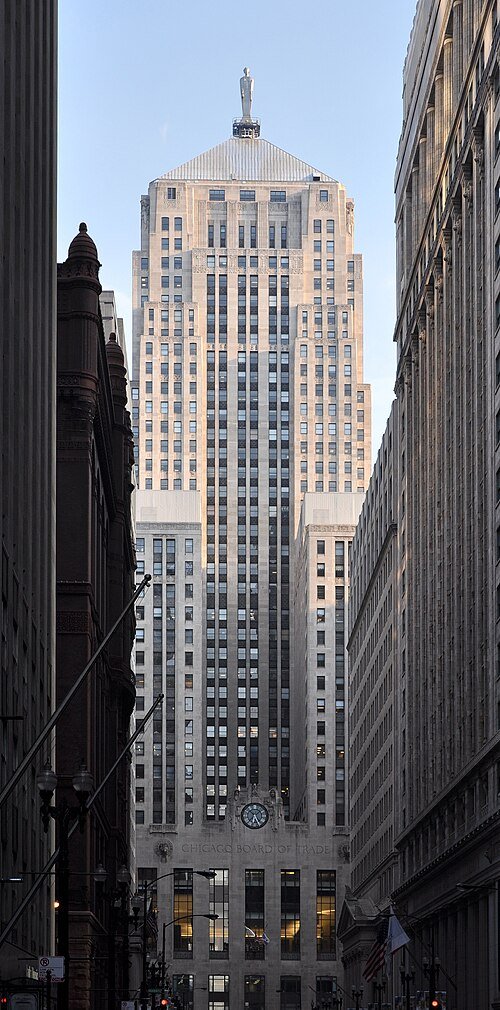
When you stand in the middle of the LaSalle Street “canyon” looking south, this imposing Art Deco behemoth makes you feel like you’re standing right in the middle of Gotham City. (Which makes sense, considering Christopher Nolan used it as Wayne Enterprises in Batman Begins).
Built in 1930, it was Chicago’s tallest building for 35 years. But the ultimate piece of local trivia sits at the very top: the 31-foot statue of Ceres, the Roman goddess of agriculture. Because the sculptor, John Storrs, never imagined another Chicago building would be built tall enough for anyone to see her up close, he completely left off her face.
📍 Where it’s at: 141 W. Jackson Blvd (Dead-ending the LaSalle Street canyon in the Financial District)
Cost: Free to walk into the stunning, marble-clad lobby.
Hours: Mon–Fri, standard business hours.
Insider Tip: Skip the formal architecture tours and head straight to the ground-floor lobby to find Ceres Cafe. This legendary, old-school, no-frills bar is a Chicago institution. It is famous city-wide for serving the stiffest, most aggressively over-poured drinks in existence—a chaotic remnant of the days when screaming commodities traders needed a serious drink after the closing bell. If you order a rum and coke, you will literally be handed a glass of straight rum and a can of coke on the side. Drink responsibly.
10. Carbide & Carbon Building
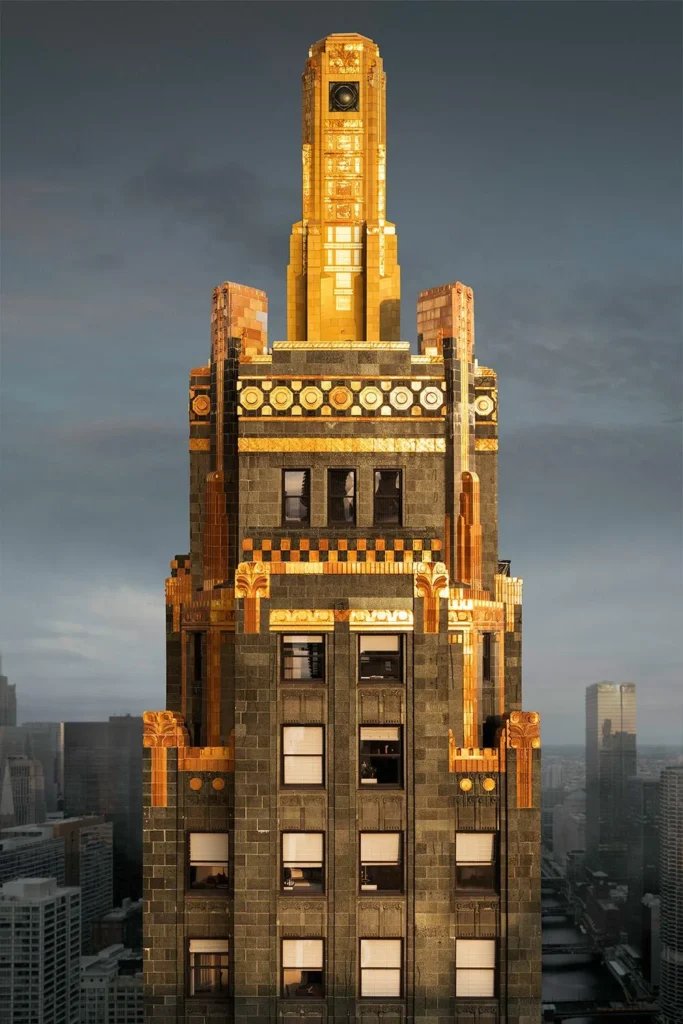
Built in 1929 right in the middle of Prohibition, this Art Deco masterpiece was designed by the Burnham Brothers (sons of the legendary Daniel Burnham). According to classic Chicago lore, they deliberately designed the building—with its polished black granite base, dark green terra cotta tower, and gleaming top—to look exactly like a foil-wrapped bottle of Mumm’s Champagne.
It was essentially a massive, 37-story, 24-karat gold-leafed middle finger to the 18th Amendment. It has changed hands as a hotel several times over the last two decades (RIP to the Hard Rock and the St. Jane), but its exterior remains one of the most uniquely beautiful sights on the skyline.
📍 Where it’s at: 230 N. Michigan Ave (Just south of the river)
Cost: Free to walk into the moody, gorgeous Art Deco lobby.
Hours: 24/7 for the lobby (it’s currently the Pendry Chicago hotel).
Insider Tip: Don’t just look at the gold roof from the street—go drink under it. During the warmer months, head up to Château Carbide, the hotel’s rooftop bar. Drinks are definitely priced with a “downtown tourist tax,” but it is absolutely worth buying one cocktail just to get up-close and personal with the intricate, real 24-karat gold detailing of the crown while looking down the barrel of Michigan Avenue.