
Chicago is a city in a constant state of reinvention.
We look at our glittering modern skyline, the vibrant Riverwalk, and the lush parks, and it’s easy to forget that they weren’t always there.
Beneath the surface of today’s metropolis lie the ghosts of a different city—a city of muddy roads and horse-drawn carriages, of industrial wastelands and forgotten infrastructure.
While you can read about Chicago’s history in a book, nothing captures the scale of this relentless change quite like seeing it with your own eyes.
And this transformation isn’t just ancient history. Some of the most dramatic “before and afters” have happened in just the last 15 years.
We’ve dug through the archives to create a photographic time machine, pairing stunning historic and recent photos with their modern-day counterparts.
From the industrial eyesore that became the stunning Riverwalk to the quiet fields that became Millennium Park, these images are a powerful reminder of Chicago’s incredible, ongoing evolution.
1. The Riverwalk Upgrade
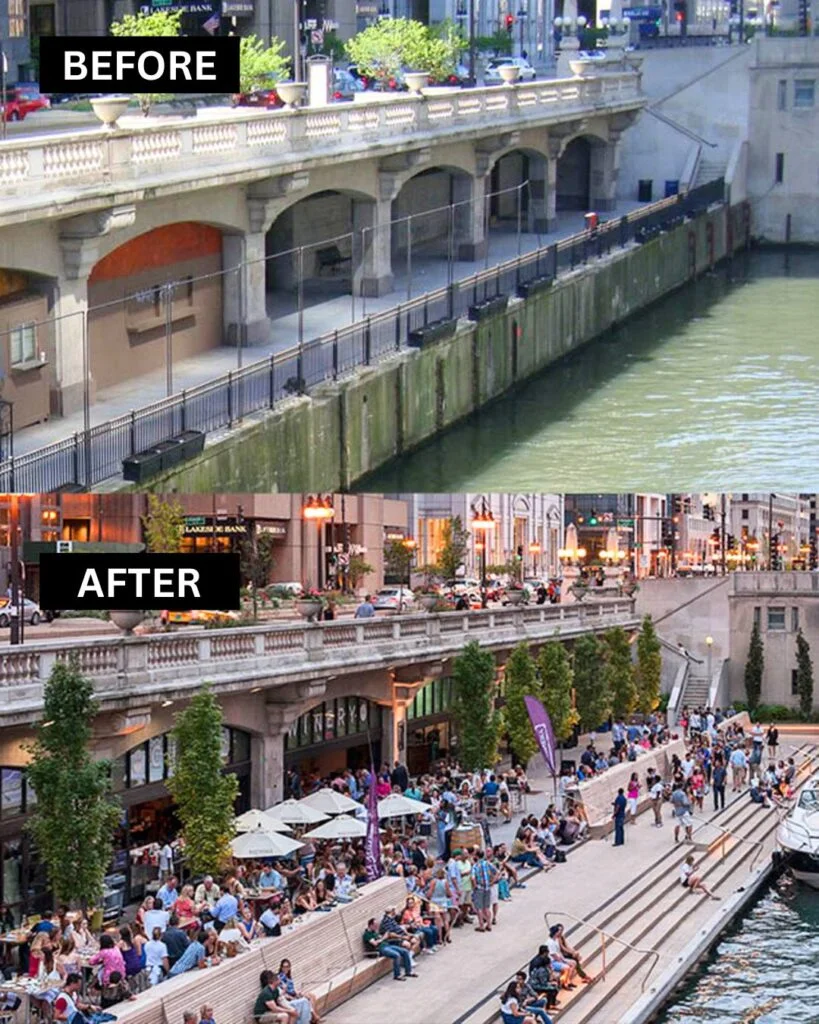
For decades, the south bank of the Chicago River was a forgotten industrial wasteland.
It was a grim, utilitarian space—a concrete-and-steel retaining wall designed for service boats and little else. You can see in the “before” photo that it was an uninviting, fenced-off stretch of concrete that most people actively avoided.
But in a stunning feat of modern urban design, the city transformed this neglected space into the crown jewel of downtown.
Completed in phases between 2009 and 2016, the new Chicago Riverwalk is a breathtaking, 1.25-mile-long pedestrian promenade.
It’s now a vibrant, multi-level public park filled with lush gardens, public art, and some of the best outdoor wine bars and restaurants in the city. The transformation from an industrial eyesore to a bustling, beautiful public oasis is one of the most successful urban renewal projects in modern American history.
2. The Birth of Millennium Park
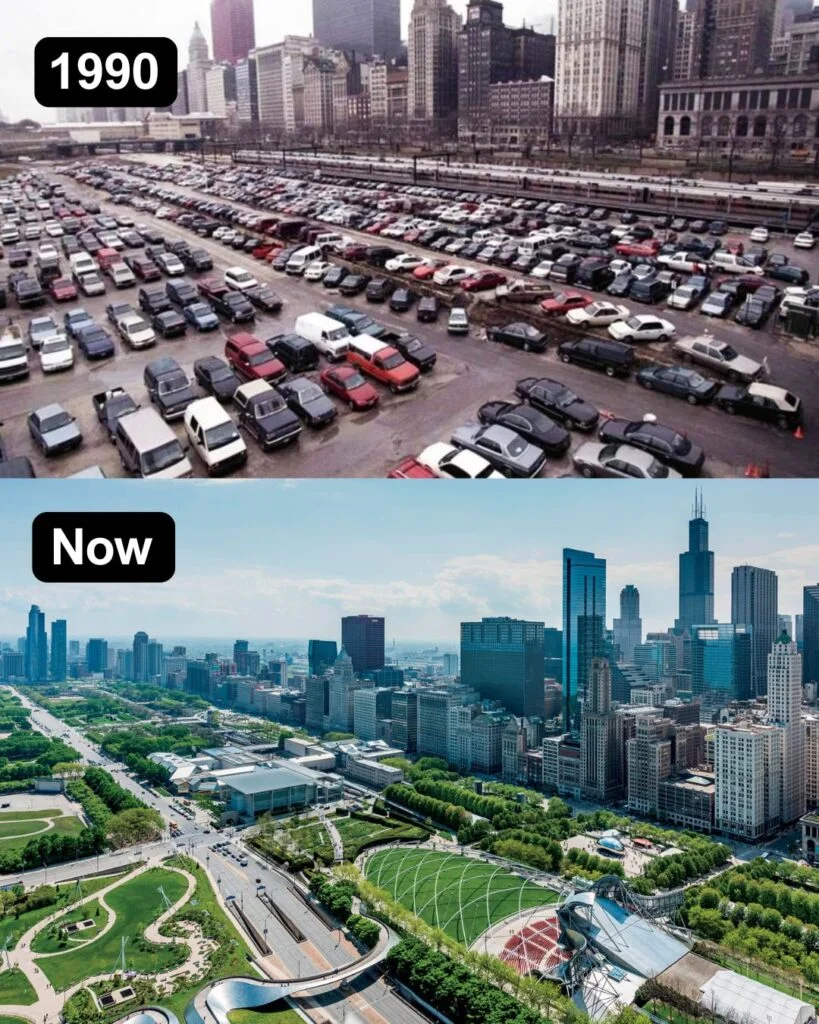
For younger Chicagoans and visitors, it’s almost impossible to believe that Millennium Park hasn’t been there forever.
But as the “before” photo from 1990 clearly shows, the land that now houses The Bean, Crown Fountain, and Lurie Garden was once a bleak, sprawling expanse of surface parking lots and rusty Illinois Central railroad tracks.
For most of the 20th century, this prime piece of lakefront real estate was a gritty, industrial eyesore separating the Loop from Grant Park.
After years of ambitious planning and construction, Millennium Park finally opened in 2004, completely transforming the face of downtown Chicago.
The project buried the ugly train tracks and parking garages underground, creating a stunning 24.5-acre public park on top.
The “after” photo shows the incredible result: a world-class cultural destination featuring iconic public art, stunning modern architecture like the Pritzker Pavilion, and lush green spaces. The transformation from a concrete wasteland into the city’s beautiful “front yard” is one of the most celebrated urban renewal projects of the 21st century.
3. The Federal Plaza Transformation
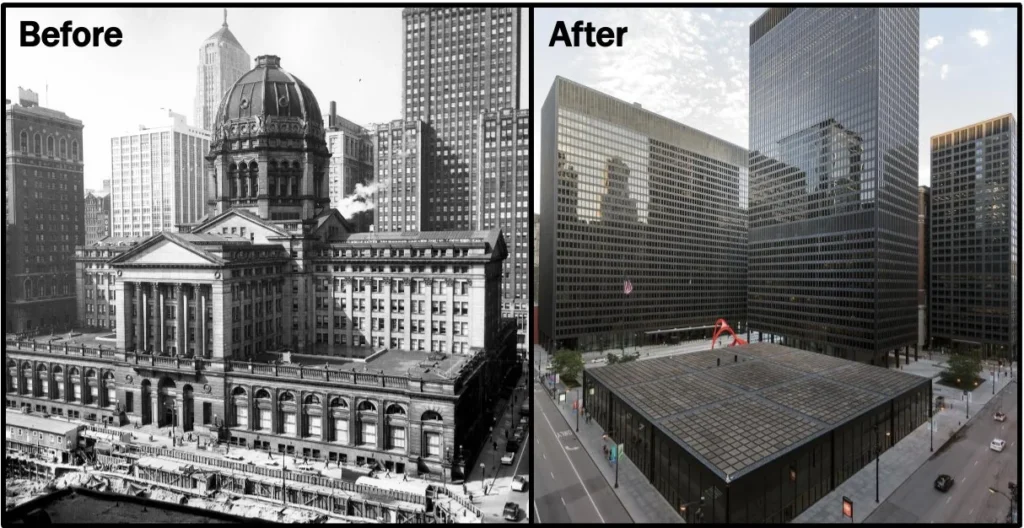
This is one of the most dramatic architectural transformations in all of downtown Chicago.
For nearly 70 years, the heart of the Loop was dominated by the magnificent Chicago Federal Building. Completed in 1905, it was a massive, ornate Beaux-Arts masterpiece with a grand central dome that was even taller than the one on the U.S. Capitol.
But as the 20th century progressed, architectural tastes shifted dramatically. The ornate, classical style fell out of favor, replaced by the sleek, minimalist lines of modernism.
In 1965, the old Federal Building was demolished to make way for a new vision of Chicago.
In its place rose the Federal Center, a starkly modern complex of black steel and glass designed by the legendary architect Ludwig Mies van der Rohe. The complex includes the Dirksen Federal Building, the Kluczynski Federal Building, and the single-story Post Office, all surrounding a wide-open plaza.
The “after” photo shows a Chicago that has fully embraced its identity as the birthplace of the modern skyscraper—a city of clean lines, towering glass, and powerful simplicity. The addition of Alexander Calder’s bright red “Flamingo” sculpture in 1974 completed the iconic plaza we know today.
4. The Evolution of Navy Pier
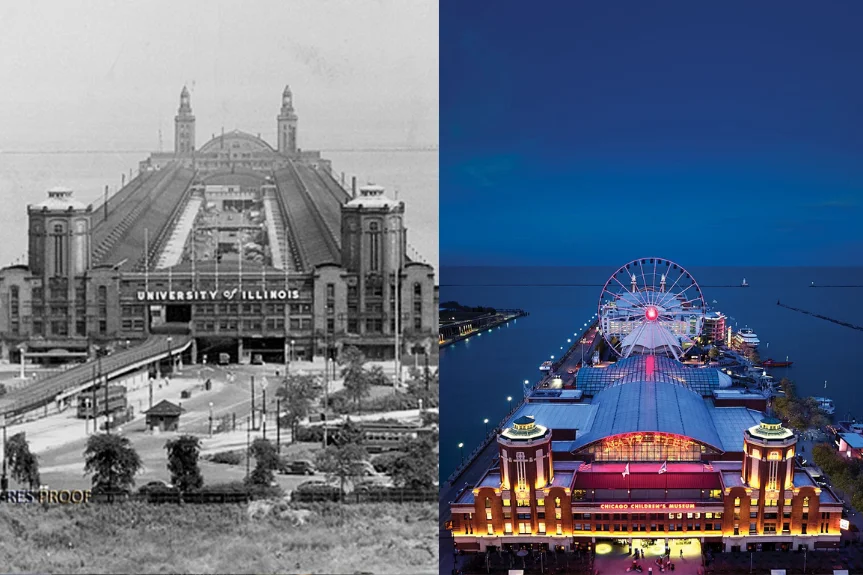
Today, Navy Pier is known as the Midwest’s number one tourist attraction—a sprawling entertainment complex of restaurants, shops, and the iconic Centennial Wheel.
But the Pier wasn’t always a playground.
When it first opened in 1916, it was known as “Municipal Pier” and was designed as a dual-purpose facility: a shipping and freight terminal on the lower level, and a public recreation space with ballrooms and theaters on the upper level.
During World War I, it was used by the military (which is where it got its “Navy Pier” name), and for decades after World War II, it served as a makeshift campus for the University of Illinois at Chicago, as you can see from the sign in the “before” photo from the 1950s.
It wasn’t until the 1990s that the Pier was completely reimagined and rebuilt into the massive tourist and entertainment destination we know today, adding the first Ferris wheel and the Chicago Children’s Museum. The transformation from a functional shipping dock and college campus into a glittering lakefront spectacle is one of the most significant changes in the city’s modern history.
5. Al Capone’s South Side Home
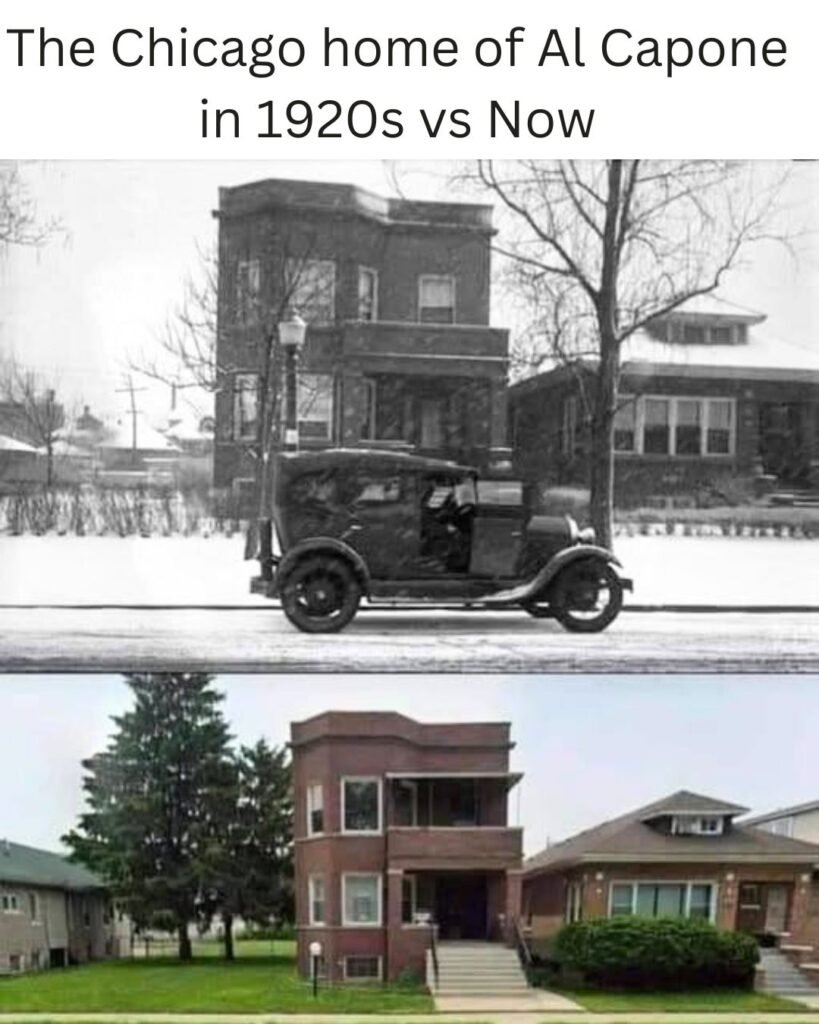
Not all of Chicago’s history happened in glittering downtown skyscrapers. Some of it happened right on the front porch of this unassuming two-flat in the Park Manor neighborhood.
This was the home of America’s most notorious gangster, Al Capone.
He purchased the modest brick house at 7244 South Prairie Avenue in 1923 for his wife and son, and it remained his official family residence throughout his violent reign over the city’s bootlegging empire.
While Capone conducted his business from lavish hotel suites downtown, this South Side house was his sanctuary. It was from this very home that he left to attend baseball games at nearby Comiskey Park, and it’s where he returned after his release from Alcatraz, a broken and ailing man.
The “before” photo shows the house as it looked during Capone’s heyday in the 1920s. Today, the house still stands, largely unchanged on the outside. Though the trees have grown and the cars have certainly evolved, the building remains a quiet, physical link to one of the most turbulent and mythologized eras in Chicago history.
6. Oak Street Beach
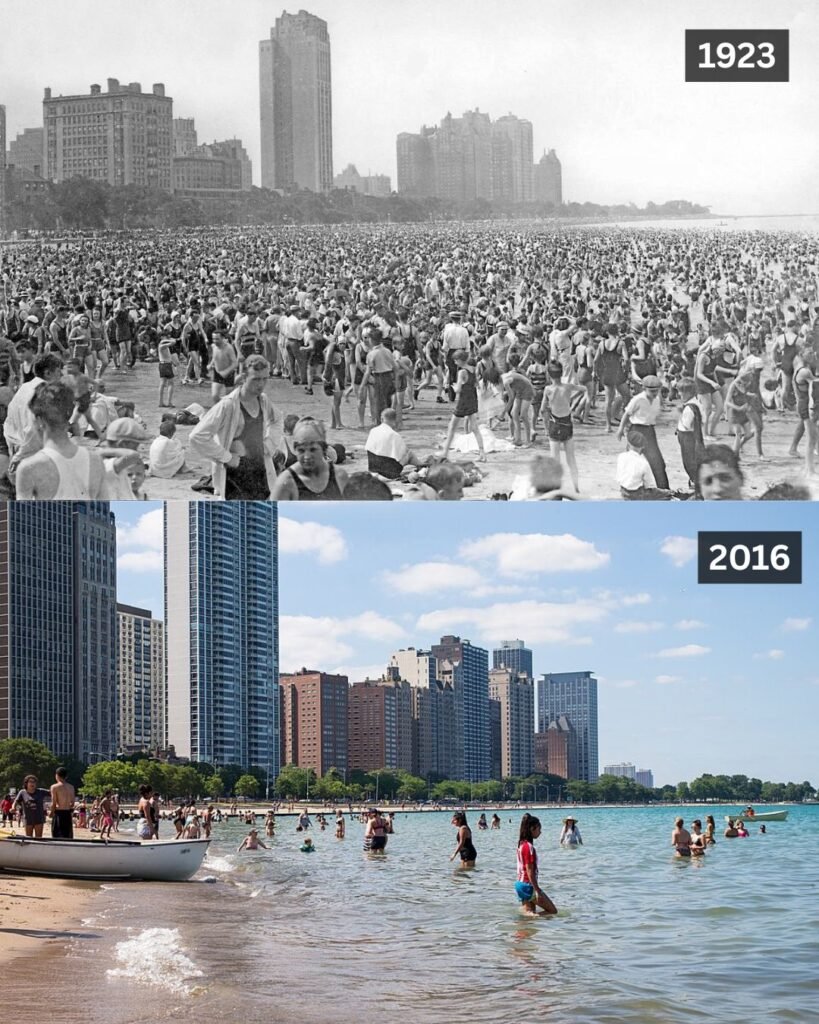
Oak Street Beach is famous today for its stunning, close-up view of the Gold Coast skyline. But a hundred years ago, that skyline looked very different—and the beach itself was in a different place.
The “before” photo from 1923 shows a massive crowd enjoying the original Oak Street Beach. Notice how close the grand, pre-war apartment buildings are to the water’s edge.
That’s because Lake Shore Drive, as we know it, didn’t exist yet.
In the late 1930s, the city undertook a massive landfill project to create the lakefront highway. They literally pushed the shoreline of the entire Gold Coast further east, burying the original beach and creating new land where the road and today’s beach now sit.
The “after” photo shows the result of that incredible engineering feat. The historic Drake Hotel and the Palmolive Building, once sitting right on the water, are now separated from the lake by a multi-lane highway. The view is no longer of the beach, but from it, looking back at a wall of modern glass skyscrapers that have risen alongside the historic stone towers.
7. Wrigley Field
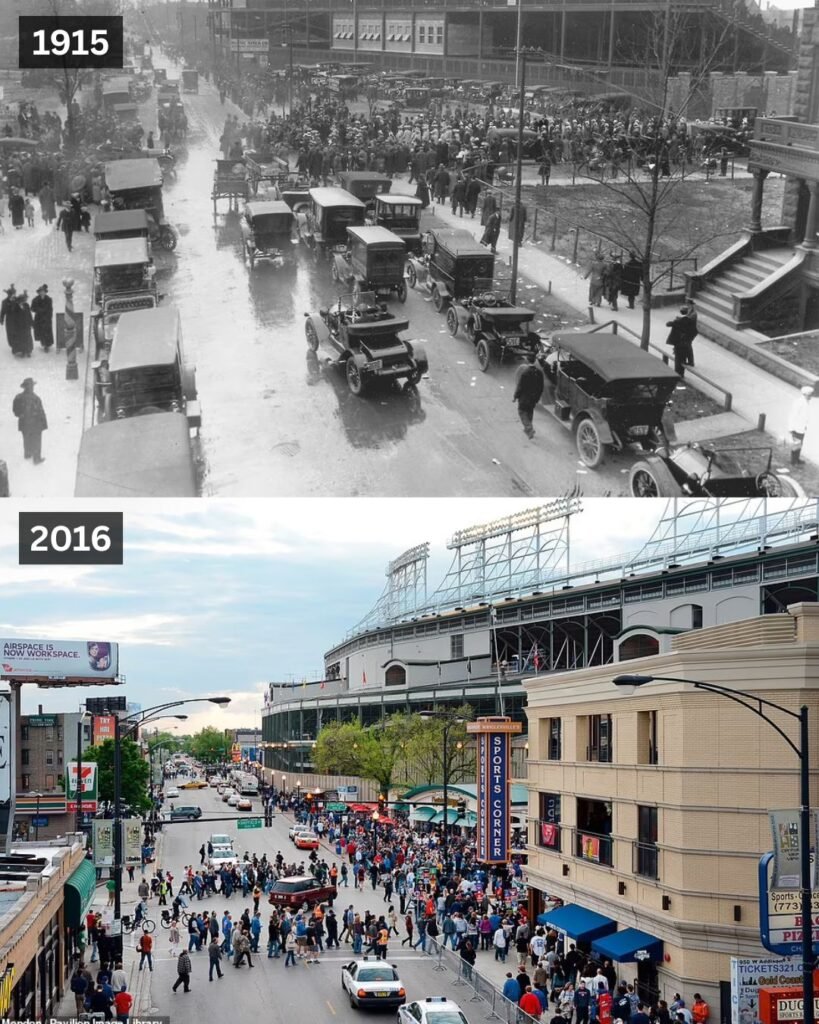
Wrigley Field is the second-oldest ballpark in Major League Baseball, and stepping inside feels like walking into a living museum. But while the iconic ivy-covered walls have remained a constant, the neighborhood around the stadium has transformed dramatically.
The “before” photo from 1915 shows a crowd gathering for a game in the ballpark’s earliest days, when it was still known as Weeghman Park and was home to the Chicago Whales of the Federal League. The streets are filled with early Model T-style automobiles, and the area is still a quiet, residential neighborhood.
Over the next century, the “Friendly Confines” would become a national landmark. The ‘L’ train was built right up to its doorstep, massive light towers were famously added in 1988 for night games, and the surrounding neighborhood of Wrigleyville exploded into a bustling entertainment district.
Today, the ballpark stands as a beautiful anchor to the past, surrounded by a thoroughly modern city of sports bars, high-rise hotels, and bright digital billboards—a far cry from the muddy streets of 1915.
8. Art Institute of Chicago
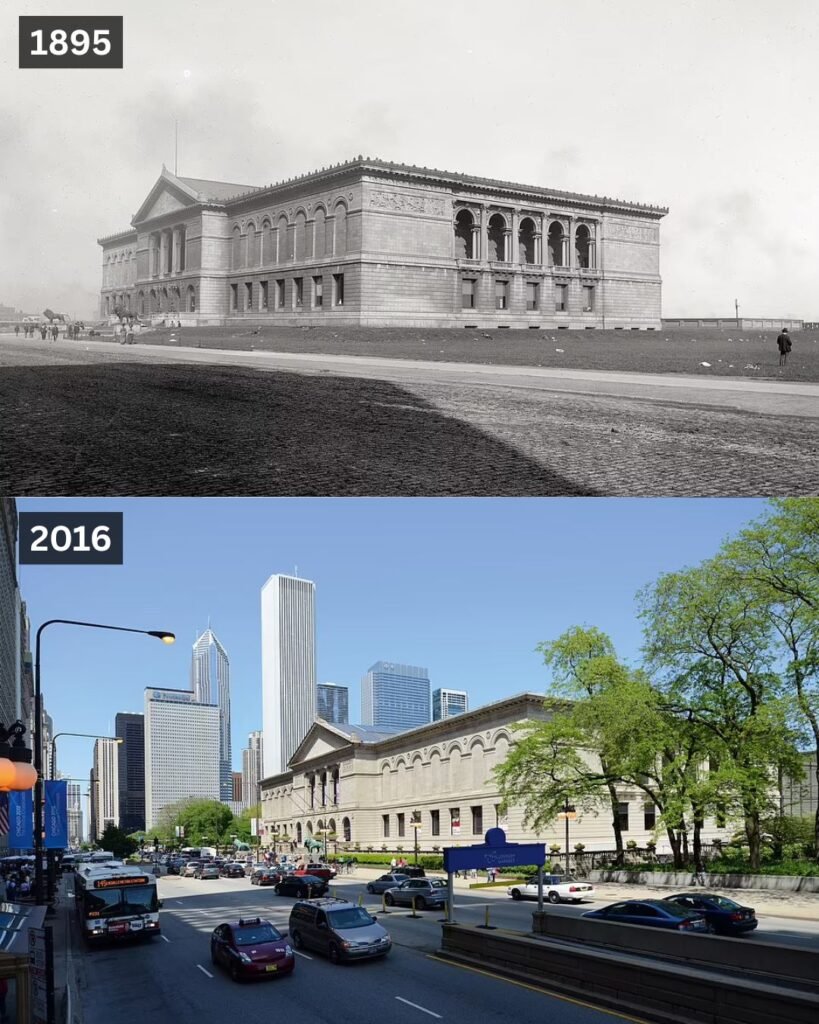
This is perhaps the most powerful “before and after” in all of Chicago. It shows not just the change of a single building, but the birth of an entire skyline.
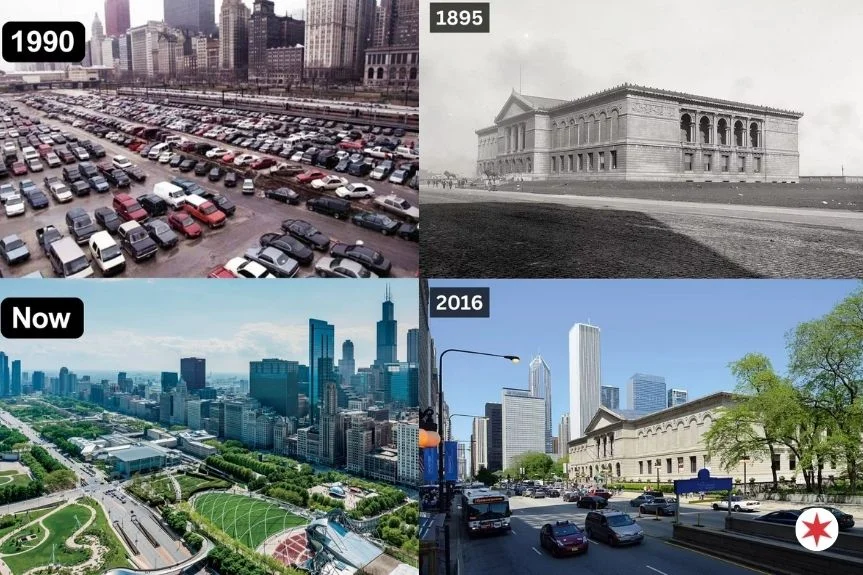
The “before” photo from 1895 shows the Art Institute of Chicago shortly after it was constructed. It’s a magnificent building, but what is most shocking is what’s around it: absolutely nothing. It sits alone on Michigan Avenue, surrounded by a vast, empty lakefront park of dirt and grass. There are no other tall buildings in sight.
This was a Chicago still recovering and rebuilding from the Great Fire, a city on the cusp of its architectural boom.
The “after” photo from the exact same vantage point today tells the story of the next 120 years. The Art Institute still stands as a proud classical anchor, but it is now dwarfed by a dense forest of modern and post-modern skyscrapers.
The empty fields have been transformed into the lush, manicured gardens of Millennium Park and Grant Park. This single comparison captures the city’s explosive growth and its transformation into the birthplace of the modern skyscraper.
9. Soldier Field
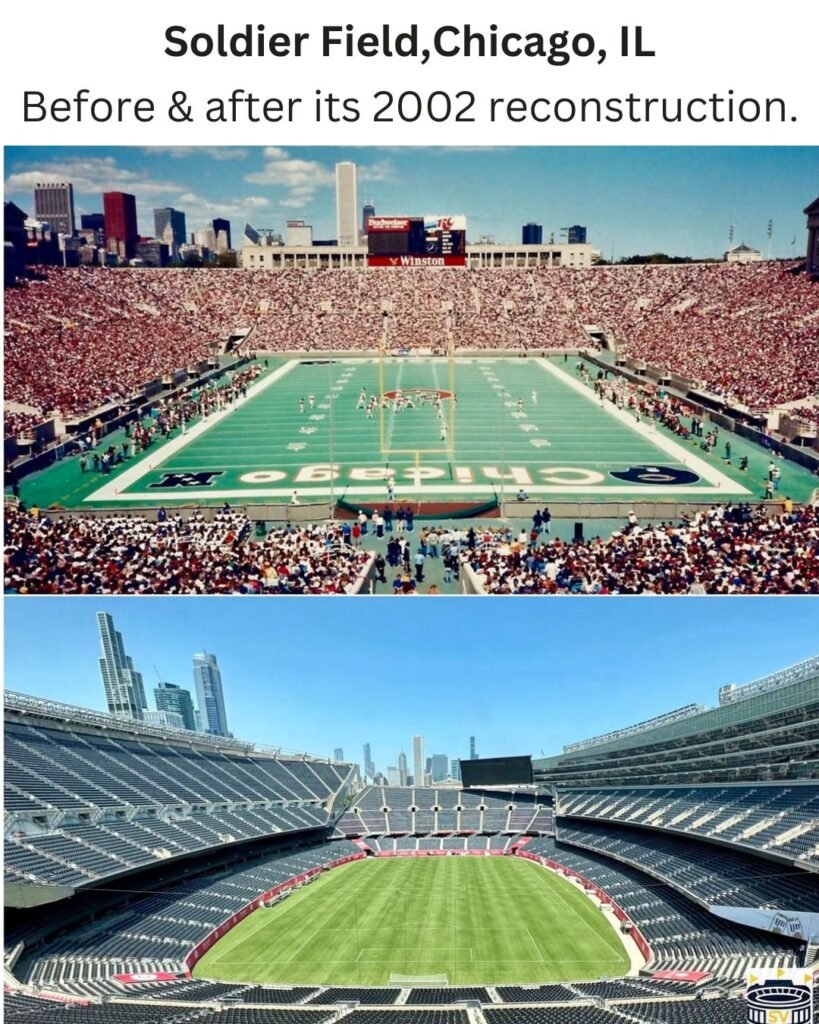
For most of the 20th century, Soldier Field was a majestic, open-air bowl, famous for its grand neoclassical colonnades that served as a memorial to fallen soldiers. The “before” photo shows the classic, wide-open stadium as generations of Bears fans remembered it.
But by the early 2000s, the historic stadium was one of the smallest and most outdated in the NFL.
To modernize the facility, the city undertook one of the most ambitious—and controversial—renovations in its history. Instead of building a new stadium, they chose to gut the historic bowl and build an entirely new, modern seating structure directly inside the old classical shell.
The result, unveiled in 2003, was so jarring that it was immediately nicknamed “The Spaceship” or “The Mistake on the Lake” by critics. The sleek, modern seating bowl rises high above the original colonnades, looking like a futuristic UFO that has crash-landed inside a Roman ruin.
The project was so architecturally divisive that Soldier Field was stripped of its National Historic Landmark status in 2006. For better or worse, the stadium stands today as a stark, undeniable symbol of Chicago’s willingness to sacrifice historic preservation for modern functionality.
10. Michigan Avenue
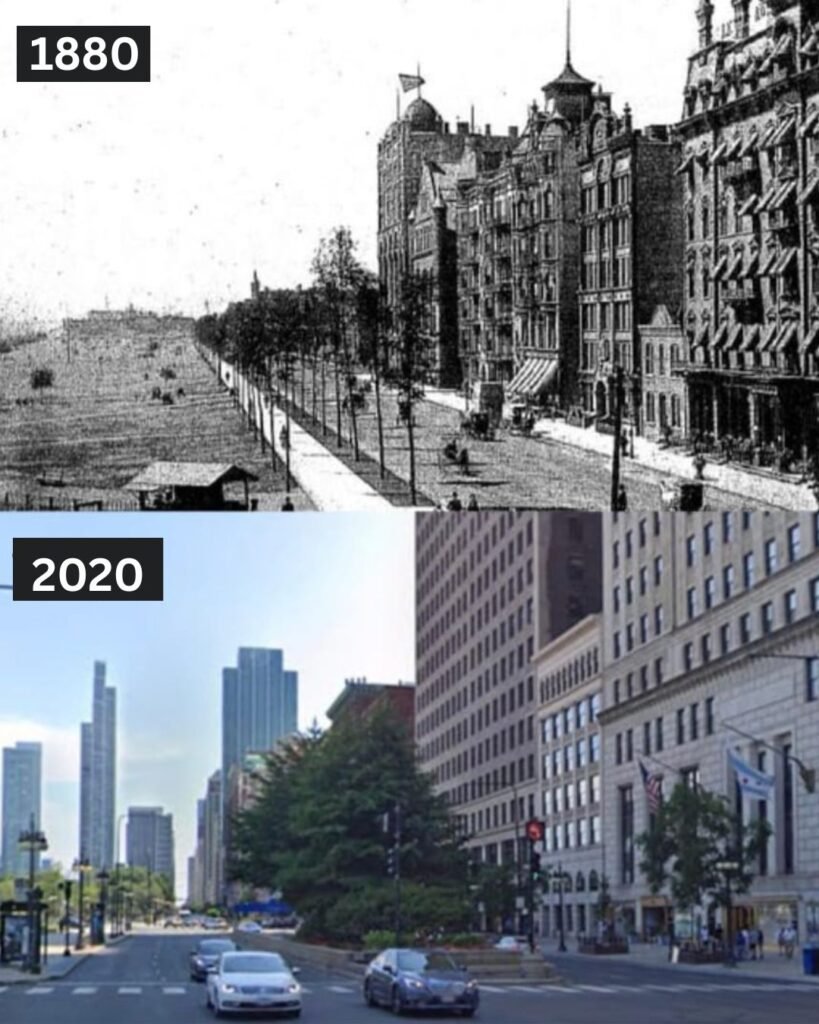
Today, Michigan Avenue is a world-famous canyon of glass skyscrapers, luxury department stores, and bustling traffic. But this “before” photo from 1880 reveals its humble, almost rural, beginnings.
Looking north from just south of the Art Institute, the photo shows a Michigan Avenue that is barely recognizable. On the right, a row of ornate, low-rise stone buildings stands as the city’s glamorous frontier. On the left, there is nothing but a vast, empty park of dirt and scattered trees where Millennium Park and the “Magnificent Mile” would one day rise.
In the late 19th century, this was the absolute edge of the city.
The “after” photo from the same spot today tells the story of Chicago’s explosive growth. The low-rise mansions have been replaced by towering steel and glass structures. The quiet, tree-lined street is now a multi-lane thoroughfare, and the empty parkland is now a dense forest of world-famous architecture. It is a powerful testament to the city’s relentless upward ambition.