

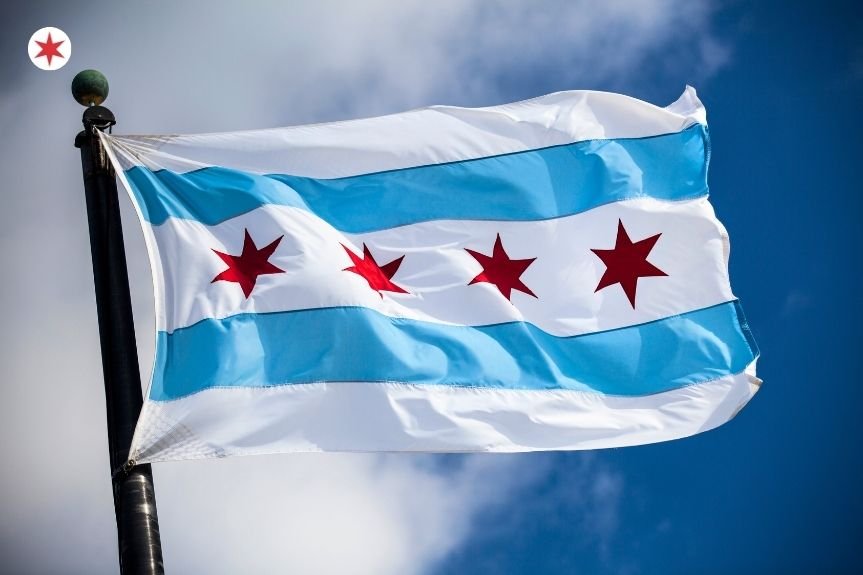
Walk down any street in Chicago, and you will see it everywhere.
It’s on t-shirts and coffee mugs, tattooed on arms, and waving from front porches. You’ll find it stitched onto the uniforms of police officers and firefighters.
More than just a civic symbol, the Chicago flag is a badge of honor—a declaration of intense local pride that you rarely see in any other major city.
So, what is it about this specific design that has so completely captured the soul of Chicago?
The answer isn’t just in the simple, bold graphics. It’s in the story the flag tells.
Each stripe and every six-pointed star is a chapter in an epic narrative of a city built on water, forged in fire, and constantly reborn through sheer, unapologetic ambition.
This isn’t just a piece of cloth. This is the story of Chicago.
A City Built on Water: The Meaning of the Stripes and Bars
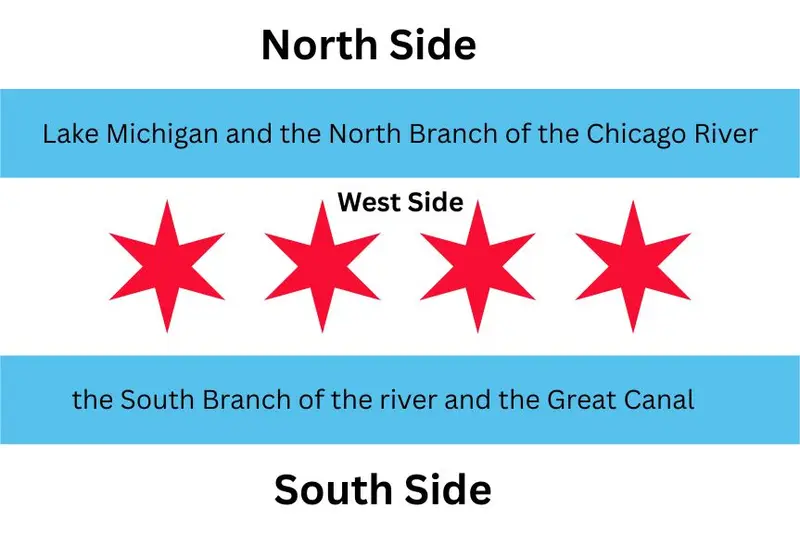
Before you can understand the story of the four famous red stars, you have to understand the canvas they are painted on. The flag’s simple, elegant background is a symbolic map of Chicago itself, representing the geography that defines the city.
The three white bars are not just arbitrary divisions; they represent the fundamental way Chicagoans understand their city: the North Side, the West Side, and the South Side.
The two blue stripes symbolize the city’s lifeblood: its water. The top stripe represents the great Lake Michigan and the North Branch of the Chicago River. The bottom stripe represents the South Branch of the river and the Great Canal that connects it to the Mississippi River system.
Together, these stripes and bars form the geographical soul of Chicago. It’s on this symbolic map that the city’s incredible four-star story is told.
An Evolving Symbol: How the Flag Grew With the City
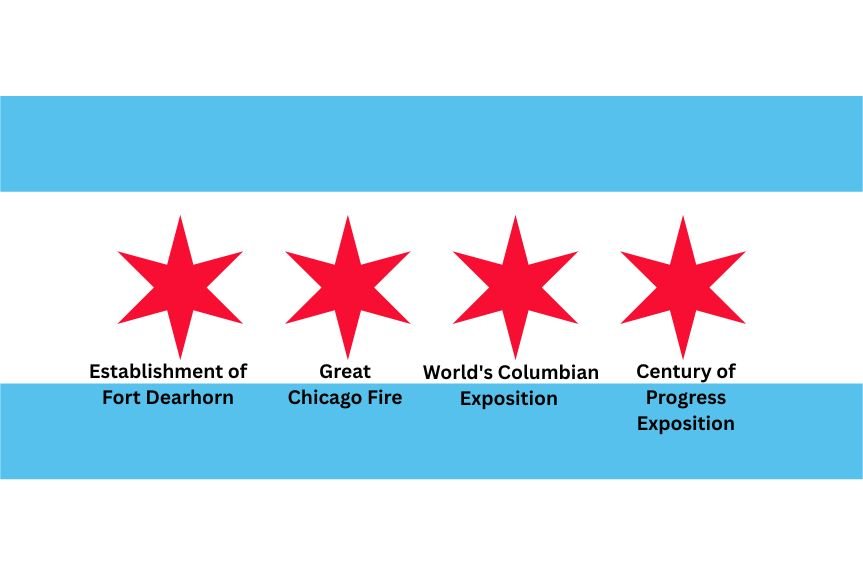
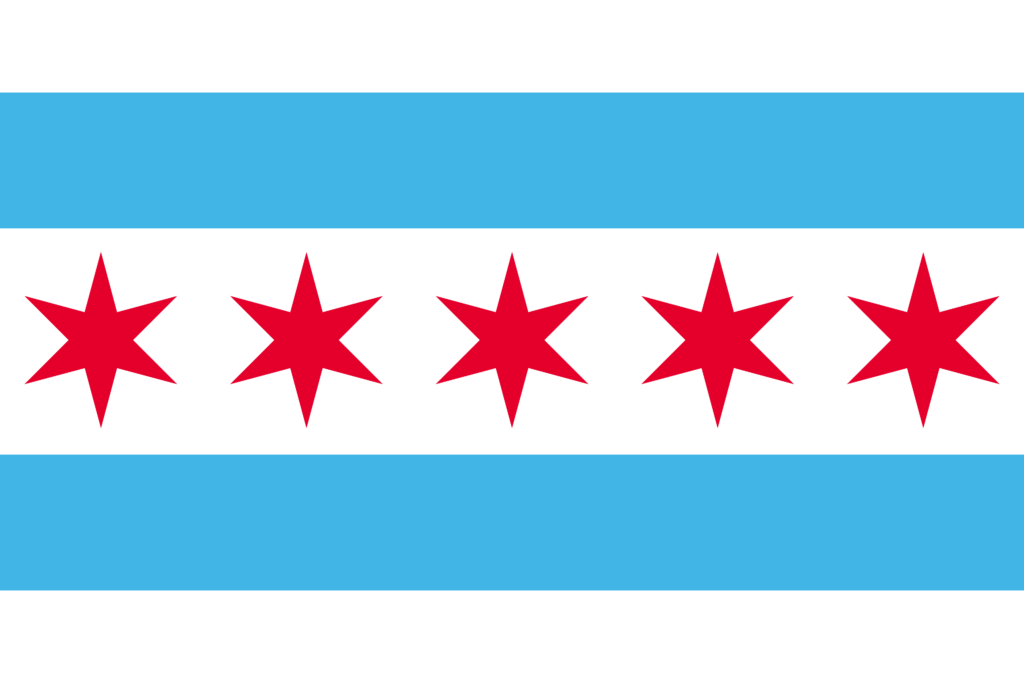
One of the most fascinating secrets of the Chicago flag is that it wasn’t born with four stars. The flag has actually grown and evolved over time, with stars being added to commemorate new chapters in the city’s epic narrative.
When the flag was first adopted by the City Council on April 4, 1917, it featured only two stars. As seen in vintage posters and newspaper clippings from the era, these original stars represented the two most pivotal events in Chicago’s story up to that point: the Great Chicago Fire of 1871 and the World’s Columbian Exposition of 1893.
In 1933, a third star was added to the flag to honor the city’s second World’s Fair, the Century of Progress International Exposition. This new star celebrated Chicago’s status as a modern, forward-thinking metropolis.
The fourth and final star came in 1939. In a move that looked back to the city’s very beginnings, this star was added to represent Fort Dearborn, the original US military outpost that marked the founding of the settlement. This means the star representing the earliest event in Chicago’s history was actually the last one added to the flag.
Today, the four stars stand together, representing the key moments that forged Chicago’s “I Will” spirit: from its rugged beginnings at Fort Dearborn and its fiery rebirth after 1871, to its triumphant announcements on the world stage in 1893 and 1933.


The Hidden Language: Why Chicago’s Stars Have Six Points

Most casual observers notice the four red stars, but they miss a crucial, deliberate detail: they all have six points, not five like the stars on the American flag.
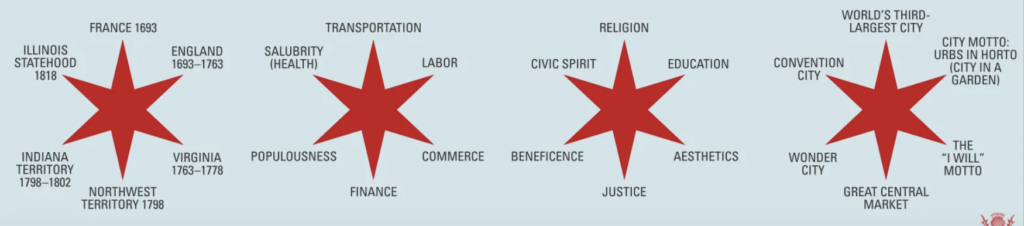
This wasn’t an accident. The flag’s original designer, Wallace Rice, chose six-pointed stars to make the design unique and to pack even more symbolism into each one. While the stars themselves represent major events, each of their six points represents a specific virtue, achievement, or historical fact.
Here is a quick breakdown of the incredible level of detail hidden in the design:
The points of the Great Chicago Fire star represent the virtues of the city: transportation, labor, commerce, finance, populousness, and health.
The points of the World’s Columbian Exposition star symbolize the cultural and civic pride of the Gilded Age: religion, education, aesthetics, justice, beneficence, and civic spirit.
The points of the Century of Progress star highlight Chicago’s proudest slogans and achievements: being the world’s third-largest city, its Latin motto “Urbs in Horto” (City in a Garden), the “I Will” motto, the Great Central Market, the “Wonder City,” and the “Convention City.”
And finally, the points of the Fort Dearborn star represent the historical timeline of who controlled the land: France (1693), Great Britain (1763), Virginia (1778), the Northwest Territory (1798), Indiana Territory (1802), and Illinois statehood (1818).
It’s this astonishing attention to detail that elevates the flag from a simple symbol to a true historical document.
The “Other” Symbol: Have You Ever Noticed Chicago’s Municipal Device?

While the four-star flag gets all the glory, Chicago has another, much more subtle official symbol that’s hidden all over the city.
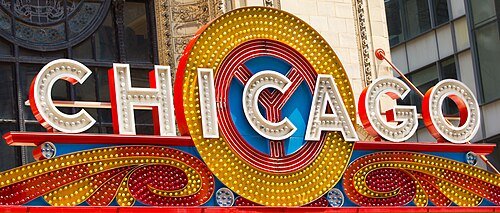
It’s called the Municipal Device.
The symbol is a simple, Y-shape enclosed in a circle. Just like the flag, it is a symbolic map of the city’s geography. The Y-shape represents the three branches of the Chicago River coming together at Wolf Point—the birthplace of the city.
Once you know what to look for, you will start seeing it everywhere.

It’s embedded in the architecture of historic buildings, carved into the sides of bridges (like the one at Merchandise Mart), and stamped onto city property like library cards and manhole covers.
While it never achieved the rock-star status of the flag, the Municipal Device is a quiet, persistent part of Chicago’s visual identity—a secret nod to the river that built the city, waiting to be discovered by observant explorers.
An Unfinished Chapter: The Passionate Debate for a Fifth Star

The story of Chicago’s flag might not be finished. For decades, there has been a passionate, ongoing debate among locals, historians, and politicians about whether a fifth star should be added to the flag to commemorate another monumental moment in the city’s history.
Several powerful contenders have emerged over the years.
Many argue for a star representing the Reversal of the Chicago River in 1900, a world-changing engineering feat that saved the city’s drinking water and literally reshaped the landscape of North America.
Others champion the first self-sustaining nuclear reaction, achieved under the football stands at the University of Chicago in 1942, an event that officially ushered in the Atomic Age.
And a strong case is always made for Chicago’s immense cultural contributions to the world, specifically the creation of two globally influential music genres: Blues and House music.
While no official decision has ever been made, the debate itself proves that the city’s story is still being written. Which event do you think has earned a fifth star?
Conclusion: More Than a Flag, It’s an Identity
So, why is Chicago so obsessed with its flag?
Because it’s not just a flag—it’s the city’s entire story of tragedy, resilience, and unapologetic ambition, distilled into one perfect, elegant symbol.
The stripes of water, the stars of fire and rebirth—each element tells a chapter of a shared history. It’s a design so powerful that it has transcended its official purpose to become a public icon, a piece of folk art, and a declaration of belonging.
It’s a visual promise of the city’s “I Will” spirit, a shared story on a piece of cloth that makes millions of people proud to call Chicago home.