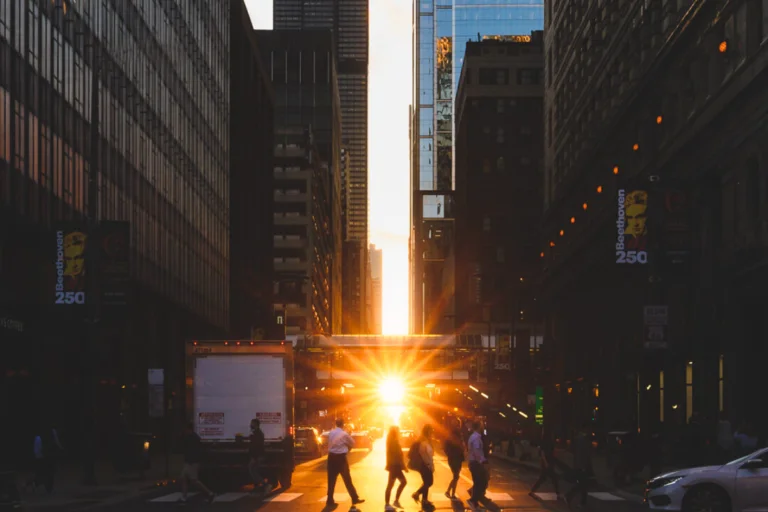
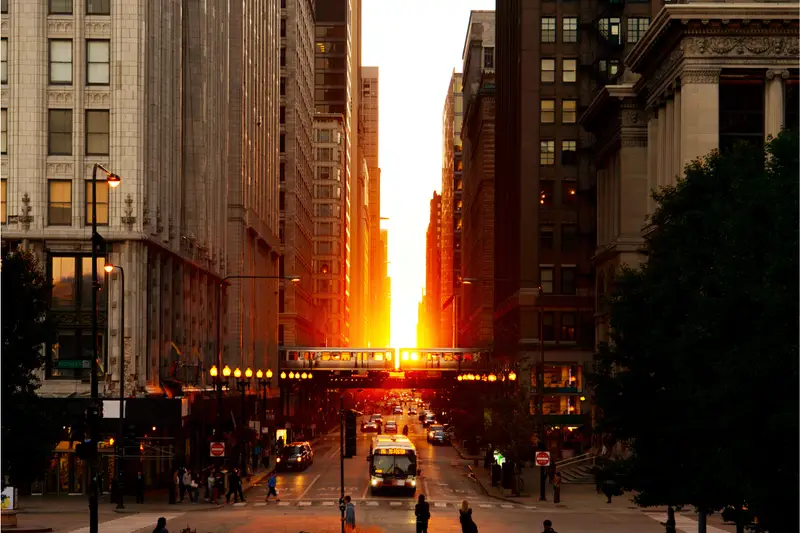
Twice a year, Chicago’s street grid lines up perfectly with the setting sun, and the skyscrapers of the Loop frame it like a photograph waiting to happen.
This September, the effect is expected to peak between September 19 and September 22, 2026, right around the autumnal equinox on Tuesday, September 22 at approximately 7:05 p.m. CDT.
The alignment itself lasts only moments, but the visual effect is visible for two to three days on either side, meaning this whole week is your window.
The exact times to look up
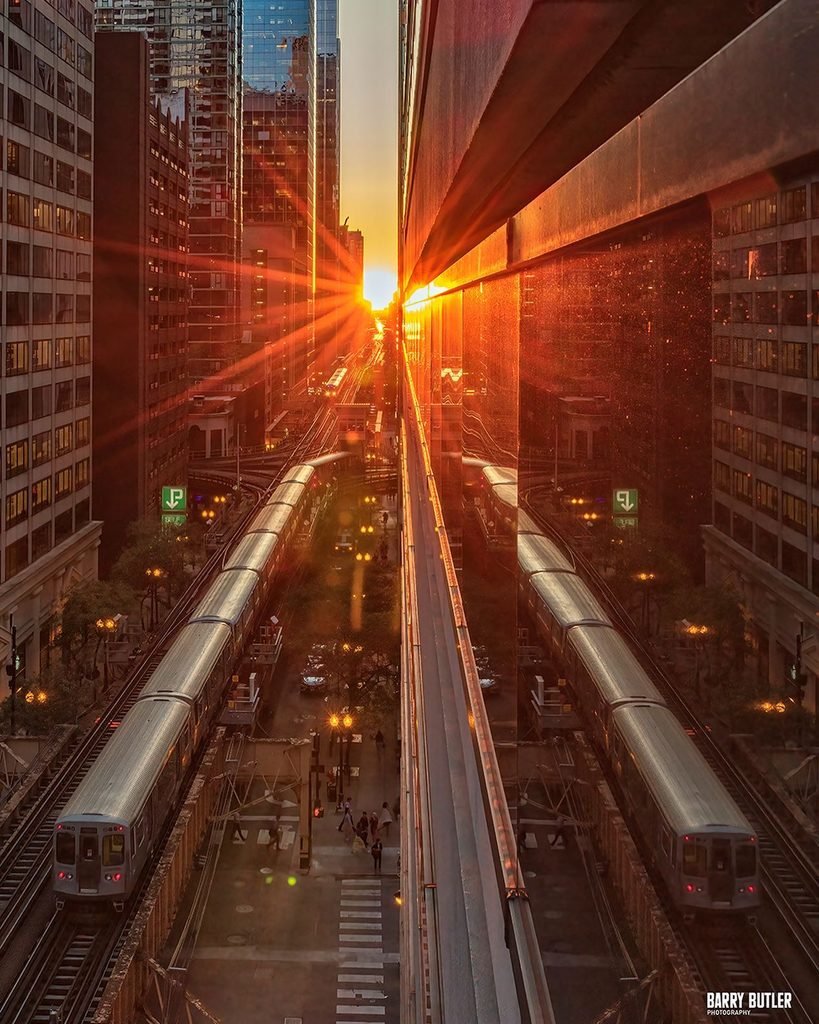
Sunset creeps earlier each night this week, so the window shifts slightly day to day.
On September 19, sunrise is at 6:34 a.m. and sunset at 6:52 p.m. By September 22, sunrise moves to 6:38 a.m. and sunset to 6:47 p.m.
The phenomenon happens because Chicago’s grid runs strictly east to west, an arrangement planned back in the early 19th century that happens to line up with the sun twice a year, once each in spring and fall.
The name itself is borrowed. Astrophysicist Neil deGrasse Tyson coined “Manhattanhenge” for the same effect in New York back in 1997, and Chicago photographers and journalists, including NPR’s David Schaper, later adapted it into “Chicagohenge.”
Where locals actually go to watch
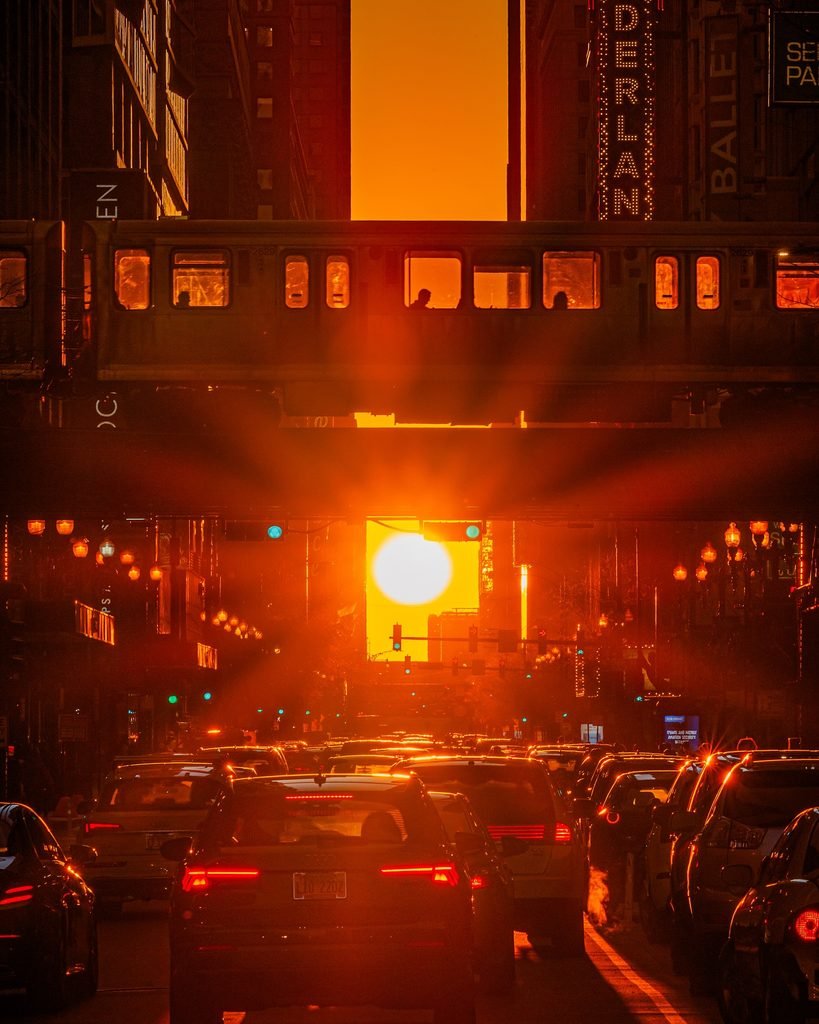
Any unobstructed east-west street in the Loop will work, but a few spots have become the regulars’ choice.
Madison Street, viewed from its intersection with Michigan Avenue, gives a clean westward look down the street’s canyon of buildings. Randolph Street, north of Millennium Park, offers a similar sightline, and Adams Street at Michigan Avenue is another unobstructed option.
For an elevated view, the Nichols Bridgeway connecting the Art Institute to Millennium Park looks out over Monroe Street, though security often won’t allow tripods up there.
Photographers also swear by the 200 N. Clark Street parking garage, nicknamed the Reflection Garage. Those chasing the shot with a camera might start from settings photographers have used before: 1/8000 shutter speed, f/5.6 aperture, ISO 320 at a 200mm focal length.

A free event ties it to science and music
The Chicago Public Library is marking the occasion with a free program called “Chicagohenge: Sun, Skyscrapers, Songs and Science.”
It runs Sunday, September 20, 2026, from 3:00 to 4:30 p.m. at the Harold Washington Library Center, 400 S. State St.
Astronomer Dr. Luke Leisman and musicians from The Pars will lead the program, which looks at where architecture and astronomy meet.
The Local’s Guide
- Address: 400 S. State St.
- Neighborhood: the Loop
- Current Hours: Sunday, September 20, 2026, 3:00 p.m. to 4:30 p.m.
- Price Range: Free
- Insider Tip: Bring your camera to the 200 N. Clark St. parking garage or Madison Street at Michigan Avenue for an unobstructed shot, but leave the tripod behind if you’re heading up to the Nichols Bridgeway, since security often won’t allow them there.