
From Nighthawks to American Gothic, the wildest stories behind the most famous paintings in Chicago.
The Art Institute of Chicago holds approximately 300,000 works across nearly a million square feet of galleries. Most visitors leave having seen maybe three percent of it.
The problem isn’t the collection. The collection is one of the best on the planet. The problem is scale. People walk in with two hours to spare, get lost in the European wing, never make it to the American galleries, and leave without realising they walked past a painting they’ve seen on a thousand T-shirts and dorm room posters.
This is the list to fix that. Fifteen works you absolutely cannot miss, with the stories behind them most visitors never hear. The kind of details that turn a quick glance into something you’ll remember years later.
If you’re planning a visit, skip-the-line tickets are worth it on weekends and during summer. Lines for the main entrance can stretch around the block.
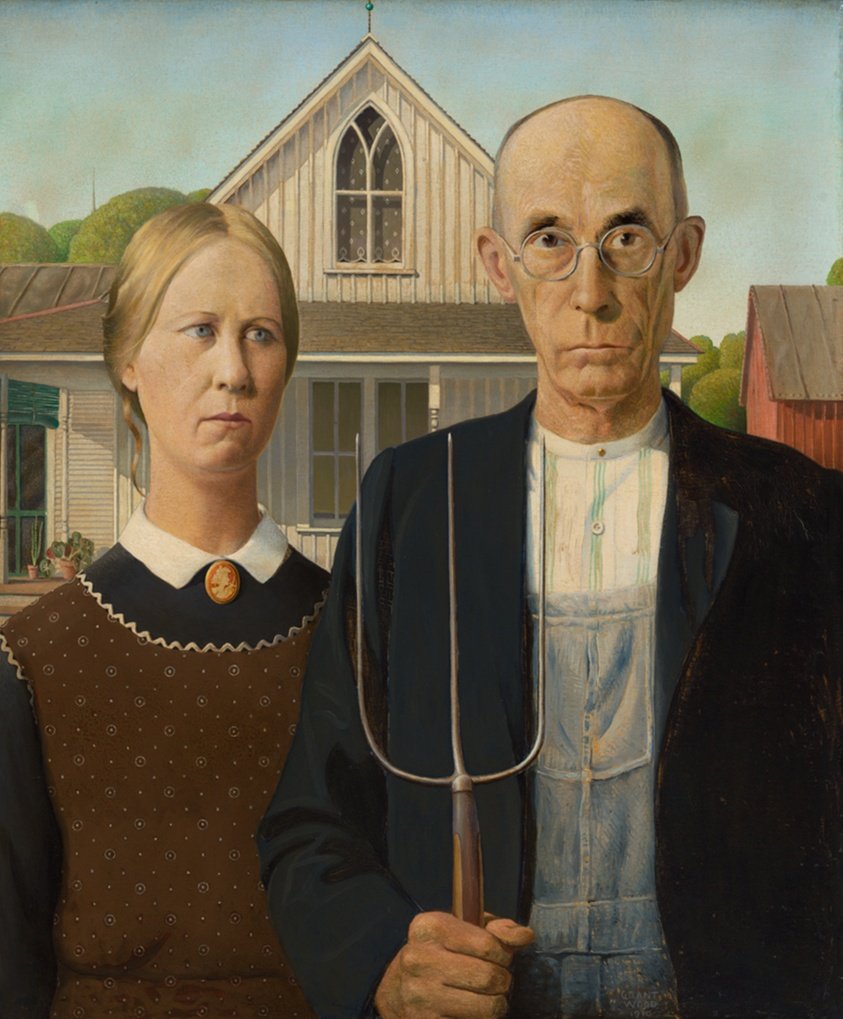
1. American Gothic. Grant Wood (1930)
Gallery 263, American Art
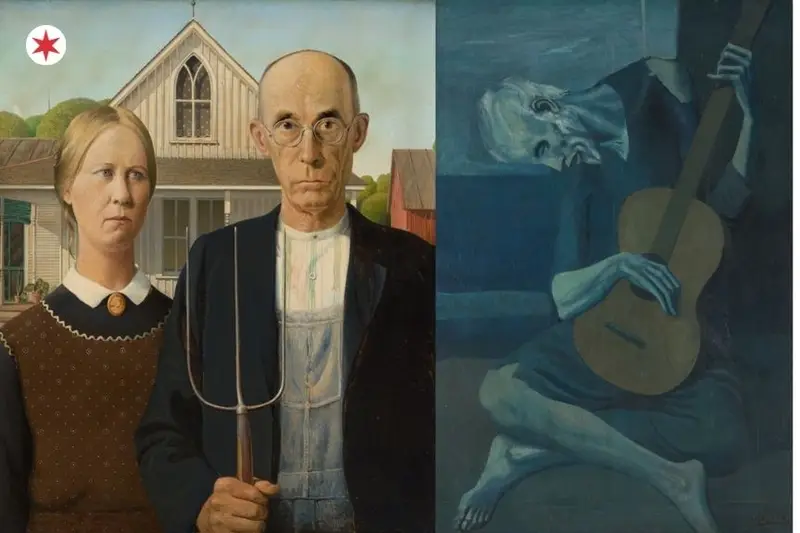
Start here. The most famous American painting of the 20th century. The one your phone autocorrects to when you type “iconic.” The one parodied in everything from The Rocky Horror Picture Show to The Simpsons. And it lives, permanently, in Chicago.
The story is stranger than the painting suggests. In August 1930, an Iowa-born artist named Grant Wood was driving through the small town of Eldon when he spotted a tiny white farmhouse with a single oversized Gothic window on the second floor. He thought the window was ridiculous, a pretentious flourish on an otherwise plain building. He sketched the house on the back of an envelope and decided to paint “the kind of people who would live in that house.”
For models, he used his sister Nan and his dentist, Dr. Byron McKeeby. Nan was 31, fashionable, and looked nothing like the dour woman in the painting. McKeeby was 62 and a more natural fit. The two had never met. They posed separately. Wood deliberately stretched their faces to match what he called “American Gothic people.”
He shipped the painting to Chicago hoping it would get into the Art Institute’s annual American art exhibition. One judge dismissed it as a “comic valentine.” A museum patron pushed back, the painting won a bronze medal and a $300 prize, and the Art Institute bought it on the spot. Within weeks, newspapers across the country were reprinting it. When the Cedar Rapids Gazette finally picked it up, Iowa lost its mind. Local farmers were furious about being depicted as grim-faced Bible thumpers. Wood spent the rest of his life insisting the painting was a tribute to rural American resilience at the start of the Great Depression. Most viewers never believed him.
A small detail almost everyone misses: Nan made the apron herself by removing rickrack trim from her mother Hattie’s old dresses. The trim was no longer sold in stores. The painting nobody can stop staring at is held together by the seamstress work of the painter’s sister.
Local tip: It’s smaller than you expect. About 30 by 25 inches. The crowd around it is usually three deep. Visit on a Wednesday afternoon when the museum is at its emptiest.
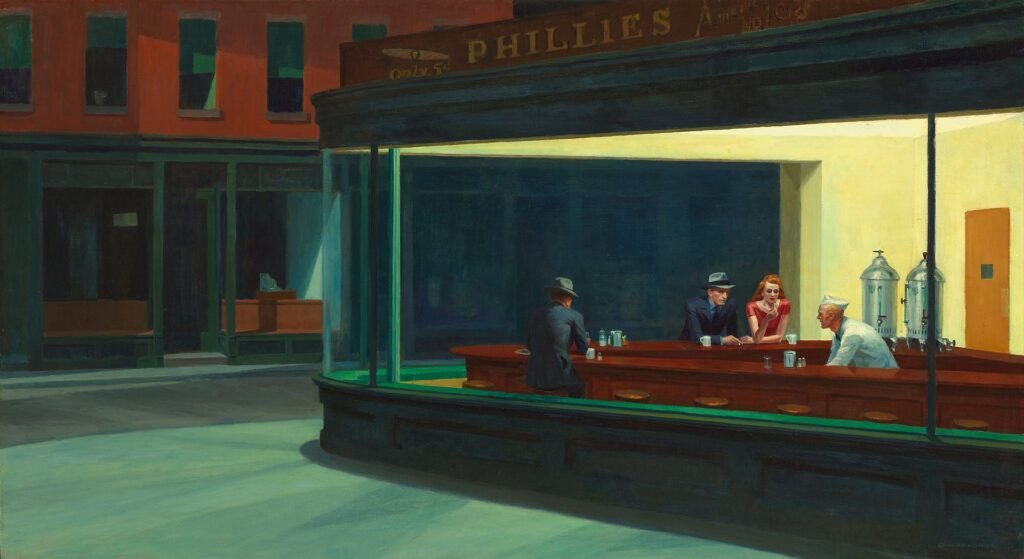
2. Nighthawks. Edward Hopper (1942)
Gallery 262, American Art
The other most famous American painting of the 20th century, and it hangs about 30 feet from the first one. Three figures and a counterman in a brightly lit diner on a deserted city corner. No door in or out. Blade Runner used it as the visual template for “future noir.” The Simpsons and CSI have referenced it. Tom Waits named an album after it. Ridley Scott waved a print of it under his production team’s noses on set.
It hangs here because of an extraordinarily lucky lunch.
Hopper finished the painting in late winter 1941 to 1942, just weeks after the bombing of Pearl Harbor. He had been walking around a New York that had gone dark. The city was practising blackout drills, killing its lights to avoid air raids, and the experience clearly seeped into the work. Hopper later said he was “unconsciously, probably, painting the loneliness of a large city.” His wife Josephine wrote about the leaking skylights in their apartment and how Edward refused to take any interest in the very real possibility of being bombed. Hopper said the diner was inspired by “a restaurant on Greenwich Avenue where two streets meet.” Decades of investigation have failed to identify the exact location.
Hopper used himself as the model for both seated men. Josephine modelled the redheaded woman. The title comes from the man with the prominent nose, which Jo nicknamed a “night hawk” after the bird’s beak. The painting sat unsold in Hopper’s New York gallery for about a month after he finished it. On St. Patrick’s Day 1942, the Hoppers attended an exhibition opening at the Museum of Modern Art. Daniel Catton Rich, the director of the Art Institute of Chicago, was there. Jo cornered him and told him he had to go see Nighthawks. Rich went, looked at it, declared it “fine as a Winslow Homer,” and bought it for the Art Institute on May 13, 1942 for $3,000.
A detail almost everyone misses on first viewing: there’s no door. There’s no way in or out of the diner. The four figures are sealed inside, and you, the viewer, are sealed outside on a dark street with no way in. Hopper meant for you to feel that.
Local tip: Nighthawks is exactly five feet wide, which is bigger than reproductions suggest. The crowd is usually smaller in the morning. See it in the same visit as American Gothic. They’re in adjacent galleries.

3. A Sunday on La Grande Jatte. Georges Seurat (1884–86)
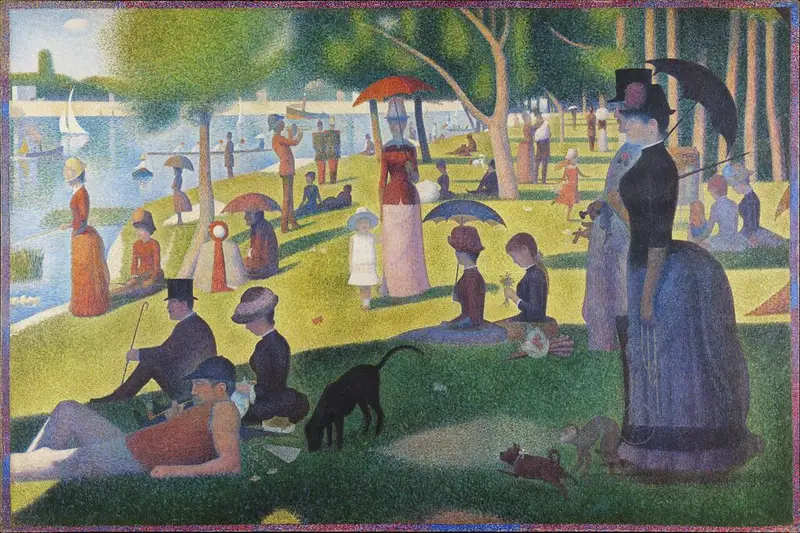
Gallery 240, European Art
This is the painting Cameron Frye stares at in Ferris Bueller’s Day Off. The one he locks eyes with until the dots dissolve into nothing and his face dissolves with it. John Hughes called the museum scene his “love letter to Chicago,” and he picked this painting out of the entire collection for the most pivotal moment in the film. There’s a reason. It’s massive. Seven feet tall, ten feet wide. It dominates an entire wall.
It’s also one of the most labour-intensive paintings ever made. Seurat started it in May 1884. He didn’t finish it until 1886. He produced dozens of preliminary studies, oil sketches, and drawings before laying down a single dot on the final canvas. He returned to it again and again, adding figures, amplifying silhouettes, even painting in the monkey on a leash near the bottom right after the rest of the composition was already finished. By the end he had applied roughly 220,000 individual dots of pure colour to the canvas. He called the technique Divisionism. The art world called it Pointillism. The point was that the dots would optically blend in the viewer’s eye to create colours more luminous than anything you could mix on a palette.
Reception in Paris was mixed. Some critics declared it the future of painting. Others mocked it. The novelist Joris-Karl Huysmans wrote that if you stripped the figures of “the colored fleas with which they are covered, underneath there is nothing, no soul, no thought, nothing.” Seurat ignored them. In 1889 he stretched the canvas, painted a border of dots around the entire composition, and framed it in pure white wood, the same way it’s displayed at the Art Institute today. He died five years later at age 31. The painting bounced through private collections for decades until the Helen Birch Bartlett Memorial Collection brought it to Chicago in 1924. It has been the most famous painting in the museum ever since.
A small detail almost everyone misses: there’s a butterfly hovering in the middle left of the painting. In 19th century French art, the butterfly was often used as a symbol for the fragility of nature in the face of industrialisation. The factories along the Seine, just out of frame, were the source of the leisure scene depicted in front of you.
Local tip: Stand close. Get within two feet of the canvas if the museum lets you. The figures dissolve into pure colour. Then back up to about 20 feet. They snap back into focus. The painting is essentially two different works at two different distances.
4. Paris Street; Rainy Day. Gustave Caillebotte (1877)
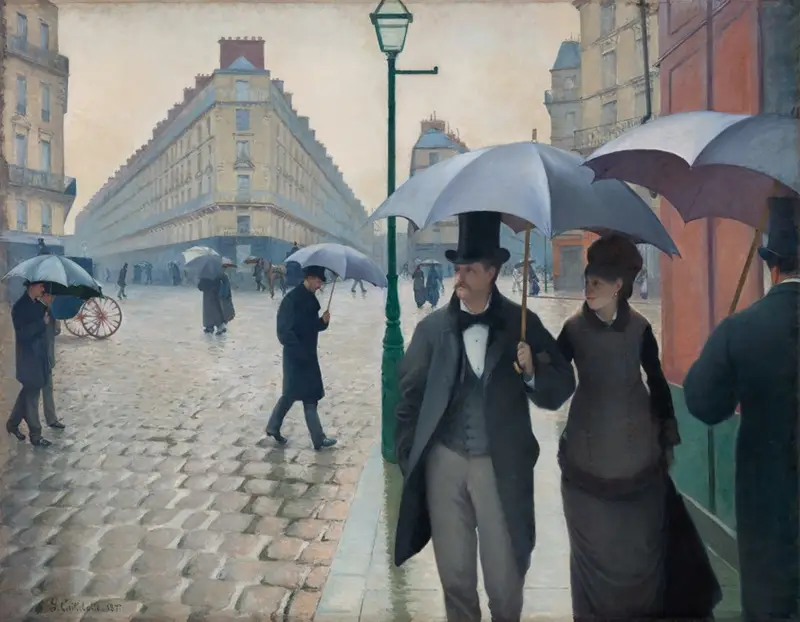
Gallery 201, European Art
The first thing that hits you is the scale. Almost seven feet tall and over nine feet wide. It dominates the wall at the top of the museum’s Grand Staircase. Then you notice the figures, the wet cobblestones, the umbrellas, the reflections, the way the foreground couple looks like they have just walked into the frame. This is one of the most visited paintings in the entire museum, and arguably the most photographed.
The intersection in the painting is real. It’s the Place de Dublin in north Paris, near the Saint-Lazare train station. It still looks almost exactly the same today. Caillebotte lived in the neighbourhood and watched it transform throughout his life. The neoclassical buildings, the wide boulevards, the cobblestones, all of it had been built within the previous 20 years by Baron Haussmann, the urban planner who tore down medieval Paris and rebuilt it as the modern capital we recognise now. The painting is, in part, a portrait of a city that was inventing itself.
Caillebotte was the strangest member of the Impressionist circle. He was rich. His father had built a fortune in military textiles, and Gustave inherited a chunk of it in 1874 along with his brothers. While Monet and Renoir were scrambling to sell paintings to pay rent, Caillebotte was buying their work to support them. Many of the great Impressionist paintings now in the Musée d’Orsay came from Caillebotte’s personal bequest, willed to the French state after his sudden death in 1894 at age 45. But he was also a serious painter himself. He painted the streets of Paris with a precision the other Impressionists rejected. No fuzzy brushstrokes. No hazy light. Just sharp lines, photographic perspective, and obsessive attention to detail. Curators at the Art Institute have established he likely used a camera lucida, an optical drawing aid, to compose this scene.
How it ended up in Chicago is its own story. The painting stayed in Caillebotte’s family for nearly a century after his death. In 1955 it was sold to Walter P. Chrysler Jr., the auto magnate’s son, who eventually sold it to the Art Institute in 1964. At the time, Caillebotte was barely known. The world’s view of him as a major painter, rather than just the wealthy benefactor of his more famous friends, didn’t really begin until this painting arrived in Chicago. The acquisition is now considered one of the great curatorial coups of the 20th century.
A small detail almost everyone misses: Caillebotte deliberately blurred the carriage wheels in the middle distance to suggest motion. He also raised one heel of the gentleman in the foreground to show that he is mid-stride. One critic at the 1877 Impressionist exhibition wrote: “the man walks, and you know the play of the muscles by the pants-legs.”
Local tip: This is also a Ferris Bueller painting. It appears prominently in the museum sequence. Stand directly in the centre and the perspective lines all converge on the lamppost. The painting is hung at the top of the Grand Staircase and you’ll see it as soon as you reach the second floor.
5. The Old Guitarist. Pablo Picasso (1903–04)
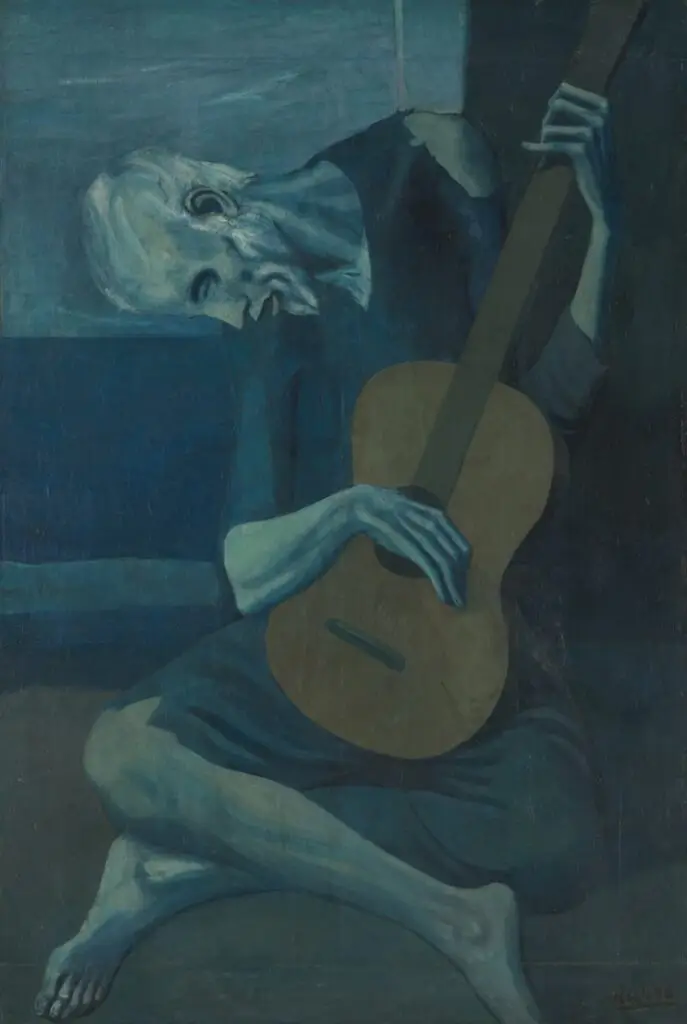
Gallery 391, Modern Wing
A blind, hunched musician in threadbare clothing playing on the streets of Barcelona. The most famous painting of Picasso’s Blue Period, and one of the strangest paintings in the entire museum. Look closely at the top centre, just above the guitarist’s head, and you can see the faint outline of a woman’s face staring out at you. It’s not your imagination. Picasso painted on top of an earlier composition, and the older painting is bleeding through the surface.
The Art Institute used infrared and X-ray imaging in 1998 to look beneath the canvas, and what they found is extraordinary. Not one but two earlier compositions are hidden underneath. The first depicts an elderly woman with her head bent forward and an outstretched arm. The second shows a young mother seated with a small kneeling child and an animal on the right side, possibly a calf. The Cleveland Museum of Art later identified a sketch Picasso had sent in a 1903 letter to his friend Max Jacob, depicting that exact mother-and-child scene. Why he abandoned both compositions, nobody knows. The likeliest answer is that Picasso could not afford new canvases. He painted The Old Guitarist during one of the bleakest periods of his life, scarcely able to feed himself.
He created the painting in late 1903 to early 1904, just two years after the suicide of his closest friend Carlos Casagemas. He was 22 years old, broke, and grieving. The Blue Period that came out of this loss was defined by a cold monochromatic palette, elongated angular figures inspired by El Greco, and subjects drawn from the destitute and forgotten of Barcelona. The brown guitar is the only warm element in the painting. Music, for the figure, becomes the only thing keeping him alive. The painting entered the Art Institute’s collection in 1926 as part of the Helen Birch Bartlett Memorial Collection, the same gift that brought La Grande Jatte to Chicago.
A small detail almost everyone misses: the ghostly woman’s face is sometimes faintly visible to the naked eye in raking light. Try standing slightly to one side of the painting and looking at the upper centre. You can see her cheekbone and the hollow of her eye.
Local tip: The Old Guitarist is in the Modern Wing on the second floor, in a different building from American Gothic and Nighthawks. Walk through the connecting bridge from the original museum. You can also enter the Modern Wing directly from Millennium Park via the Nichols Bridgeway.
6. The Bedroom. Vincent van Gogh (1889)
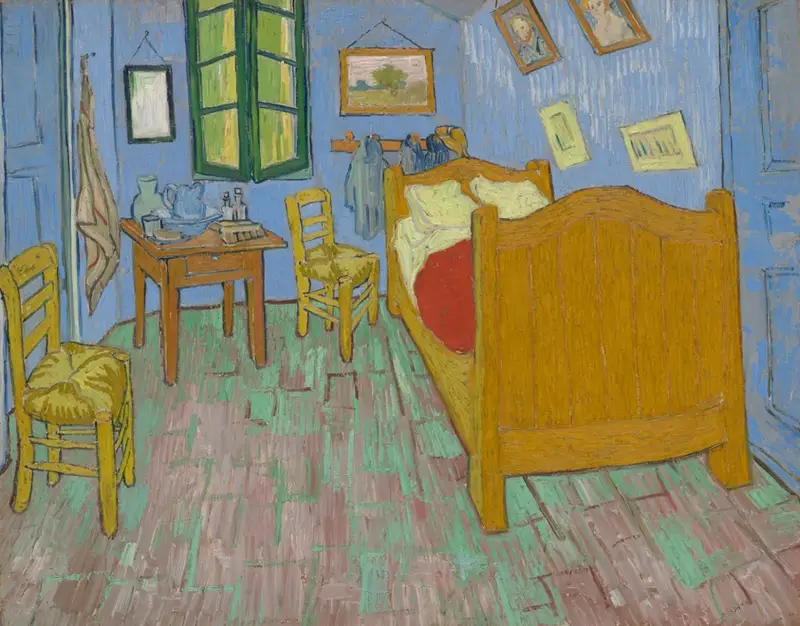
Gallery 241, European Art
Most people think there is only one Bedroom by Van Gogh. There are three, all nearly identical, painted within a year of each other. The first is in Amsterdam. The third is in the Musée d’Orsay in Paris. The second, which some scholars consider the finest of the three, is in Chicago.
The first version was painted in October 1888, just after Van Gogh moved into his beloved “Yellow House” in Arles. It was the first time in his adult life he had a home of his own, and he was so excited about it that after spending two and a half days in bed exhausted from decorating, he decided to paint his bedroom. He wrote to his brother Theo: “It amused me enormously doing this bare interior.”
A year later, after Van Gogh’s mental breakdown and his admission to the asylum at Saint-Rémy-de-Provence, he learned that flooding in the Yellow House had badly damaged the original painting. He asked Theo to have it relined. Theo suggested making a copy first as a precaution. In September 1889, in the asylum studio, Van Gogh painted the second version. It is identical in scale to the original and almost identical in composition, but slightly bolder, with thicker brushstrokes and more vivid contrasts. Three weeks later he painted a third smaller version as a gift for his mother and sister Willemien. The Chicago painting is the second, the one made from memory in the asylum, captured at a moment when Van Gogh was longing for the home he had lost.
A small detail almost everyone misses: the walls were originally violet, not blue. The red pigment Van Gogh used has faded over the past 130 years. If you imagine the walls a deep purple, you are seeing the painting closer to how Van Gogh saw it.
Local tip: Compare the portraits hanging on the wall to the right of the bed. In the Amsterdam version they are paintings of two of Van Gogh’s friends, Eugène Boch and Paul-Eugène Milliet. In the Chicago version, one of them is a self-portrait and the other is a portrait of an unknown woman. Each version of the painting has different portraits inside it.
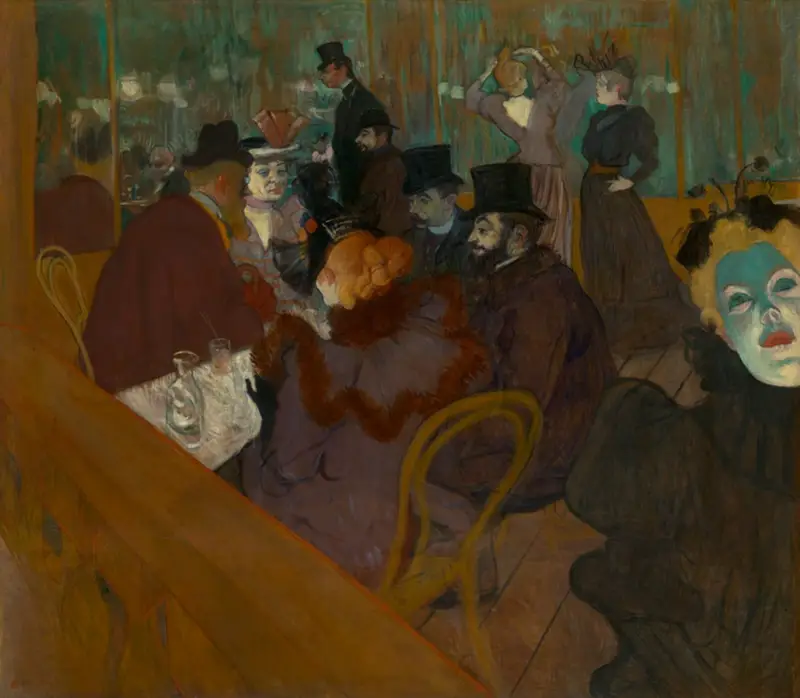
7. At the Moulin Rouge. Henri de Toulouse-Lautrec (1892–95)
Gallery 201, European Art
One of the most famous paintings of Belle Époque Paris, and one of the most peculiar. Toulouse-Lautrec was a regular at the Moulin Rouge from the night it opened in 1889. He had a permanently reserved table. He painted the dancers and singers obsessively. At the Moulin Rouge is essentially a group portrait of his crowd. The figures around the central table are real people: dancers Jane Avril and La Macarona, photographer Paul Sescau, poet Édouard Dujardin, vintner Maurice Guibert. Lautrec painted himself into the background, the diminutive figure walking next to his much taller cousin, the physician Gabriel Tapié de Céleyran.
But the figure that dominates the painting is the one in the lower right corner. The acid-green face of English dancer May Milton looms out of the canvas with red lips and an unsettling stare. The Moulin Rouge had just installed electric lights, and Lautrec exploited the artificial glare to make Milton’s face appear ghoulish. It is the single strangest face in any painting in the museum.
Then comes the strange part. Sometime after Lautrec finished the canvas, either Lautrec himself or his dealer cut off the entire bottom right corner, removing Milton from the painting. The reason has never been confirmed. The most accepted theory is that Milton’s appearance made the work too unsettling to sell. The painting hung in this trimmed state for decades. By 1914, the cut section had been reattached. You can still see the seam if you look closely.
A small detail almost everyone misses: Lautrec’s self-portrait in the background is deliberate self-deprecation. He had broken both his legs as a teenager and they never grew properly. He stood about four foot eight as an adult. His cousin in the background towers over him, making the artist appear even shorter. Lautrec painted himself this way often.
Local tip: The seam from the canvas reattachment runs vertically through the painting just to the left of Milton’s face. Stand at an angle and look for the slight surface change. It’s faint but visible.
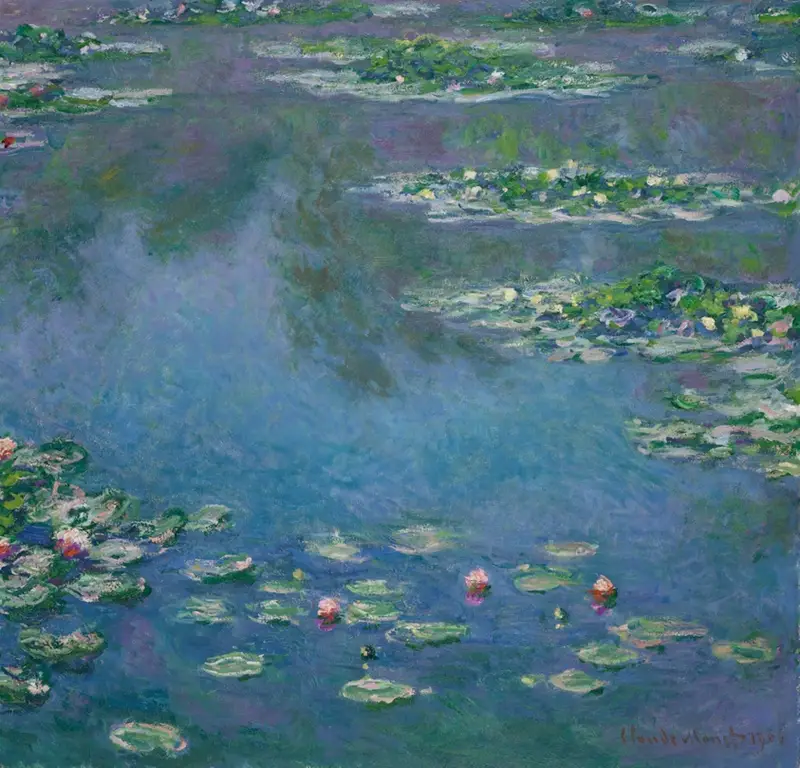
8. Water Lilies. Claude Monet (1906)
Gallery 243, European Art
The Art Institute owns one of the largest Monet collections in the world: 33 paintings and 13 drawings, the largest grouping outside Paris. Water Lilies is the centerpiece. It is one of approximately 250 water lily paintings Monet produced over the last three decades of his life, all of them depicting the pond he built at his property in Giverny.
The story of how Monet came to paint these is part horticulture and part obsession. He bought the Giverny property in 1890. Three years later he started building a Japanese-style water garden, rerouting a small river to feed the pond and importing exotic water lily hybrids from a French nursery called Latour-Marliac. Until then, the standard water lily in France had been white. The Latour-Marliac nursery had bred new varieties in pinks, yellows, and deep reds. Monet was one of the first major patrons. The flowers in his pond, and the flowers in this painting, were essentially a new species developed during his lifetime.
The Chicago Water Lilies dates to 1906, in the middle of Monet’s water lily project. It is nearly square, which marks a deliberate shift from his earlier landscapes. There is no horizon line. No sky. No bank. The painting is just water, lily pads, and the reflections of trees and clouds on the surface. This was radical at the time. Monet was painting reflections rather than objects. The image is simultaneously a flat decorative pattern and an infinite illusion of depth.
A small detail almost everyone misses: Monet originally planned a denser grouping of lilies in the foreground. Conservation analysis has found evidence that he painted some lilies in and then painted them back out, opening up the watery space to achieve the right balance.
Local tip: The Art Institute has multiple Monets clustered in Gallery 243, including landscapes and other water scenes. Spend at least 15 minutes in this gallery. Monet’s paintings reward slow looking. Standing still in front of one for two minutes is worth more than rushing past five.
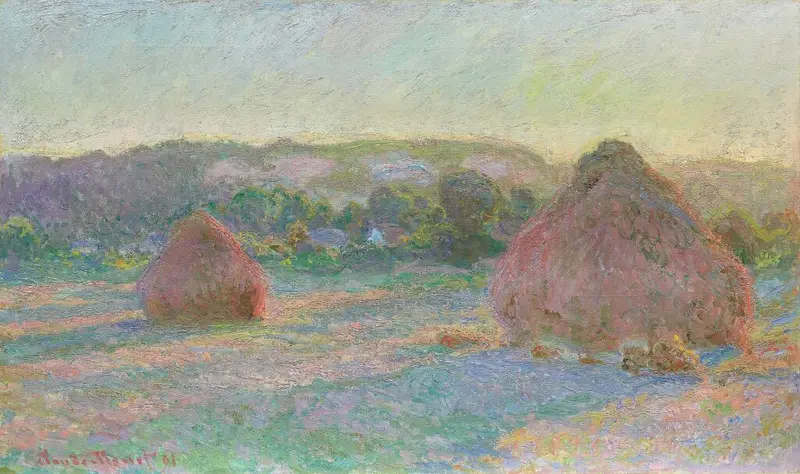
9. Stacks of Wheat. Claude Monet (1890–91)
Gallery 243, European Art
Six of them. The Art Institute holds six paintings from Monet’s Stacks of Wheat series, the largest grouping anywhere in the world. The series itself consists of 25 canvases Monet painted between late September 1890 and the spring of 1891, all depicting the same wheat stacks in a field near his Giverny home.
The point of the series was not the stacks. It was the light. Monet painted them at every hour of the day, in every season, in every weather condition. He worked outdoors at multiple easels at once, switching between canvases as the light changed. Then he reworked the paintings in his studio. A single stack appears in dawn, in noon, at sunset, in snow, in fog, in summer, in winter. The paintings are essentially scientific documents of how light transforms a single subject across time.
When Monet exhibited 15 of them at the Durand-Ruel gallery in Paris in May 1891, hanging them all in a single room, the critical reaction was extraordinary. Most of them sold within a month. American collectors went especially crazy for them. The Chicago socialite Bertha Honoré Palmer alone bought nine. The series transformed Monet from a respected Impressionist into the most famous painter alive. It also influenced Wassily Kandinsky. When the Russian painter saw one of these stacks paintings on display, he later wrote that he could not even tell what the subject was. The stack had dissolved into pure colour and atmosphere. That experience pushed him toward inventing abstract painting.
A small detail almost everyone misses: each of the six stacks at the Art Institute has its own subtitle: End of Summer, End of Day, Autumn, Sunset, Snow Effect, Snow Effect, Overcast Day, Thaw, Sunset. Read the labels. The variations are extraordinary.
Local tip: Stand in the centre of Gallery 243 and look at all six stacks together as a sequence. This is exactly how Monet wanted them seen, and how he originally exhibited them in Paris in 1891. You are getting the same experience the 19th century viewers got.
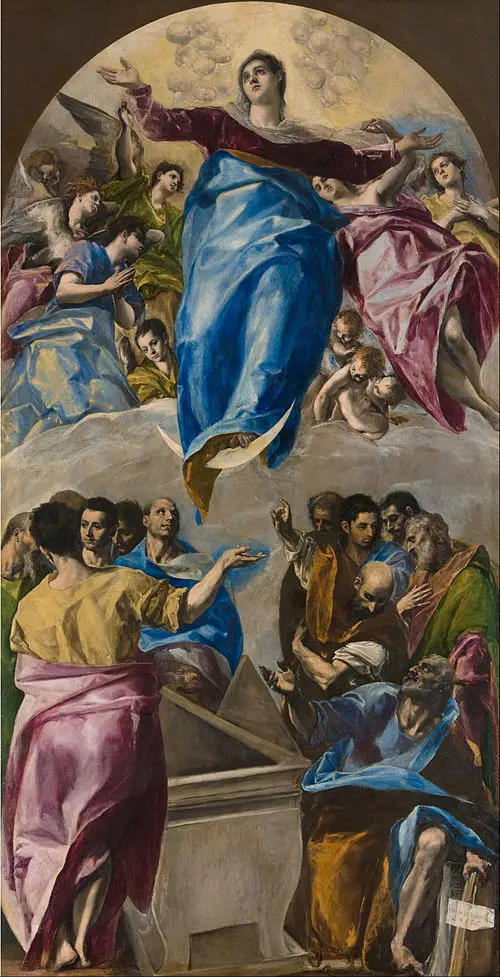
10. The Assumption of the Virgin. El Greco (1577–79)
Gallery 211, European Art
The single most important pre-Impressionist painting in the museum’s European collection. Thirteen feet tall. The first major commission of El Greco’s career, painted just after he arrived in Toledo, Spain. And the painting that essentially launched the Spanish phase of one of the most influential artists in Western history.
In 1577, El Greco was a 35-year-old Greek painter who had failed in Italy. He had trained in Crete, moved to Venice to study under Titian and Tintoretto, then to Rome where he had failed to win papal patronage. He arrived in Toledo desperate. Within months he had landed the commission for the high altarpiece at the church of Santo Domingo el Antiguo, a Cistercian convent. The Assumption of the Virgin was the central painting of that altarpiece. He had never worked at this scale before. He painted the Virgin rising into heaven on a half moon, surrounded by angels in the upper half of the canvas, while the twelve apostles stand around her empty sarcophagus below. He signed it in Greek at the lower right, proudly: Domenikos Theotokopoulos, Cretan, displayed this 1577.
The painting stayed in the church for more than 250 years. In 1830 it was sold to a young Spanish nobleman named Sebastián Gabriel de Borbón, a distant descendant of Spanish and Portuguese royalty. His insignia, the crowned letters S and G, is still stamped on the back of the canvas. The painting passed through his estate, his heirs sold it, and by 1905 it was in Paris. Mary Cassatt, the American painter who lived in Paris and exhibited with the Impressionists, saw it and recognised what it was. She personally lobbied the Art Institute of Chicago to acquire it. The trustees were initially split. They had never bought a work this expensive. In July 1906 they took out a loan to cover the cost and bought the painting for 200,000 francs. It was the first El Greco to enter any American museum.
A small detail almost everyone misses: look at the apostles’ faces in the lower half. Each one has a different emotional expression. El Greco compressed an entire range of human reaction (awe, doubt, fear, rapture) into the bottom of the canvas. The painting is essentially two paintings stacked: the celestial scene above, the human drama below.
Local tip: This is the painting in the museum that benefits most from standing close. The figures appear flat from a distance. Within six feet of the canvas, the brushwork dissolves into something almost expressionist, four centuries before Expressionism existed.
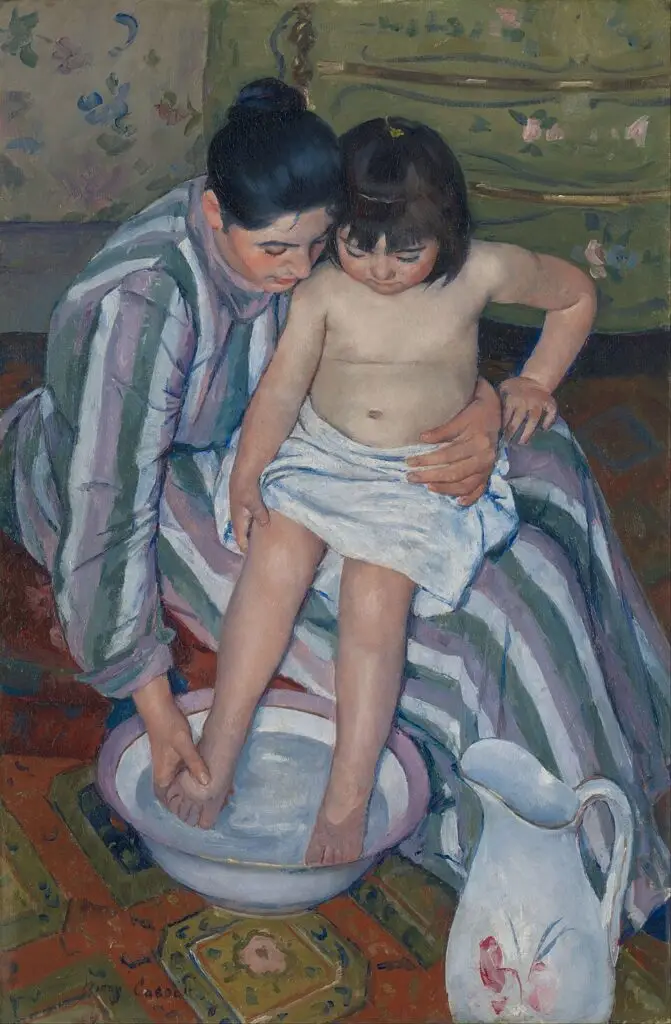
11. The Child’s Bath. Mary Cassatt (1893)
Gallery 273, American Art
The same Mary Cassatt who tracked down The Assumption of the Virgin and brought it to Chicago. The Child’s Bath is her own most celebrated painting. A woman and a young child seated together, the child’s bare feet in a porcelain basin, the mother gently washing them. The composition is one of the most quietly intimate scenes in 19th century art.
Cassatt was the only American artist invited to exhibit with the French Impressionists. She moved to Paris in 1874 and spent her career there, exhibiting alongside Degas, Monet, and Renoir. The Child’s Bath is from 1893, the year she also painted the Modern Woman mural for the Woman’s Building at the World’s Columbian Exposition in Chicago. She was at the height of her powers. The composition is overhead, the figures are cropped at the edges, the patterns of the woman’s striped dress run vertically against the horizontal lines of the floor and dresser. All of these devices were borrowed from Japanese woodblock prints, which Cassatt had encountered at a major exhibition in Paris in 1890.
There is something quietly revolutionary about this painting. Mother-and-daughter scenes were rare in Western art. The Madonna and Child was everywhere. Mothers and sons appeared often. But intimate, ordinary moments between a mother and her young daughter were almost never depicted, and almost never by a woman painter exhibiting at this level. Cassatt rejected the idea that painting motherhood was sentimental or trivial. The Art Institute bought The Child’s Bath in 1910. Cassatt was still alive. It is now considered one of the most important American paintings ever made by a woman.
A small detail almost everyone misses: the mother’s hand and the child’s hand mirror each other almost perfectly. As the mother’s left arm encircles the child’s right side, the child’s left arm matches her gesture. The bodies echo across generations. Cassatt arranged the limbs deliberately to create that visual rhyme.
Local tip: Cassatt never married and never had children. She spent her life painting other women’s children and other women’s lives. Knowing that changes how you read the tenderness in this painting.
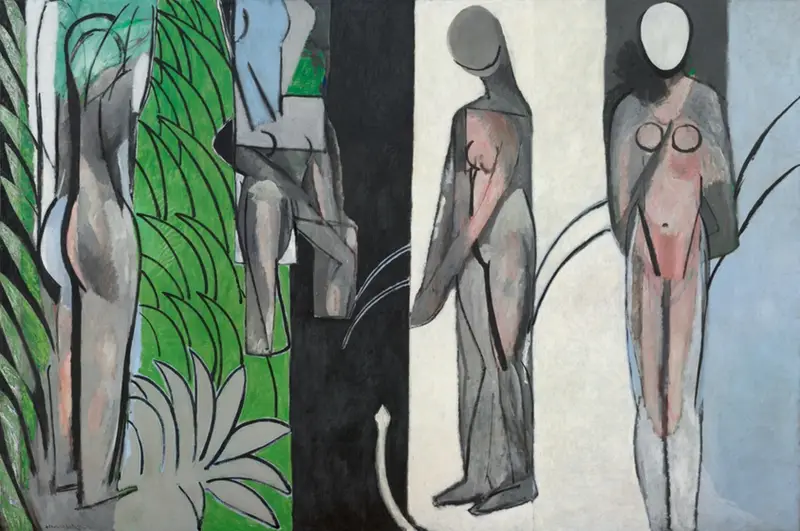
12. Bathers by a River. Henri Matisse (1909–17)
Gallery 391, Modern Wing
Matisse called this one of the five most “pivotal” works of his entire career. He worked on it for eight years, on and off. He started it in 1909 as part of a commission from the Russian collector Sergei Shchukin, who wanted three large pastoral paintings for the staircase of his Moscow mansion. Shchukin took two of them, Dance II and Music, both now at the Hermitage. He rejected the third. Matisse abandoned it.
Four years later, in 1913, he came back to the canvas. The world had changed. Cubism had exploded across Paris. Then came the First World War. Matisse worked on this painting through the worst of it, locked in his studio in Issy-les-Moulineaux outside Paris, listening to bombs in the distance. He repainted it again and again. The original idyllic pastoral scene was steadily replaced by something austere and frightening. He simplified the four bathers into columnar grey figures with faceless ovoid heads. He turned the once-blue river into a stark vertical band of black. He divided the background into four hard-edged vertical strips of green, black, white, and pale grey. By the time he finished it in 1917, the painting had become one of the most extreme works he ever made.
In 2010, Art Institute conservators undertook a major cleaning of the painting, and the discovery was extraordinary. Beneath the surface, layers of earlier compositions were preserved like geological strata. X-rays and infrared imaging revealed the entire eight-year history of the painting in a single image. You can see, in those scans, the original 1909 watercolour idea, the 1913 Cubist intervention, and the final stark wartime version, all stacked on top of each other.
A small detail almost everyone misses: the painting is over eight feet tall and twelve feet wide. Matisse worked on it standing on a ladder, climbing up and down, reworking sections from different angles. It dominates the room.
Local tip: Look at the small painting hanging next to it. Several of Matisse’s other works at the Art Institute, including Daisies, Apples, and Woman before an Aquarium, were also acquired by the museum and have similarly extraordinary stories. The Modern Wing has an entire Matisse cluster.
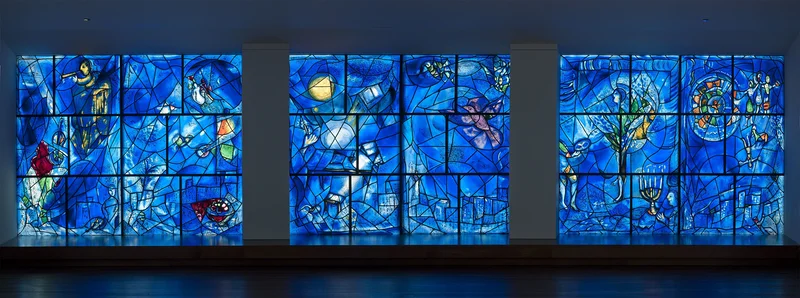
13. America Windows. Marc Chagall (1977)
Gallery 144, European Art
Three monumental panels of stained glass, each more than eight feet tall, together stretching over thirty feet across. Deep cobalt blue is the dominant colour. Floating through the glass are musicians, dancers, painters, the Statue of Liberty, the Chicago skyline, and a menagerie of figures from American and Jewish history. Marc Chagall designed these windows in 1976 and gave them to the Art Institute as a gift in 1977 to celebrate the American Bicentennial.
Chagall fell in love with Chicago in 1974, when he came to install his mosaic The Four Seasons at the Chase Tower Plaza, just blocks from the Art Institute. He learned during that visit that the museum was planning a gallery in his honour. He offered to create stained glass windows for the new space. He spent the next two years designing them. When Mayor Richard J. Daley died unexpectedly in December 1976, Chagall decided the windows would also be a memorial to Daley, a longtime advocate of public art. The windows were unveiled on May 15, 1977, what would have been Daley’s 75th birthday.
The fabrication is extraordinary. Chagall worked with the French stained glass master Charles Marq, who built 36 colour glass panels to Chagall’s specifications. Chagall then hand-painted his designs onto each panel using metallic oxide paints, which were permanently fused to the glass through firing. The panels were assembled and shipped to Chicago.
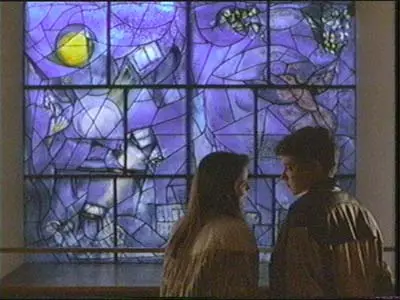
In Ferris Bueller’s Day Off, Ferris and Sloane share a kiss in front of the America Windows. The scene is set in their original location, on the east side of the museum overlooking McKinlock Court. The windows were removed in 2005 to protect them from vibration during construction of the Modern Wing, then deep-cleaned with cotton swabs and water for five years. They were reinstalled in their current location, Gallery 144, in November 2010.
A small detail almost everyone misses: in the third panel from the right, look for a small image of the Chicago skyline. It is one of the few literal references to the city in the entire composition.
Local tip: This is the gallery to visit if you want a quiet moment in the museum. The room is dim. The windows are lit from behind. The blue saturates everything. People talk in whispers, even when nothing is asked of them.
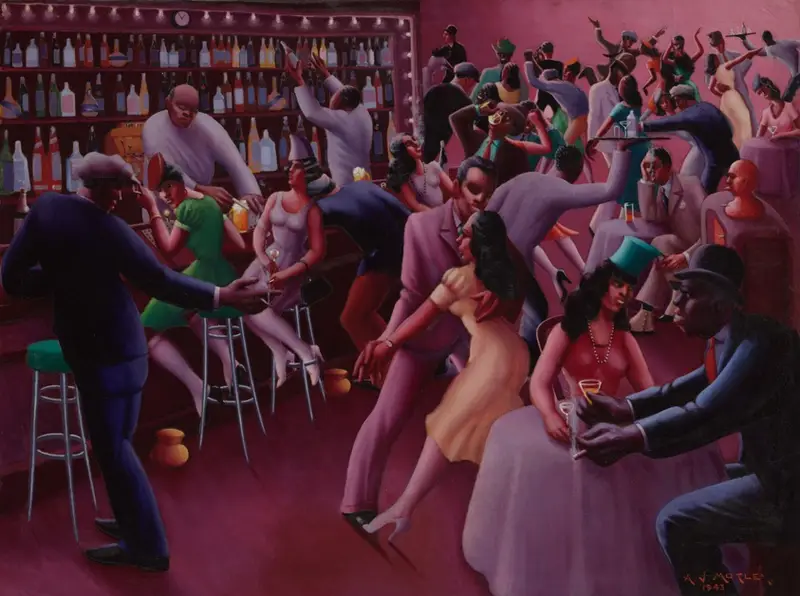
14. Nightlife. Archibald Motley (1943)
Gallery 263, American Art
Painted in 1943, just one year after Nighthawks, hanging in the same gallery, depicting almost the exact same subject from the exact opposite perspective. Where Hopper saw urban loneliness, Archibald Motley saw urban energy. Nightlife is set in a Bronzeville jazz club on the South Side of Chicago, packed with Black Chicagoans dancing, drinking, smoking, talking. Vivid red dominates the room. Bodies twist with motion. The clock on the back wall reads 1 a.m. The whole painting feels like sound.
Motley was born in New Orleans in 1891 and raised in Chicago. He was one of the first major Black American artists to gain critical recognition during the Harlem Renaissance, even though he never lived in Harlem. He painted Bronzeville, the South Side neighbourhood where the Great Migration brought hundreds of thousands of Black Americans from the rural South. By the 1940s, Bronzeville had its own jazz clubs, its own theatres, its own newspapers, its own world. Motley painted that world from inside it.
He explicitly conceived Nightlife as a response to Nighthawks. He saw Hopper’s painting at the Art Institute when it went on view in 1942, and the loneliness of those white figures struck him as a fundamentally white experience. The Bronzeville jazz scene he knew was the opposite. Communal. Loud. Crowded. Joyful. He set out to paint the antithesis. The Art Institute hangs the two paintings near each other now. Side by side, they tell the story of two simultaneous Americas in the same year.
A small detail almost everyone misses: the colours in Nightlife are not naturalistic. The red glow is not the actual light of the club. Motley saturated everything in red to convey the feeling of the music, the heat of the bodies, the energy of the room. It is closer to a Fauvist painting than a realist one.
Local tip: See Nighthawks and Nightlife in the same five minutes. Walk back and forth between them. Painted one year apart, in the same city’s collection, depicting the same hour of the same night. They are two of the most important conversations in 20th century American art, and they happen in this single room.
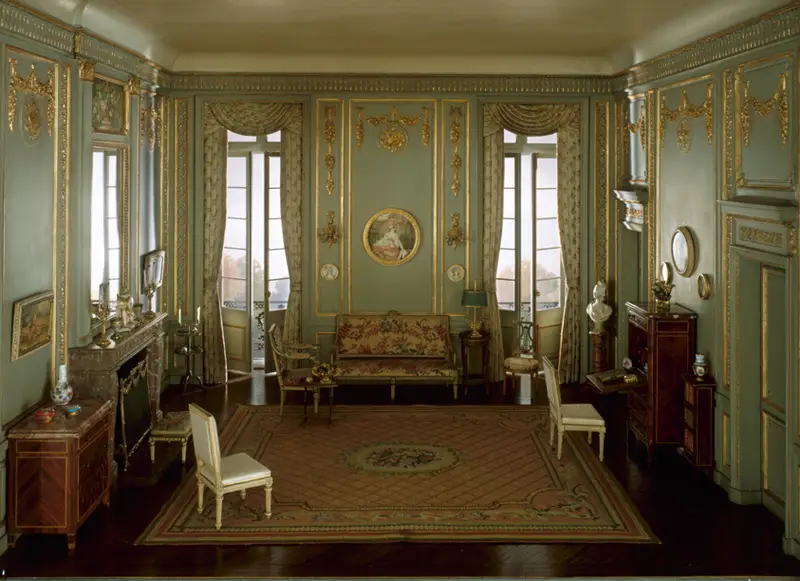
15. The Thorne Miniature Rooms. Narcissa Niblack Thorne (1932–40)
Gallery 11, lower level
Sixty-eight tiny rooms. Each one a 1:12 scale model of a historical interior, ranging from a 13th century English Gothic church to a 1930s California hallway. Real silver tea services. Hand-stitched rugs. Working chandeliers wired with miniature bulbs. Tiny eyeglasses on miniature side tables. The detail is genuinely difficult to comprehend without standing in front of one. This is the most loved exhibit at the Art Institute that nobody outside Chicago has heard of.
Narcissa Niblack Thorne was a wealthy Chicago socialite who had married into the Montgomery Ward department store fortune. As a child she had collected miniatures. As an adult she had travelled extensively through Europe, photographing and sketching historic interiors. In the early 1930s, with the Great Depression putting countless skilled craftsmen out of work, she hired the best of them to construct her dream collection. Architects, cabinetmakers, silversmiths, weavers, painters. They worked at her studio on Oak Street on the Near North Side between 1932 and 1940. The 31 European rooms were finished by 1937. The 37 American rooms were completed by 1940. Thorne supervised every detail.
The rooms are not just dollhouses. They are miniaturised history. Many recreate specific historic interiors: rooms from real houses Thorne had visited, museum installations, palace galleries. Some include tiny original artworks by real artists, including miniature paintings by Fernand Léger and sculptures by John Storrs. When you look into a Thorne Room you are not looking at a model. You are looking at a complete world reduced to one twelfth its size.
A small detail almost everyone misses: many of the rooms have working light sources behind their windows. The lighting changes throughout the day, simulating dawn or dusk in the miniature scene, depending on which room you are looking at. The illusion is uncanny.
Local tip: The Thorne Rooms are in the lower level of the Michigan Avenue building, down a marble staircase from the main hall. Most visitors miss them entirely. Allow at least 30 minutes to walk through all 68. Bring kids. They will lose their minds.
Practical Tips For Visiting
The museum is open Monday, Wednesday, Thursday, Friday, Saturday, and Sunday. Closed Tuesdays. Thursday evenings until 8 p.m. are the quietest time to visit. After 5 p.m. on a Thursday you can stand directly in front of Nighthawks with no crowd at all.
Illinois residents get free admission on select days throughout the year. Check the museum website before you go. If you’re not an Illinois resident, skip-the-line tickets are worth it on weekends and during summer when the main entrance line can stretch around the block. The Chicago CityPASS includes the Art Institute along with four other major attractions and can pay for itself if you are doing a full tourist weekend.
Allow at least three hours. Most people underestimate this. The museum is enormous. If you are short on time, focus on the second floor of the original Michigan Avenue building, which has nearly all the most famous Impressionist and Post-Impressionist works including La Grande Jatte, Paris Street; Rainy Day, Water Lilies, the Stacks of Wheat, The Bedroom, and At the Moulin Rouge. American Gothic and Nighthawks are also on the second floor in the American galleries. The Modern Wing across the bridge holds The Old Guitarist, Bathers by a River, and most of the 20th century work.
Photography is allowed throughout most of the galleries. No flash. Tripods only with a permit. Backpacks must be checked at the cloakroom, which is free.
If you are combining the Art Institute with the rest of Chicago, our Perfect 3 Day Chicago Itinerary covers the rest of the city. The museum sits directly across from Millennium Park and the Bean, so build a half day around the area.
Before You Go
The lions outside the Michigan Avenue entrance are bronze sculptures by Edward Kemeys, installed in 1894. They have names. The north lion is On the Prowl. The south lion is In an Attitude of Defiance. During Chicago sports playoffs, the museum dresses them in helmets for the Bears, Bulls, Cubs, and Sox. It’s been a tradition for decades.
Don’t try to see everything. The museum holds 300,000 works. You will see maybe 200 of them in a long visit. Focus on quality over coverage. Stand in front of one painting for ten minutes rather than walking past 100 of them. The works on this list reward slow looking more than they reward checking off a list.
If you are hungry afterward, the museum’s restaurant Terzo Piano on the third floor of the Modern Wing has skyline views over Millennium Park. For something cheaper, walk out to the Loop and grab lunch at one of our recommended Chicago restaurants.