

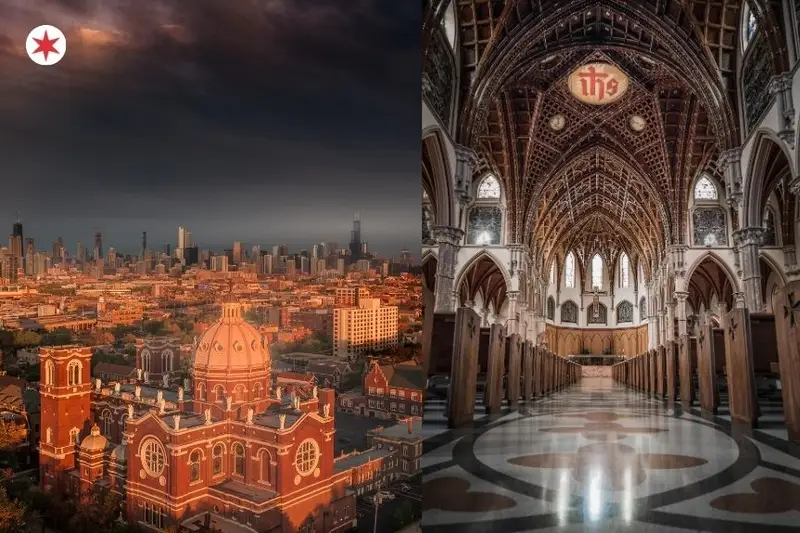
You don’t need to fly to Europe. These are all within an hour of downtown.
Chicago is one of the great architecture cities in the world, and yet the most spectacular interiors in the entire city are not its skyscrapers. They are not its lobbies. They are not its museums.
They are its churches.
After the Great Fire of 1871 levelled much of the city, Chicago rebuilt itself from scratch. The Polish, Irish, Italian, German, Ukrainian, Lithuanian, and Czech immigrants who flooded into the city in the decades that followed each anchored their communities with churches that rivalled anything in Europe. They hired the best architects. They imported marble from Italy, stained glass from Germany, and stone from across the Midwest. They built domes that wouldn’t look out of place in Rome and ceilings that took painters years to finish.
Most of those churches are still standing. Most are free to enter. And most visitors to Chicago never set foot in a single one.
Here are 15 worth seeking out.
1. Holy Name Cathedral. The Heart Of Catholic Chicago
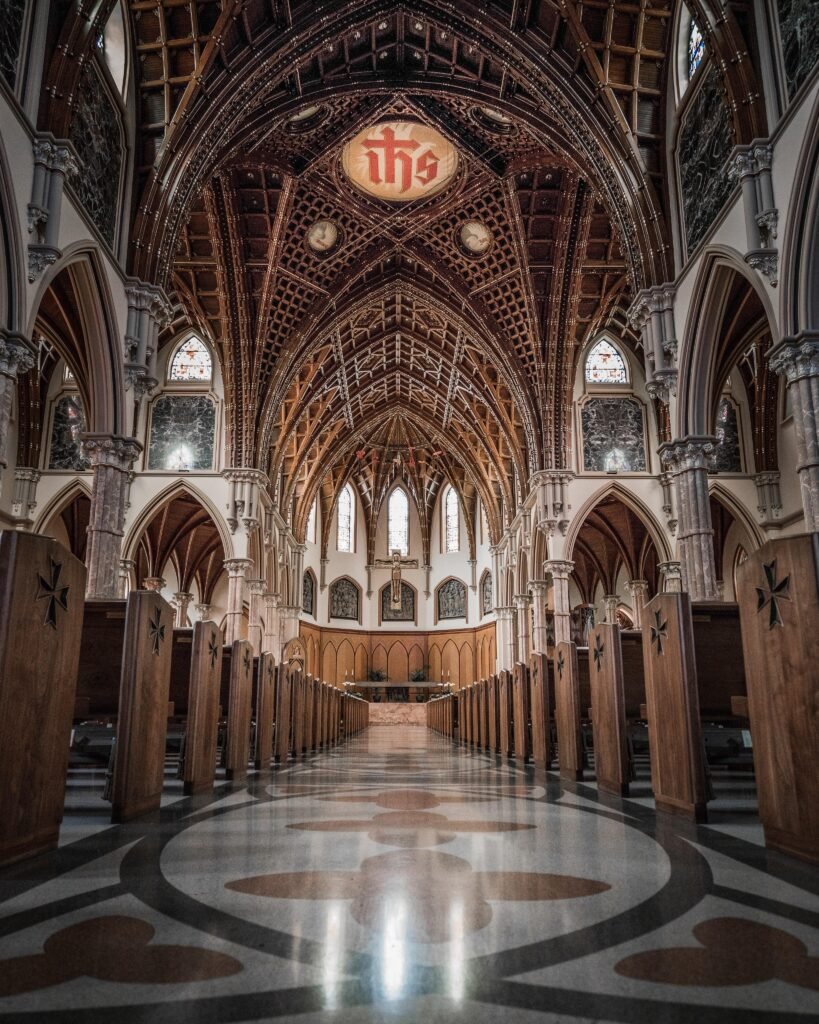
This is the seat of the Archdiocese of Chicago. The most important Catholic church in the third largest archdiocese in America. And the only major cathedral in the city with actual bullet damage in its cornerstone from a Prohibition-era mob hit.
The current building was dedicated on November 21, 1875. Architect Patrick Charles Keely designed it to replace the original Cathedral of Saint Mary, which burned to the ground in the Great Fire of 1871. The exterior is neo-Gothic with hand-carved bronze doors at the main entrance. Inside, the suspended Resurrection Crucifix sculpted by Ivo Demetz dominates the sanctuary, and five red galeros, the broad-brimmed hats of cardinals, hang from the ceiling. Tradition says they stay there until they fall apart on their own.
The story most visitors come for happened on October 11, 1926. Mob boss Hymie Weiss was walking across State Street toward the Schofield Flower Shop when assassins opened fire from a second floor window. Weiss took ten bullets and died on the spot. Several rounds struck the cathedral’s cornerstone, blasting the inscription so badly the words no longer made sense.
Local tip: That obvious round hole on the southwest corner of the cornerstone? Not a bullet hole. It was drilled to hold a placard with the church service schedule. The actual bullet damage is four faded pockmarks surrounding the dedication year, just south of the State Street entrance. You’ll walk past it if nobody tells you where to look.
📍 735 N State St, Chicago, IL 60611 (Near North Side)
2. St. Mary Of The Angels. The Dome You’ve Definitely Already Seen
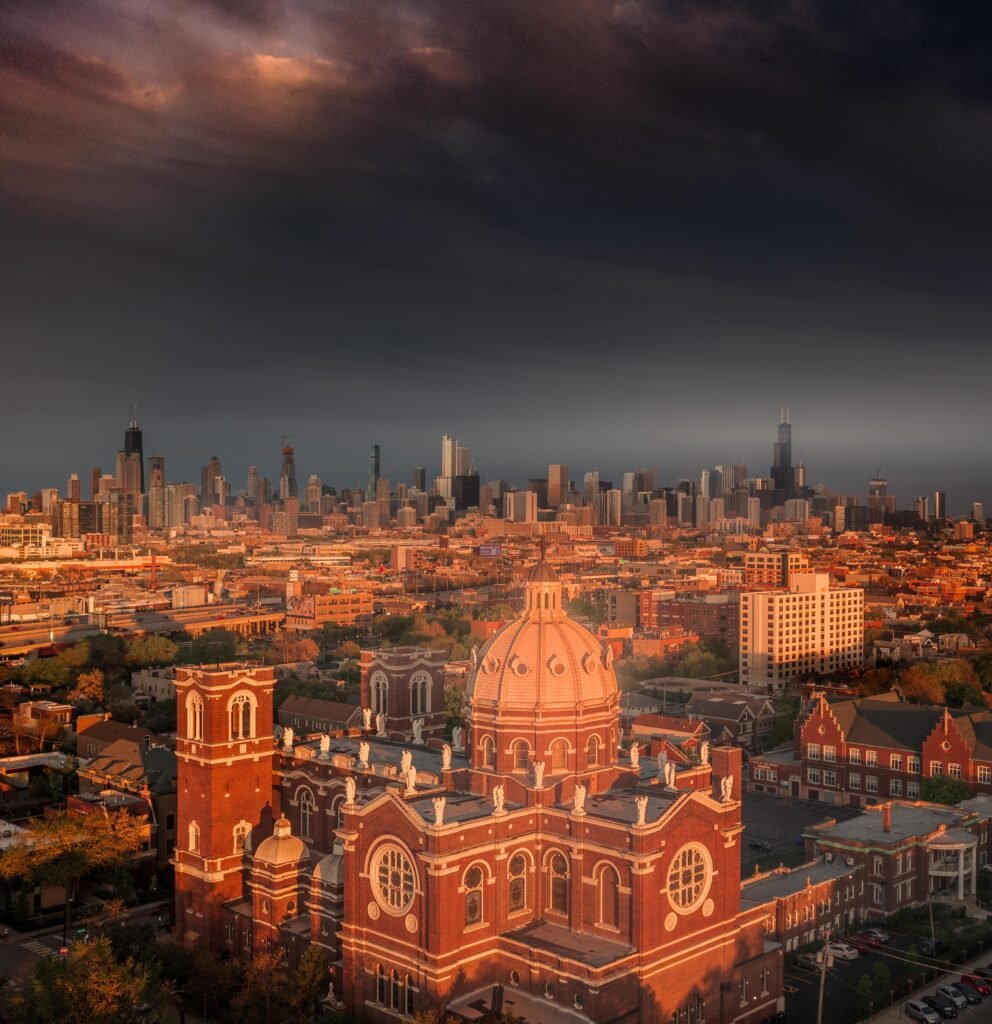
If you’ve ever driven the Kennedy Expressway, you’ve seen this church. The dome and twin bell towers of St. Mary of the Angels rise above the rooftops of Bucktown like someone airlifted them out of Rome and dropped them on the northwest side.
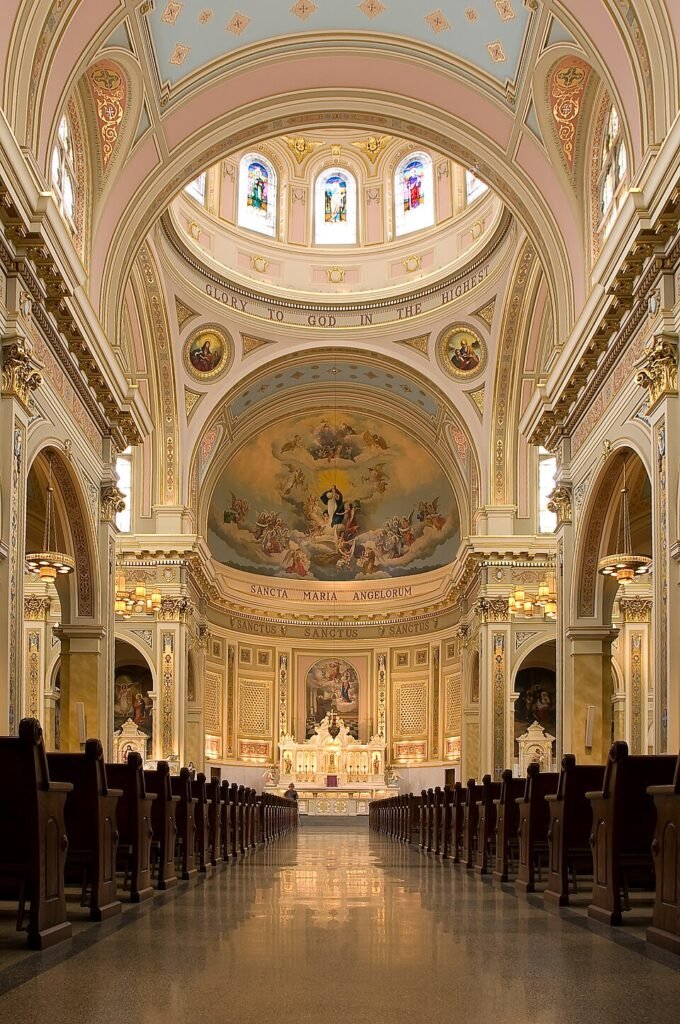
That’s pretty much what happened. Architects Henry W. Worthmann and John G. Steinbach modelled the building on St. Peter’s Basilica when construction started in 1911. The Polish immigrant community that founded the parish in 1899 wanted a church that matched the grandeur of what they’d left behind. The building was finally dedicated on May 30, 1920. It seats 2,000 people. The dome stretches 125 feet into the sky. And the interior is one of the finest examples of Roman Renaissance architecture in the entire country.
It also nearly got demolished. By 1988 the building was in such bad shape that the Archdiocese shut it and scheduled it for the wrecking ball. Parishioners fought back. The campaign delayed demolition long enough for the priests of Opus Dei to take the parish over in 1991, and they spent years restoring the dome, the roofs, the stained glass, and the interior. Twenty-six rebuilt angels still stand on the rooftop.
Local tip: Walk in slow and look up before you do anything else. The ceiling, painted in deep blue, gold, and rose, is the single most photographed church interior in Chicago for a reason. Most first-time visitors have never heard of it. That’s their loss.
📍 1850 N Hermitage Ave, Chicago, IL 60622 (Bucktown)
3. Holy Trinity Orthodox Cathedral. Yes, Louis Sullivan Designed A Church
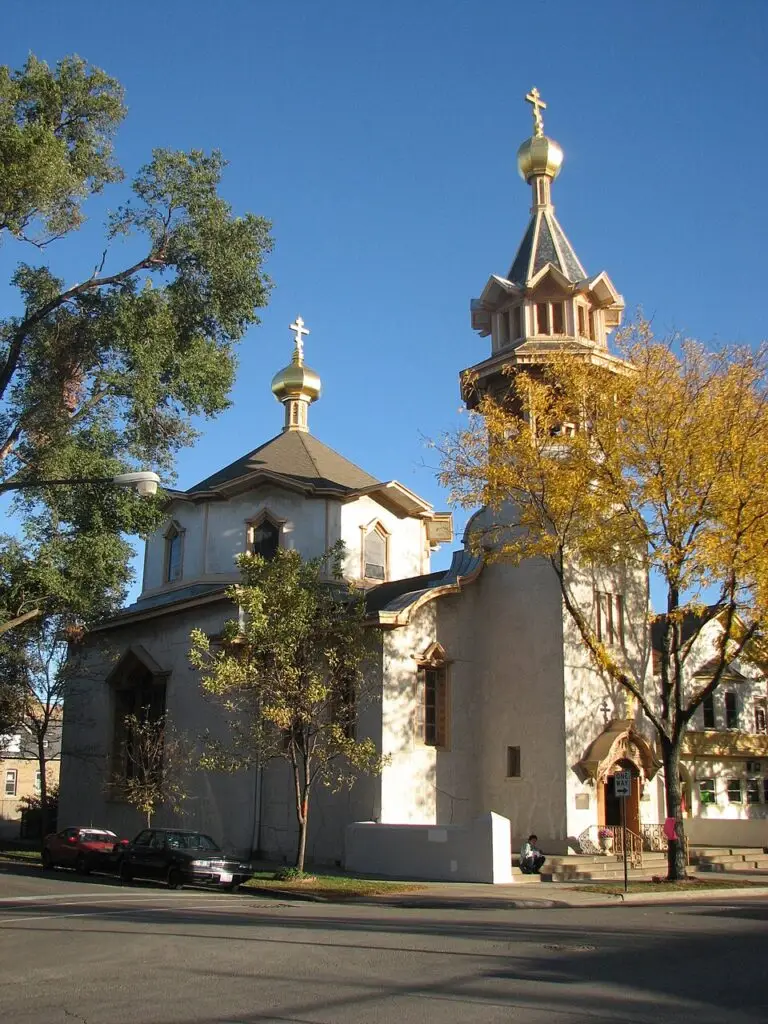
Louis Sullivan invented the modern skyscraper. Frank Lloyd Wright was his apprentice. He gave us “form follows function.” And in his entire career he designed only two religious buildings. Only one of them is still standing.
Holy Trinity sits on a quiet residential street in Ukrainian Village, and from the outside it looks like a wooden church plucked out of rural Russia. That’s deliberate. The original parishioners were Russian, Carpatho-Rusyn, and Serbian immigrants from small towns in Eastern Europe. They didn’t want a grand metropolitan cathedral. They wanted something that reminded them of home.
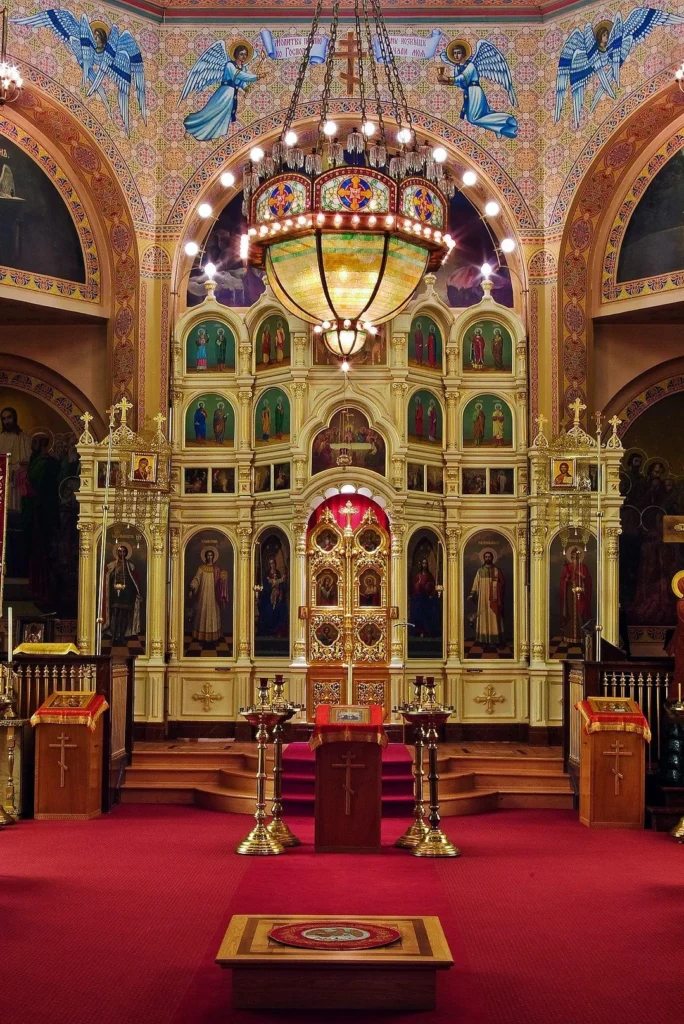
The building was completed in 1903 with funding from a surprising source. Tsar Nicholas II personally donated 4,000 rubles, roughly $2,700, to the project. Sullivan was so invested in the work that he donated half his own fee back to the church and personally designed the stained glass chandelier that still hangs in the sanctuary. It became a cathedral in 1923 and was named a Chicago Landmark in 1979.
Local tip: The cathedral runs guided tours on selected Saturdays through Eventbrite. Book one. The interior is covered in painted iconography and looks nothing like the exterior suggests. If you can’t make a tour, attend a Saturday Vespers service or a Sunday Liturgy. Both are open to visitors. The chanting alone is worth the trip.
📍 1121 N Leavitt St, Chicago, IL 60622 (Ukrainian Village)
4. Fourth Presbyterian Church. Hidden In Plain Sight On Michigan Avenue
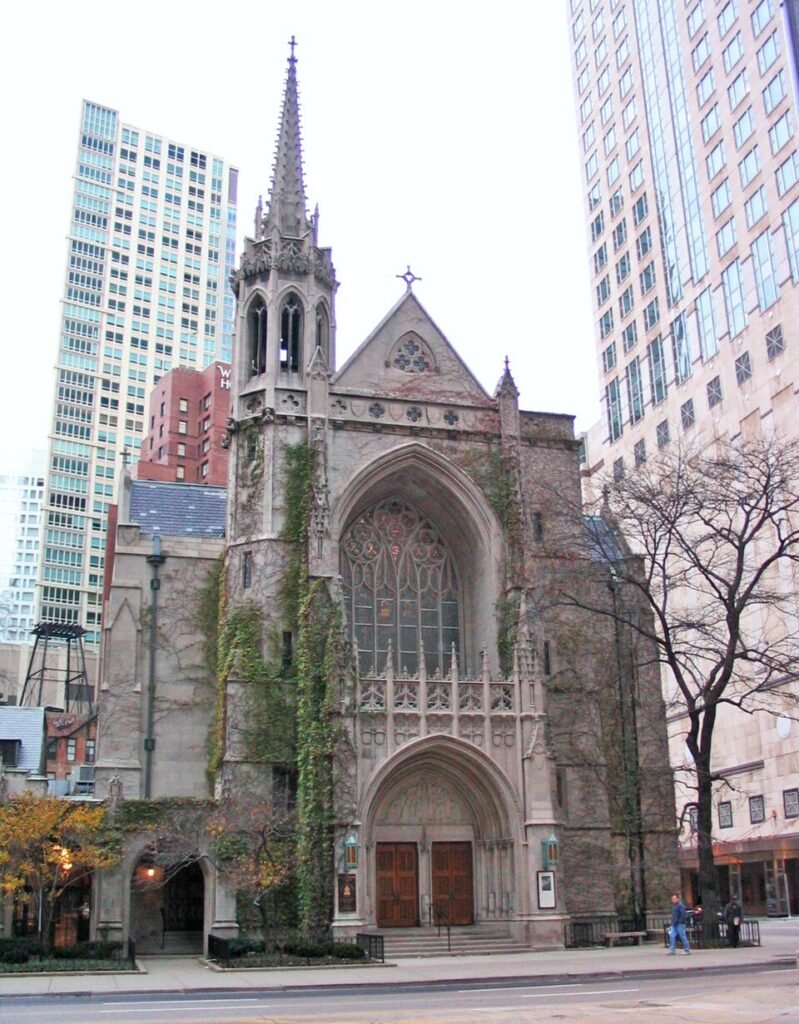
You’ve walked past this one. Everyone has. It sits directly across Michigan Avenue from the Hancock, the second oldest building on the entire Magnificent Mile after the Water Tower. And almost nobody steps inside.
That’s a mistake. The cornerstone was laid in 1912 and the sanctuary opened in May 1914. The architect was Ralph Adams Cram, the leading Gothic Revival architect in America at the time, who happened to be designing the Cathedral of St. John the Divine in New York City at the exact same moment. St. John the Divine is the largest Gothic cathedral in the world. Fourth Church is essentially its smaller Chicago cousin, blending English and French Gothic into something that feels straight out of Oxford.
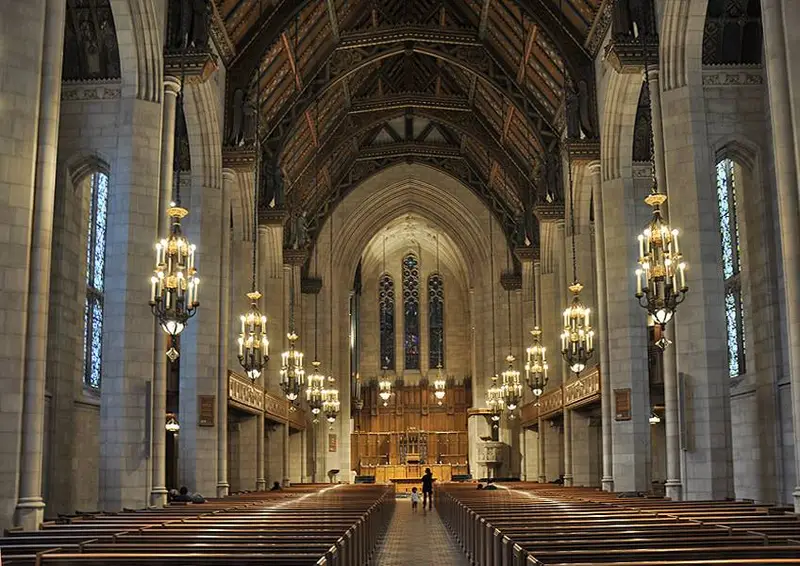
The walls are Bedford limestone from Indiana, the same stone used to build the Pentagon, Rockefeller Center, and the Empire State Building. The Tudor-style parish buildings, the cloister, and the courtyard around the corner were designed by Howard Van Doren Shaw, one of the great Midwestern architects of the era. The pipe organ inside is the largest in Chicago, with 8,343 pipes and the longest reaching 32 feet tall.
Local tip: Walk through the Michigan Avenue entrance, head down the south side of the sanctuary, and step out into the cloister courtyard. It’s free, it’s almost always empty, and it feels like a pocket of medieval England dropped between Bloomingdale’s and a Verizon store. The Children’s Fountain in the middle was a personal gift from Howard Van Doren Shaw.
📍 126 E Chestnut St, Chicago, IL 60611 (Near North Side)
5. St. Michael’s In Old Town. The Church That Actually Survived The Fir
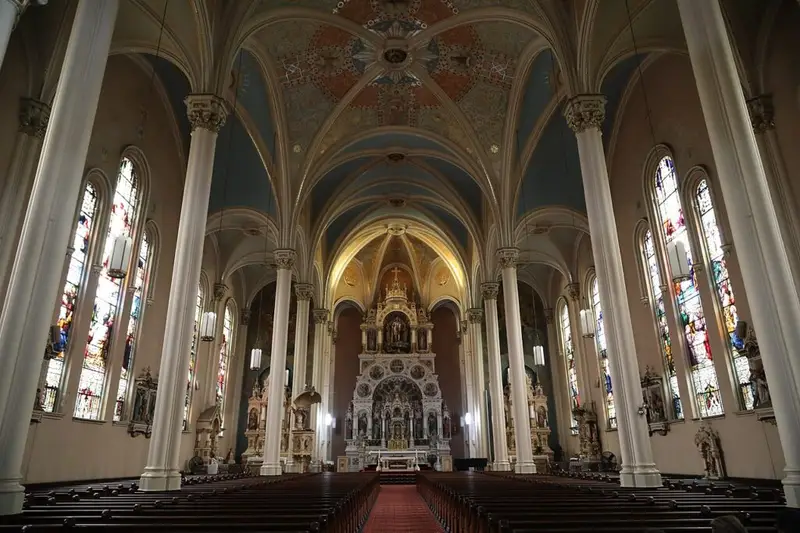
There’s a saying in Chicago. If you can hear the bells of St. Michael’s, you’re in Old Town. It’s been true since 1869, and the bells are still ringing.
The current church was completed that year, built of red sandstone brick by architect August Wallbaum to serve the German and Luxembourgish Catholic immigrants who had settled north of the river. When the steeple went up, it made St. Michael’s the tallest building in Chicago and in the entire United States, a title it held until 1885. Two years after the church was finished, the Great Fire of 1871 ripped through Old Town. The interior was gutted and the bells melted in the tower. But the brick walls held. St. Michael’s became one of only seven buildings to survive the fire’s path.
Rebuilding started within a week. Five new bells were cast and hoisted into the tower in 1876, ranging from two to six tons each. The clock face went in in 1888. The cross on top weighs over a ton. Inside, the interior is Bavarian Baroque, with five wooden altars added in 1902 to celebrate the parish’s golden jubilee. There’s also a story that an icon of Mary was found intact in the charred ruins after the fire and was taken as a sign to rebuild. It still hangs above one of the side altars today.
Local tip: Take the Brown Line to Sedgwick and walk two blocks west to Cleveland, then one block north. The exterior is Romanesque and looks unassuming from the street. The inside is the surprise. Stop in on a weekday morning when the church is open for private prayer between 7:30am and 7pm.
📍 1633 N Cleveland Ave, Chicago, IL 60614 (Old Town)
6. St. Hyacinth Basilica. The Heart Of Polish Chicago
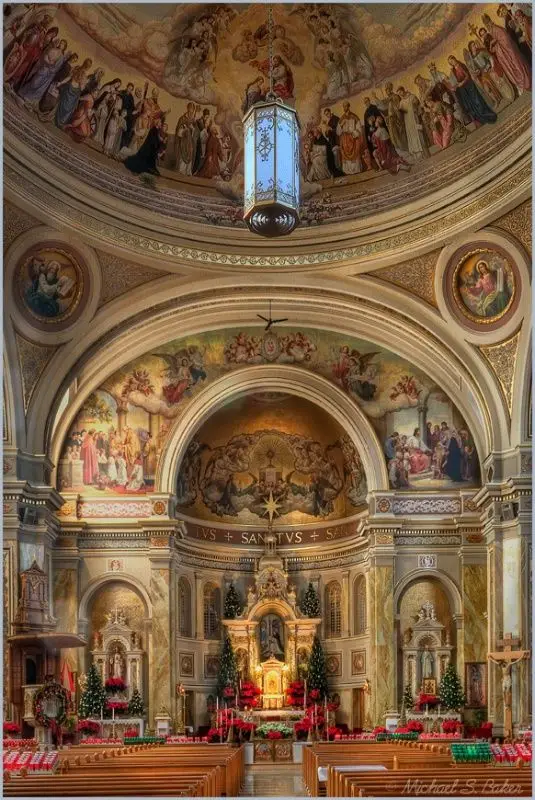
If you want to understand how deep Chicago’s Polish roots run, come here. The neighbourhood around St. Hyacinth has its own name, “Jackowo,” which is Polish for “Hyacinth’s place.” Buses on the Milwaukee Avenue route still announce “Jackowo” instead of the cross street, and most of the passengers get off at this stop on Sundays.
The parish was founded in 1894 by 40 Polish families who outgrew St. Stanislaus Kostka, the city’s first Polish parish. Construction of the current building started in 1917 and dragged on through funding and material shortages until the first Mass was held on August 7, 1921. The architects were Worthmann and Steinbach, the same firm that built St. Mary of the Angels. They designed it in classical revival style with a red brick exterior and an interior dripping with Baroque detail. Three towers rise above the rooftops of Avondale, the kind of three-towered facade you almost never see in American church architecture.
The dome over the crossing has a 3,000 square foot mural with over 150 figures painted across it. The stained glass came from Mayer of Munich and Zettler of New York. The church holds 121 relics of Roman Catholic saints, displayed on All Saints Day and on each saint’s feast day. Pope John Paul II elevated the church to a minor basilica in 2003, the third in the entire state of Illinois.
Local tip: Go on a Sunday and stay for the Polish Mass. Even if you don’t speak a word of Polish, the experience is unforgettable. Then walk Milwaukee Avenue afterward for pierogi at one of the surrounding Polish bakeries. Stop at the Garden of Memory next to the church, with monuments to Pope John Paul II and Father Jerzy Popiełuszko.
📍 3636 W Wolfram St, Chicago, IL 60618 (Avondale)
7. St. Adalbert. The Twin Towers Of Pilsen
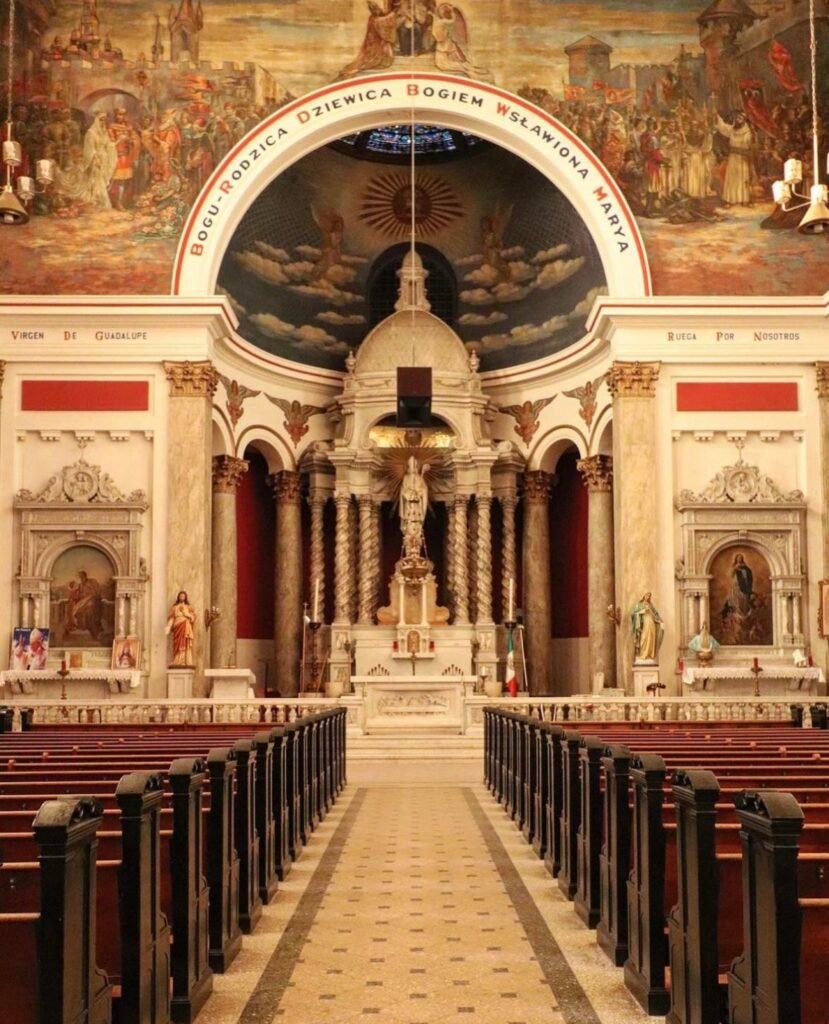
If you’ve ever stood in Pilsen and looked up, you’ve seen the towers. Two 185-foot Baroque bell towers rising 19 stories over the surrounding neighbourhood. They’re the tallest things in Pilsen, and they have been since 1914.
The church was built between 1912 and 1914 by Polish immigrants who had outgrown their original parish. The architect was Henry J. Schlacks, who trained at MIT and apprenticed under Adler and Sullivan before going on to found the school of architecture at Notre Dame. He designed it in Renaissance Revival style with cream-coloured brick, granite columns at the entrance, and one of the most spectacular interiors in Catholic Chicago. Over 30 tons of Carrara marble. A Tiffany half dome above the altar. Stained glass shipped in from Germany.
The story of St. Adalbert now is a story of survival. The Archdiocese closed the church in 2019 due to declining attendance and millions in needed repairs. It was nearly demolished. The community fought back. In 2023, the Commission on Chicago Landmarks granted preliminary landmark status to the entire campus, protecting the buildings from the wrecking ball. The building has since been sold to a developer who has committed to restoring it for public access, with plans to convert the towers into observation decks.
Local tip: As of 2026, the church is still closed for regular access while restoration plans move forward. But you can still see the exterior, which is genuinely stunning, and walk the surrounding Pilsen neighbourhood. Combine it with a visit to the National Museum of Mexican Art, which is free and a 10-minute walk away. Check our Pilsen guide for what else to do in the area.
📍 1650 W 17th St, Chicago, IL 60608 (Pilsen)
8. Old St. Patrick’s. The Oldest Public Building In Chicago
This is older than the Civil War. Older than the Great Fire. Older than basically every other building in Chicago that’s still standing today. Old St. Pat’s was dedicated on Christmas Day, 1856, and it has been holding services in the same location ever since.
The church was founded on Easter Sunday, April 12, 1846, as the first English-speaking Catholic parish in Chicago. The cornerstone of the current building was laid on May 23, 1853, and architects Augustus Bauer and Asher Carter designed it in Romanesque style using yellow Cream City brick from Milwaukee. When the Great Fire ripped through Chicago in October 1871, it missed Old St. Pat’s by two blocks. That stroke of luck is the only reason it’s still here. The two distinctive octagonal spires, one taller than the other, were added in 1885.
The real reason to come is what’s inside. From 1912 to 1922, Chicago artist Thomas O’Shaughnessy designed and personally installed 15 stained glass windows in Celtic Revival style, inspired by the Book of Kells he’d studied in Ireland. The interior was decorated entirely in ancient Celtic art, the first time a Catholic church in America had been done that way. The patterns wrap around the columns, the arches, the ceiling. Nothing else in Chicago looks like it.
Local tip: Old St. Pat’s hosts the “World’s Largest Block Party” every July, which has been running for over 30 years. If you’re not in town for that, just go on a weekday morning when the church is open and quiet. The light through the stained glass at midday is when the Celtic patterns really come alive.
📍 700 W Adams St, Chicago, IL 60661 (West Loop)
9. Quinn Chapel A.M.E. The Oldest Black Congregation In Chicago
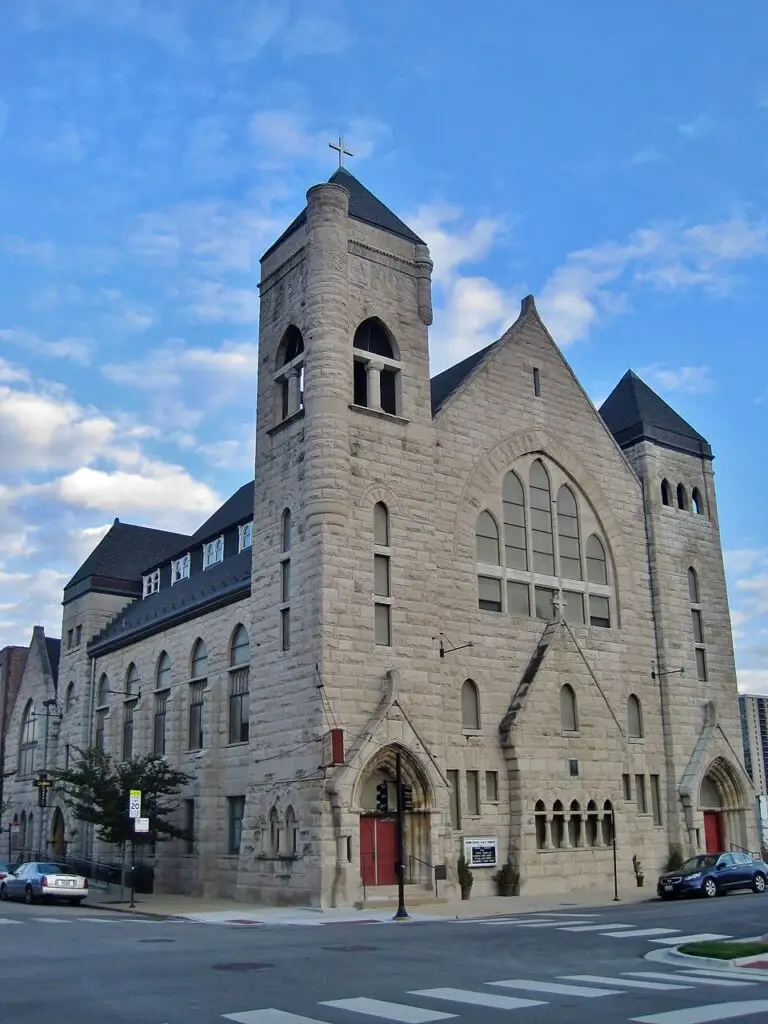
This is sacred ground in Chicago history. Quinn Chapel houses the oldest Black congregation in the city, founded in 1844 when seven members of a prayer group started meeting in a private home near what is now the Chicago Theatre. By 1847 they had organised as a congregation of the African Methodist Episcopal Church, the first independent Black denomination in the United States.
The original Quinn Chapel building was destroyed in the Great Fire of 1871. The congregation met in temporary locations for nearly two decades while raising money to rebuild. Buying land was difficult for Black people in 19th century Chicago, so Reverend Jon T. Jenifer, who had a fair complexion, passed for white to purchase the land at 24th and Wabash and then deeded it to the church. It is still the longest continually held piece of property by African Americans in the entire city of Chicago. Architect Henry F. Starbuck designed the current building in Victorian Gothic style. Ground broke in 1891 and the church was completed in 1893.
Before that, Quinn Chapel was a station on the Underground Railroad. The Daughters of Zion, a group of women from the congregation, smuggled freedom seekers through the church on their way to Detroit and Canada. Frederick Douglass spoke from this pulpit. So did Martin Luther King Jr., his father Martin Luther King Sr., Booker T. Washington, and Presidents William McKinley and William Howard Taft. The original stained glass, wood fixtures, and pews are still in place. The massive organ was purchased from the German pavilion at the 1893 World’s Columbian Exposition.
Local tip: Quinn Chapel is currently undergoing a major restoration funded by $5 million in state grants. The congregation is still active and Sunday services are open to visitors. Even if you can’t go inside during construction, just standing on the corner of 24th and Wabash and knowing what happened on this piece of land is worth the trip.
📍 2401 S Wabash Ave, Chicago, IL 60616 (South Loop)
10. St. Stanislaus Kostka. The Church That Moved An Expressway
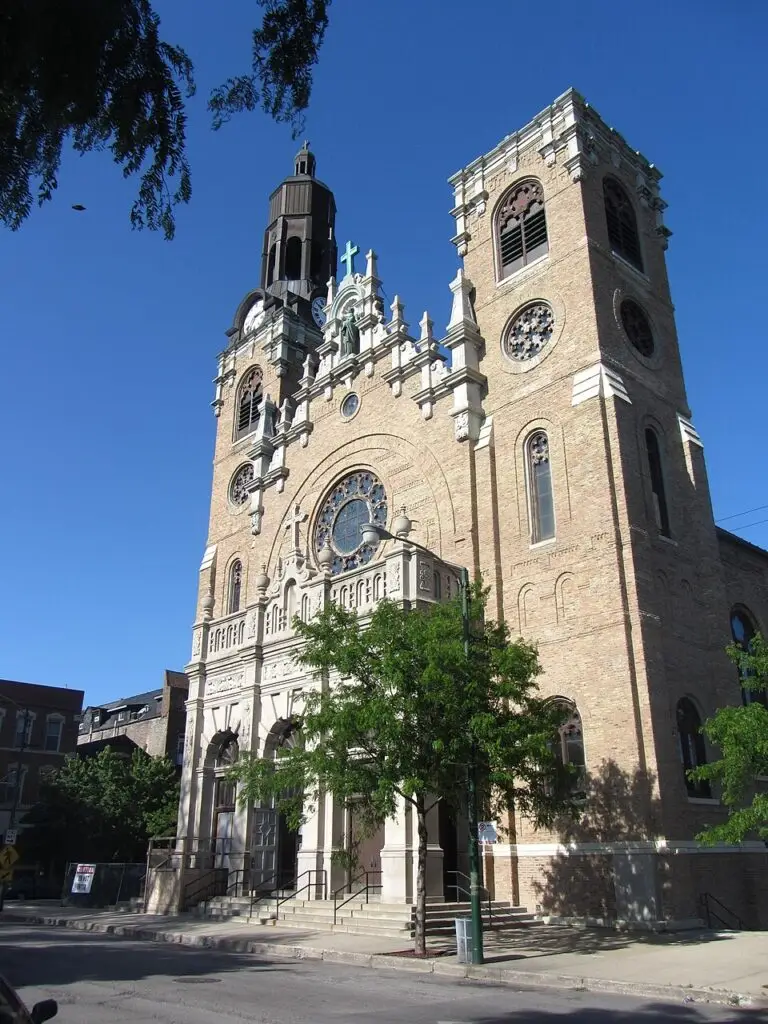
This is the mother of all Polish churches in Chicago. Founded in 1867, it was the first Polish parish in the city, and at the end of the 19th century it was the largest Catholic parish in the entire United States. By 1897 the church had 8,000 families and 40,000 individual parishioners. They held 12 Masses every Sunday, six in the upper church and six in the lower church.
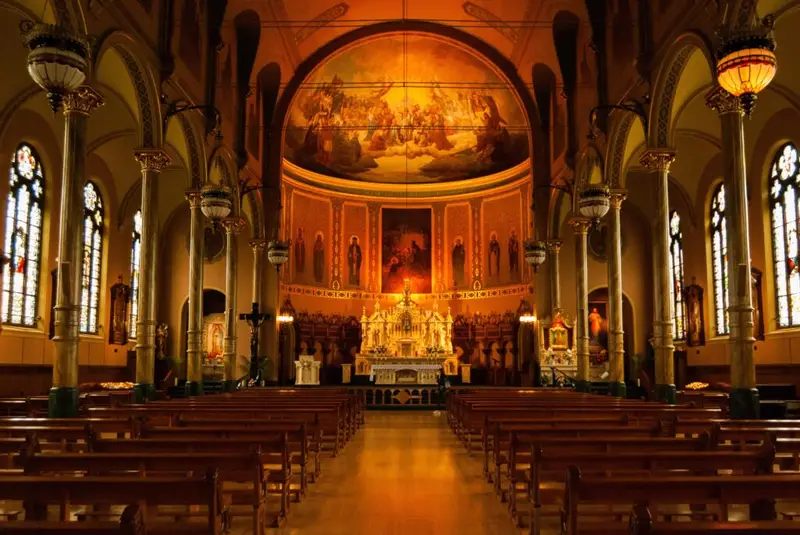
The current building was designed by Patrick Charles Keely, the same architect who designed Holy Name Cathedral. Construction started in 1877 and the church was dedicated in 1881. Renaissance Revival in style, built of yellow brick with limestone accents, the interior runs 200 feet long and 80 feet wide and seats 1,500. The painting above the altar was done in 1899 by Tadeusz Żukotyński and shows Our Lady placing the infant Jesus into the arms of St. Stanislaus Kostka. The stained glass came from Munich in 1903, the Tiffany-style chandeliers from St. Louis in 1908. The original twin bell towers were identical until June 1964, when lightning struck the southern tower and started a fire that destroyed its cupola.
The story locals love is what happened in the 1950s. The Kennedy Expressway was being built and the original route ran straight through St. Stanislaus Kostka. The church was scheduled for demolition. The Polish community fought back, hard, led by a civil engineer turned politician named Bernard Prusinski who came up with the plan to shift the expressway eastward. They won. The Kennedy now makes a sharp curve as it passes the church, with cars whirling past just feet from the rearmost wall. Locals call it the “Rostenkowski curve.”
Local tip: This is the only church on this list that’s open 24 hours a day, 7 days a week. In 2007 the Archdiocese designated St. Stanislaus Kostka the Sanctuary of the Divine Mercy in Chicago, and there’s been Perpetual Adoration ever since. You can walk in at three in the morning if you want to. Driving from O’Hare, you literally pass within feet of it. If you’ve taken the Blue Line into the city, you’ve ridden right past.
📍 1351 W Evergreen Ave, Chicago, IL 60642 (Pulaski Park)
11. Rockefeller Memorial Chapel. The Tallest Building On The University Of Chicago Campus
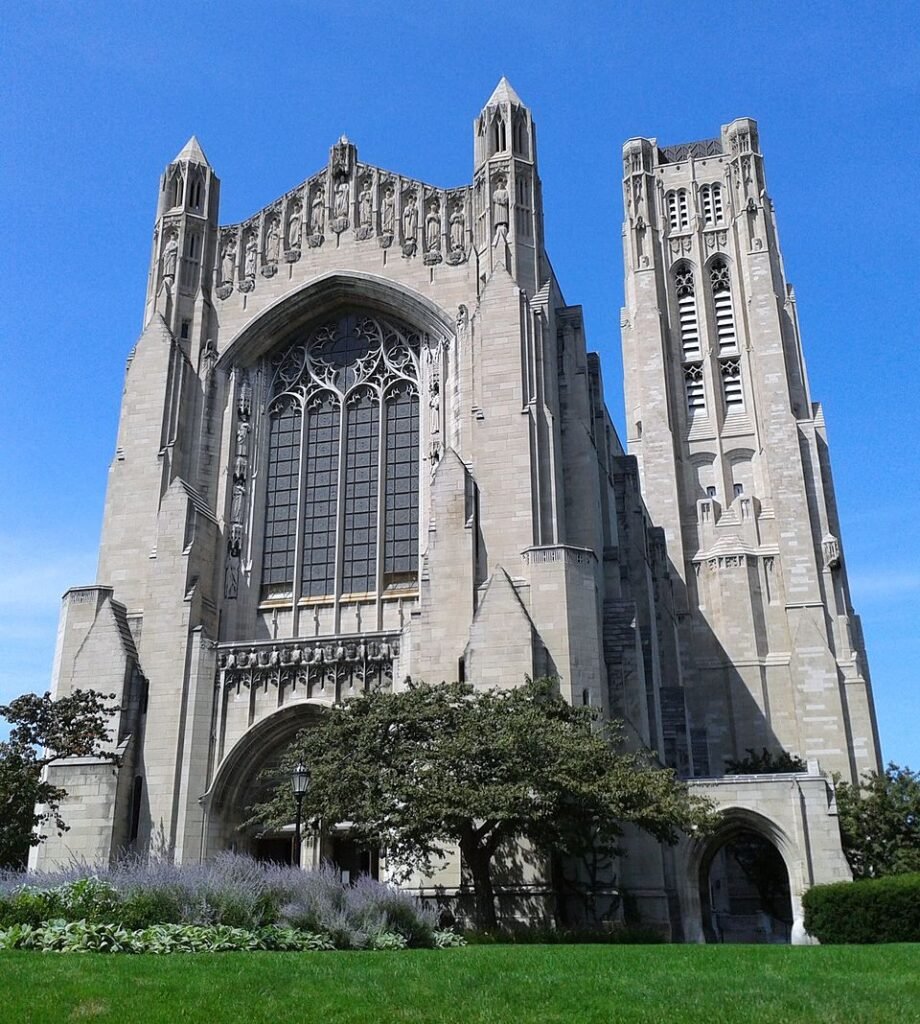
This is the chapel John D. Rockefeller built. The most imposing Gothic Revival building on the entire University of Chicago campus, and at over 200 feet tall, the tallest structure in Hyde Park. Rockefeller intended it to be the “central and dominant feature” of the university, and it still is.
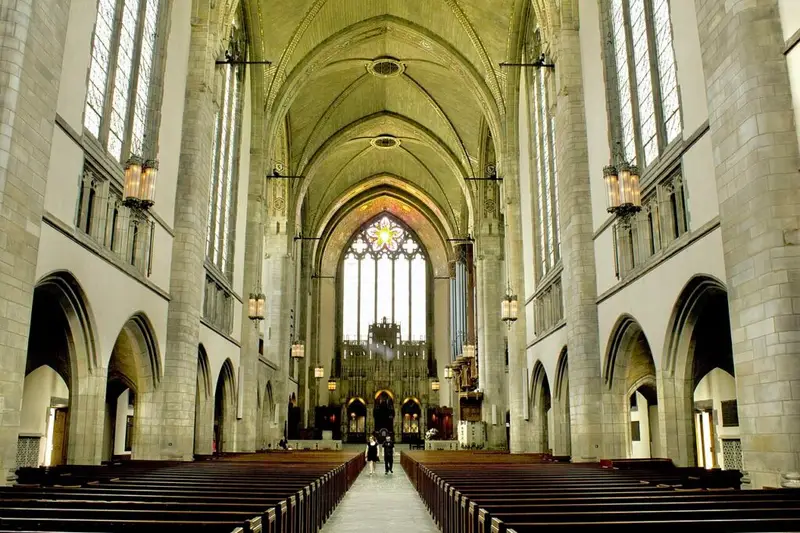
The building was designed by Bertram Goodhue, the same architect who designed the Cadet Chapel at West Point and St. Thomas Church in New York. He drew it up between 1918 and 1924 and the chapel was built between 1925 and 1928, all without using structural steel. The vaulted ceiling alone weighs 800 tons, decorated with over 100,000 pieces of Guastavino tile. It is the only Gothic vaulted ceiling in the world that uses coloured glazed tile. Around 70 figural sculptures by Lee Lawrie and Ulric Ellerhusen line the interior, with mosaic work by Hildreth Meière.
The bell tower holds the Laura Spelman Rockefeller Memorial Carillon, a 72-bell instrument installed in 1932 as a separate gift from John D. Rockefeller Jr. in honour of his mother. It weighs 100 tons of bronze. The largest bell, sounding a low C sharp, weighs 18.5 tons by itself, more than Big Ben. It is the second largest carillon in the world by mass. The largest is its sister instrument at Riverside Church in New York, which Rockefeller Jr. also donated.
Local tip: Tower tours run Tuesday through Friday at 11:30am and 4:30pm during the academic year, and they are extraordinary. You climb 271 steps up a spiral stone staircase, walk across a narrow catwalk above the false ceiling, and end up face-to-face with the largest bell. Each tour times out with a live carillon recital from the cabin. The student carillonneurs play a mix of classical, original work, and pop. Locals have heard them play “Call Me Maybe,” “Sweet Caroline,” and the Game of Thrones theme. From the top of the tower, the view stretches all the way to the downtown skyline.
📍 5850 S Woodlawn Ave, Chicago, IL 60637 (Hyde Park)
12. Second Presbyterian Church. Chicago’s Best-Kept Tiffany Secret
If you’ve never heard of this one, you’re not alone. It sits on a stretch of Michigan Avenue that most tourists never reach, and the unassuming Gothic exterior gives almost no hint of what’s inside. Step through the doors and you walk into one of the finest Arts and Crafts interiors in the entire United States.
The original Gothic Revival church was designed by James Renwick Jr., the same architect who gave us St. Patrick’s Cathedral in New York and the Smithsonian Castle in Washington. It opened in 1874 to serve the wealthiest residents of Chicago’s Prairie Avenue district, including the Pullman family, Robert Todd Lincoln, and the Armours and Swifts. A devastating fire on March 8, 1900 gutted the entire interior. Only the limestone exterior walls survived. The congregation hired one of their own members, a 31-year-old architect named Howard Van Doren Shaw, to rebuild it. He chose to do something radical: he abandoned Gothic Revival entirely and rebuilt the interior in Arts and Crafts style.
What he created is a museum. Thirteen pre-Raphaelite murals by Frederic Clay Bartlett. 175 plaster angels above the nave. Twenty-one significant stained glass windows, including nine by Louis Comfort Tiffany himself, made between 1892 and 1918. Two more windows were designed by Edward Burne-Jones and made by William Morris & Co., among the only Burne-Jones windows in the entire Midwest. The Tiffany windows display every glass-working technique he ever pioneered: folded glass, confetti glass, striated glass, layered glass. The church was named a National Historic Landmark in 2013 specifically for being the finest unaltered Arts and Crafts interior in America.
Local tip: Second Presbyterian is open for free public tours run by the Friends of Historic Second Church, but visiting hours are limited so check their website before you go. The Tree of Life mural was fully restored in 2022 and the Tiffany windows are being cleaned in stages. Avoid going on overcast days. The Tiffany glass needs sunlight to come alive.
📍 1936 S Michigan Ave, Chicago, IL 60616 (South Loop)
13. St. Nicholas Ukrainian Catholic Cathedral. Thirteen Domes Over Ukrainian Village
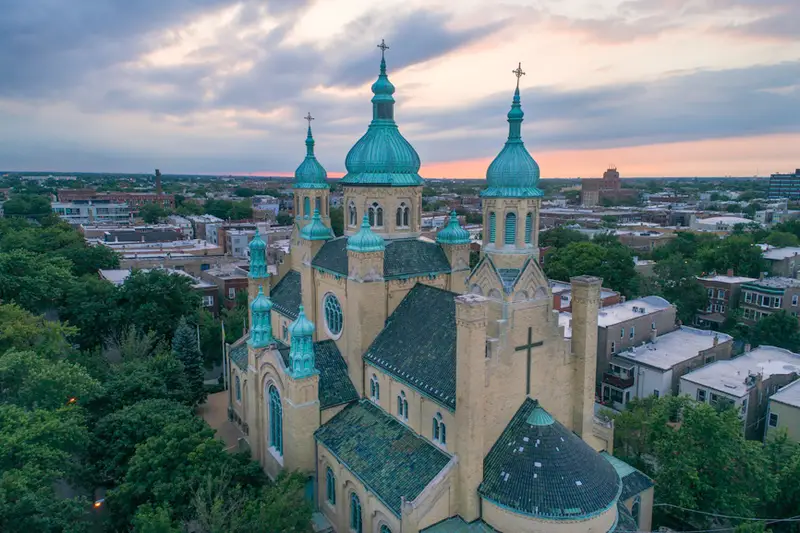
If Holy Trinity is the small, intimate Russian-style church on a quiet residential street, St. Nicholas is its enormous Ukrainian counterpart three blocks south. You can’t miss it. Thirteen green copper domes topped with gold crosses rise 167 feet above the rooftops of Ukrainian Village. Each dome represents Christ and his twelve apostles.
The parish was founded on December 31, 1905, when 51 Ukrainian immigrants gathered to establish St. Nicholas the Wonderworker Ruthenian Catholic Parish. The current building was completed in 1915, designed by Worthmann and Steinbach, the same firm behind St. Mary of the Angels and St. Hyacinth. It was modelled directly on the 11th century Cathedral of St. Sophia in Kyiv, the most important church in all of Ukraine. There is a fresco of St. Sophia above the main altar, just to make sure no one misses the connection. Inside, the walls are covered in mosaics and frescos depicting Christ, the Virgin Mary, the saints, and the prophets, all painted in the Byzantine tradition.
The intricate exterior mosaics were added in 1988 to commemorate the 1,000th anniversary of Christianity in Ukraine. Hanging from the highest dome is a nine-tiered golden chandelier from Greece with 480 lights, one of the largest of its kind in North America. In 1961 the parish was elevated to cathedral status as the seat of the Ukrainian Greek Catholic Eparchy of St. Nicholas of Chicago. Since the start of the war in Ukraine, it has become one of the most important Ukrainian institutions in the United States.
Local tip: Walk Ukrainian Village in one go and see this and Holy Trinity together. They are about three blocks apart and represent the two great Eastern Christian traditions in Chicago. Two completely different architectural styles, two completely different congregations, both extraordinary. Stop at the Ukrainian National Museum at 2249 W Superior St while you’re in the neighbourhood.
📍 2238 W Rice St, Chicago, IL 60622 (Ukrainian Village)
14. Unity Temple. The Frank Lloyd Wright UNESCO Site Hiding In Oak Park
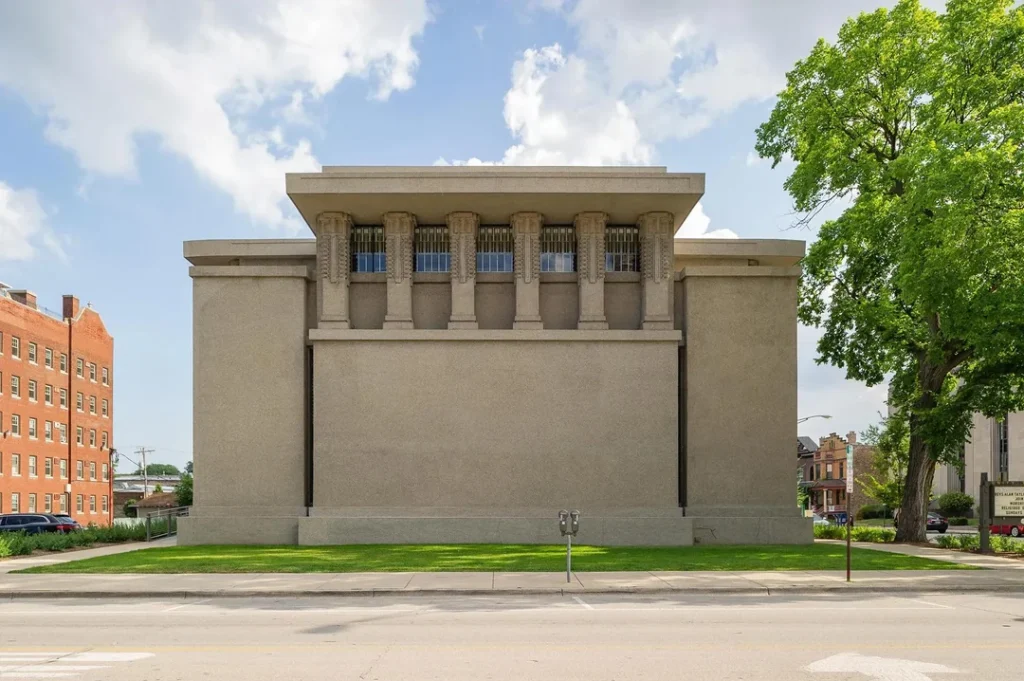
This one is in Oak Park, technically not Chicago, but it’s a 25-minute Green Line ride from the Loop and absolutely worth the trip. Unity Temple is one of only eight Frank Lloyd Wright buildings in the entire world recognised as a UNESCO World Heritage Site.
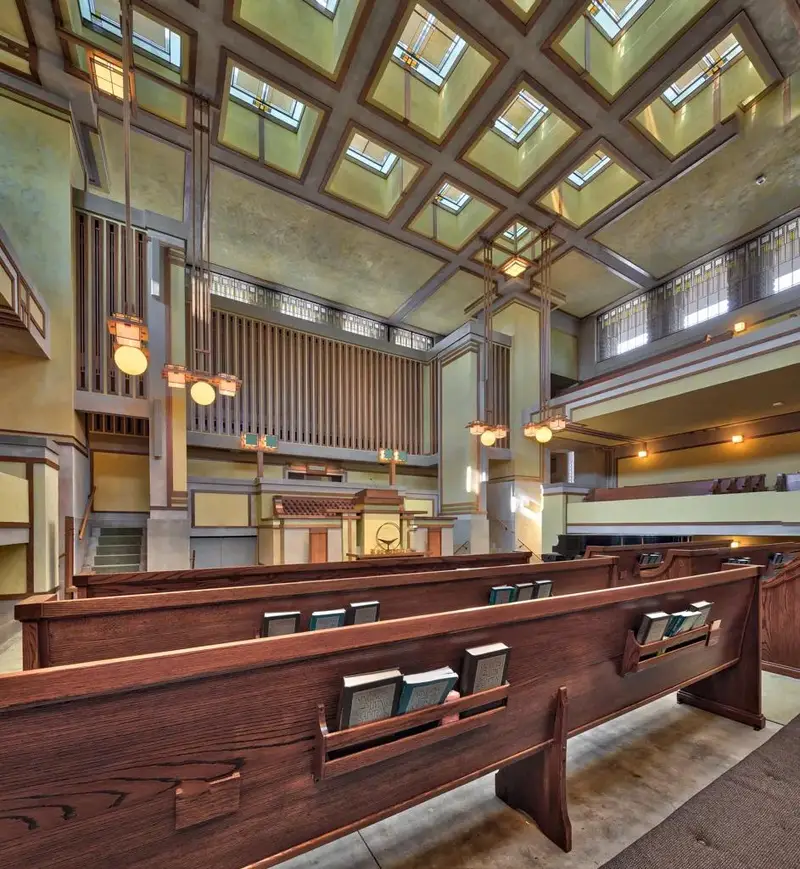
The story starts with lightning. In June 1905, a bolt struck the spire of the Universalist Unity Church of Oak Park and burned the original wood-framed building to the ground. The next morning, a young Frank Lloyd Wright, who attended the church with his mother, walked into the congregation’s leadership and offered to design a replacement. He was given a $45,000 budget, which was about a third of what a typical neo-Gothic church cost at the time, and a small triangular site on a busy street. What he produced changed religious architecture forever.
Wright did something nobody had ever done. He built a church entirely out of poured-in-place reinforced concrete, a material previously reserved for warehouses and factories. The exterior is a series of bold geometric blocks. There’s no obvious entrance, no spire, no traditional church language whatsoever. You enter through a low side passage, walk through a deliberately compressed foyer, then emerge into a soaring three-story sanctuary bathed in honey-coloured light from coffered art glass skylights. It seats 400 people and the pulpit sits at the centre, not the front. The building was completed in 1908 and dedicated in September 1909.
Local tip: Unity Temple underwent a $25 million restoration that wrapped up in 2017, and the building has never looked better. Tour tickets are sold through the Frank Lloyd Wright Trust and run Monday to Saturday. Combine your visit with the Frank Lloyd Wright Home and Studio (a 10 minute walk away) and the Hemingway Birthplace Museum, also in Oak Park. Take the CTA Green Line to Oak Park Avenue. Closed Sundays unless you’re attending a service.
📍 875 Lake St, Oak Park, IL 60301 (Oak Park)
15. The Chicago Temple. The Tallest Church Building In The World
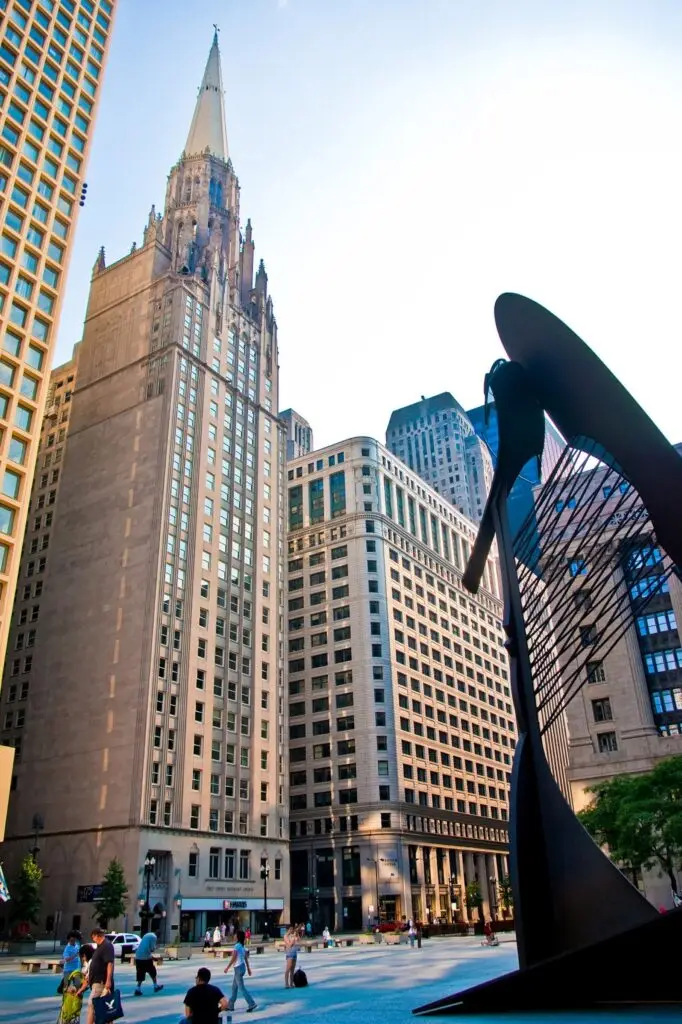
You walk past this one all the time and never realise what you’re looking at. The Chicago Temple sits directly across from the Daley Center in the heart of the Loop, a 568-foot Gothic skyscraper that holds three sanctuaries, 17 floors of rented office space, and the highest worship space in the world. It’s the tallest church building on the planet, measured from the entrance to the top of the spire.
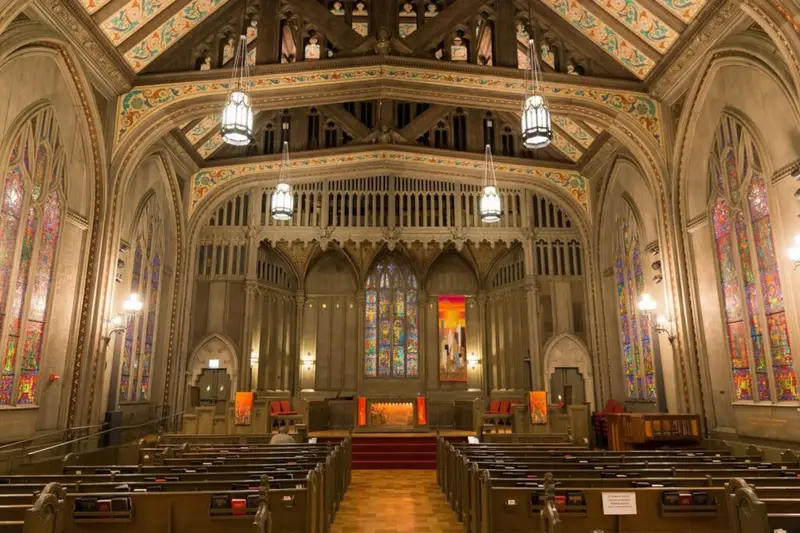
The First United Methodist Church of Chicago is the oldest church congregation in the city, founded in 1831, six years before Chicago was even incorporated as a city. The original log cabin was built on the north bank of the Chicago River in 1834, then literally rolled across the river on logs four years later to its current location at Washington and Clark. They’ve been on this corner ever since. The 1858 building burned down in the Great Fire of 1871. The replacement served until 1924, when the congregation made the decision that defines this place. Instead of selling their downtown property and moving to the suburbs after World War I, they hired Holabird and Roche, the architects behind early Chicago skyscrapers, and built up.
The building was completed in 1924 and was the tallest in Chicago for six years. Holabird and Roche designed it neo-Gothic in style, with limestone over a steel frame and a spire crowned by a radiant cross. The main sanctuary on the ground floor seats 1,000. The Dixon Chapel sits on the second floor. And then there’s the Sky Chapel, donated by the Walgreen family in 1952, located 400 feet above the street directly under the spire. Stained glass windows in the main sanctuary depict the Chicago skyline, the Chicago Temple itself, and the institutions the congregation helped found, including Northwestern University and Wesley Hospital. Famed lawyer Clarence Darrow once kept his law office on the sixth floor.
Local tip: Free Sky Chapel tours run Tuesday, Thursday, Friday, and Saturday at 2pm, plus Sunday and Wednesday after services. Meet at the second floor church office. The chapel is intimate, the wood carvings are exquisite, and the view through the small window at 400 feet is unforgettable. Then walk out into the Daley Plaza, look up, and try to spot the spire you were just standing under. You’ll never walk past this building the same way again.
📍 77 W Washington St, Chicago, IL 60602 (The Loop)
16. Our Lady of Sorrows Basilica. Chicago’s First Basilica And Most Stunning Hidden Interior
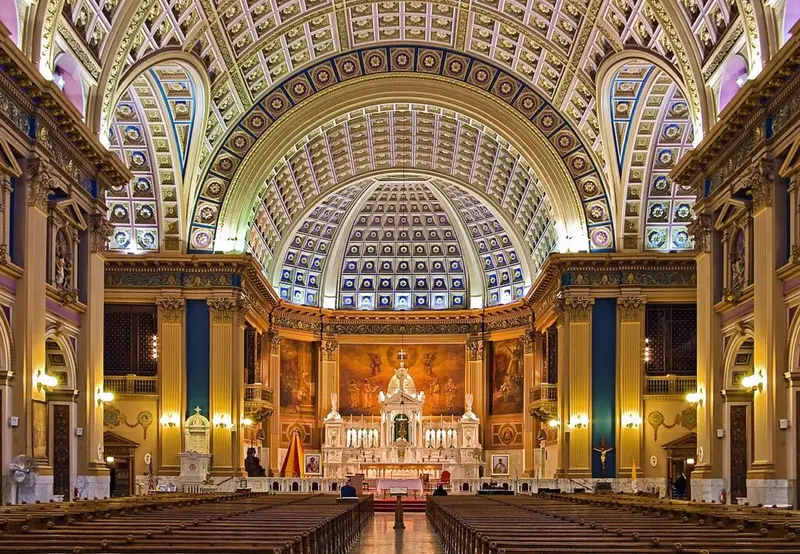
This is the church almost nobody outside the West Side knows about, and it has one of the most spectacular interiors in the entire United States. From the outside it’s deliberately understated: a flat, restrained Italian Renaissance facade in muted stone, the kind of building you walk past without a second look. Step through the doors and the world changes.
The barrel-vaulted ceiling stretches 80 feet high and 65 feet across, coffered with hundreds of square panels in a style modelled directly on the work of 15th century Italian Renaissance architect Donato Bramante. The half-dome above the high altar is painted with biblical scenes in deep blue and gold. Ornate Carrara marble columns line the nave. The high altar is carved entirely from Carrara marble. Twelve pilgrimage chapels and side altars line the walls, each one detailed enough to be a destination on its own. There’s a full-size marble replica of Michelangelo’s Pietà and the National Shrine of St. Peregrine, the patron saint of cancer patients.
The parish was founded in 1874 by three Servite priests who came to Chicago to build a sanctuary devoted to Our Lady of Sorrows. Ground broke on the current building on June 17, 1890, and the church was dedicated on January 5, 1902. The architects were Henry Engelbert, John F. Pope, and William J. Brinkmann. In 1956, Pope Pius XII designated it the first basilica in Chicago, calling it “the foremost Church in America.” During the late 1930s and 1940s, the Sorrowful Mother Novena drew so many worshippers that the church had to run 38 separate Friday services every week to accommodate over 70,000 attendees. The novena spread to 2,000 parishes around the world from this one church on Jackson Boulevard.
You may have already seen the basilica without realising it. It appears in the 1987 Brian De Palma film The Untouchables as the backdrop to Sean Connery’s “the Chicago way” speech to Kevin Costner.
Local tip: Open weekdays 9am to 4:30pm and Saturdays 9am to noon. If the doors are locked, ring the bell at the Servite monastery just west of the basilica and somebody will let you in. Combine your visit with the Garfield Park Conservatory, which is less than two miles away and one of the best free attractions in Chicago.
📍 3121 W Jackson Blvd, Chicago, IL 60612 (East Garfield Park)
Before You Go
Most of these churches are still active places of worship, which means visiting hours can change without warning. A funeral, wedding, or special service can close the doors to visitors at any time. Always check the parish website or call ahead before making the trip, especially if you’re travelling from outside the city.
A few more practical tips. Dress modestly. Many of these churches expect shoulders covered and no shorts, particularly the Catholic and Orthodox cathedrals. Photography is allowed in most of them but turn off your flash, especially around historic stained glass and frescos. If a service is happening, sit at the back, stay quiet, and don’t wander. You’re welcome to be there. Just be a good guest.
If you want to see as many of these as possible in one trip, build a route. Holy Name, Fourth Presbyterian, and the Chicago Temple are all walking distance from each other in the Near North Side and Loop. St. Stanislaus Kostka, St. Mary of the Angels, and St. Hyacinth cluster along the Kennedy Expressway corridor on the northwest side. Holy Trinity and St. Nicholas are three blocks apart in Ukrainian Village. Quinn Chapel and Second Presbyterian sit within a mile of each other in the South Loop. Old St. Pat’s and St. Adalbert can be combined with a Pilsen day trip. Rockefeller Chapel anchors a Hyde Park visit. Unity Temple is its own afternoon out in Oak Park.
If you want a full Chicago itinerary that pairs these with everything else worth seeing in the city, our Perfect 3 Day Chicago Itinerary covers it. And if you’re staying downtown, these are the best hotels for first-time visitors to Chicago.
WHAT ??? Not even an honorable mention for St. Hedwig in Bucktown . The church is beautiful inside as well as on the outside. Has a history…