
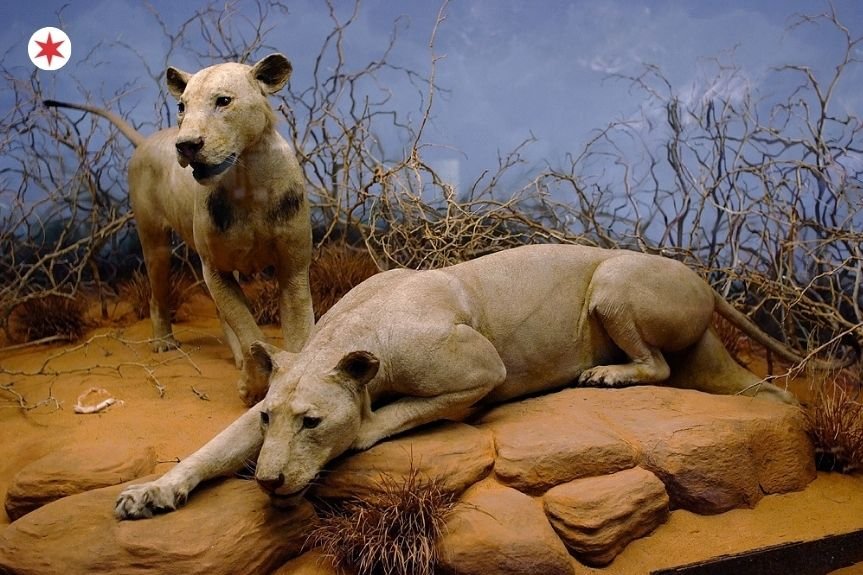
In a quiet corner of the Field Museum, behind a sheet of glass in the Rice Gallery, two maneless lions stand frozen mid-stalk. The plaque is matter-of-fact. Most visitors stop for thirty seconds and move on.
They shouldn’t. These are the man-eaters of Tsavo.
Tsavo, 1898: a railway through nowhere
To understand the lions, you have to understand the project they interrupted.
In the late 1890s, the British Empire decided to build a railway from the port of Mombasa, on the Indian Ocean, all the way to Lake Victoria, deep in the interior of what’s now Uganda. The route ran nearly 600 miles through some of the most punishing terrain in East Africa. British newspapers nicknamed it the Lunatic Express. Most of the labor was imported from British India: thousands of indentured workers shipped across the ocean to lay track through a continent they’d never seen.
In March 1898, the project hit the Tsavo River. The bridge crew set up camp in a stretch of dry, thornbush country in present-day Kenya. The man in charge was Lieutenant Colonel John Henry Patterson, an Anglo-Irish military engineer who’d been hired to oversee the bridge construction. He was thirty years old. He’d hunted big game before. He thought he knew what he was walking into.
He didn’t.
Within days of his arrival, workers began disappearing from camp at night. The first few cases were hand-waved as desertion or wild dog attacks. Then someone found bones. Then someone heard the screams. The men working the bridge realized something was hunting them, and that something had a method. It was coming into camp at night, picking a tent, dragging a body out, and eating it within earshot of the rest of the workers.
There were two of them. Both male. Both adult. Both, oddly, without manes (Tsavo lions are genetically maneless, an adaptation to the heat and thornbush of the region). And they were not behaving like normal lions.
The nine months of terror

Normal lions don’t hunt humans. Lions are ambush predators that prefer zebra, buffalo, wildebeest. When lions do attack people, it’s almost always opportunistic and almost always a single animal. Two lions hunting humans cooperatively, repeatedly, methodically, for nine months straight, is so rare that scientists have spent the last century trying to figure out why these two did it.
Two theories dominate.
The first is environmental. The 1890s in East Africa saw a catastrophic rinderpest outbreak, a viral cattle disease that swept through the continent and decimated the populations of buffalo, antelope, and other large grazers that Tsavo lions normally eat. By 1898, much of the lions’ usual prey base had collapsed. The region was also in the middle of a years-long drought. So the standard story goes: the lions were starving, the railway camp was full of relatively defenseless humans, and the math was simple.
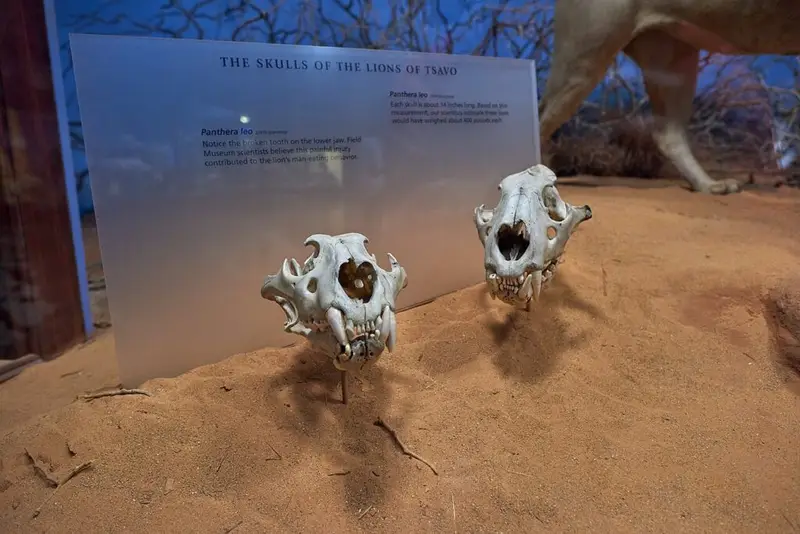
The second theory is dental. When researchers examined the lions’ skulls decades later, they found that one of them had a severe root abscess in a canine tooth, plus a broken premolar. That kind of injury would make it almost impossible for a lion to suffocate a struggling buffalo. Humans, by comparison, are much smaller, much weaker, and much easier to kill. A 2017 study at Vanderbilt University by Larisa DeSantis and the Field Museum’s Bruce Patterson examined microscopic wear patterns on the lions’ teeth and concluded that the lions hadn’t been desperately scavenging bones. They’d been eating soft tissue. The dental injury, not the rinderpest, was probably the bigger driver.
Either way, the result was the same. Patterson’s camp, by his own account, became a place where men slept in trees, built thorn fences called bomas around their tents, kept fires burning all night, and still got dragged out screaming. Workers deserted in waves. Construction stopped completely for around three weeks at the worst point. The British Parliament in London actually debated the situation. A railway project meant to symbolize imperial competence was being held up by two cats.
Patterson tried everything. He built elevated platforms (called machans) to wait in at night. He set traps baited with donkey carcasses. He sat up in trees with a rifle for nights at a stretch. The lions seemed to learn his patterns and would avoid the tents he was watching, hitting the ones he wasn’t. This went on, in waves, from March until December.
10 Hidden Architectural Details Chicago Locals Walk Past Every Day (But Tourists Never Notice)


The end of it
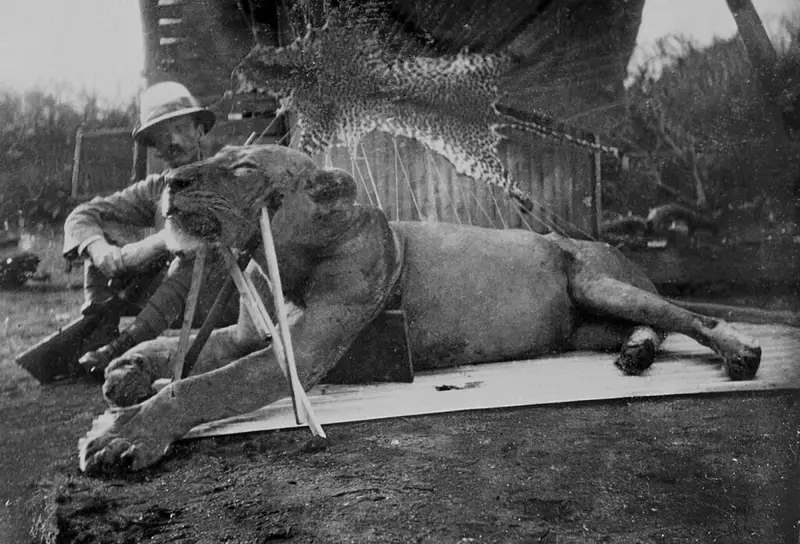
The first lion died on December 9, 1898.
Patterson had built another platform near a partially eaten goat carcass, hoping the lion would return to its kill. It did. He fired. He missed the killing shot but hit the animal, which staggered off into the bush. The next morning, he tracked it through the thorn scrub and finished it with a second rifle. The body, when measured, was nine feet eight inches from nose to tail. Today that lion is the standing mount in the Field Museum’s diorama, catalogued as FMNH 23970.
Patterson assumed the worst was over. It wasn’t.
The second lion kept killing. It went after a railway inspector, a worker, a hospital orderly. Patterson tried to ambush it on December 27 from a partially built scaffolding using a goat as bait. The lion charged the scaffolding and very nearly killed him. He fired multiple shots. The lion escaped, wounded.
Two days later, on December 29, Patterson cornered the wounded lion in the bush. It took roughly ten shots from two different rifles before the animal finally stopped. That second lion, smaller than the first, is now the crouching mount: FMNH 23969.
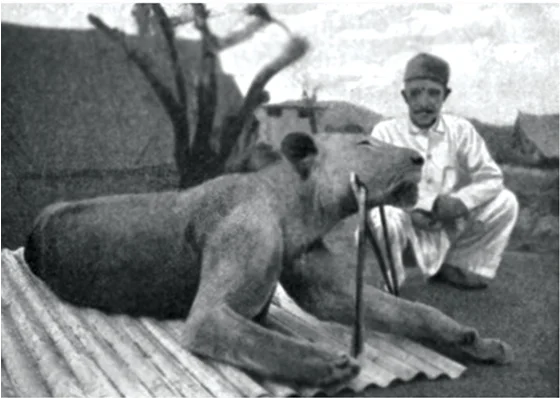
The bridge over the Tsavo River was finished a few months later. The Uganda Railway eventually reached Lake Victoria. The line is still in service today.
How many people did they actually kill?
This is where the numbers get messy.
In The Man-Eaters of Tsavo, the bestselling memoir Patterson published with Macmillan in 1907, he claimed the two lions had killed 135 people between them. That number got bigger over time. In a 1925 pamphlet he wrote for the Field Museum, he hardened it: 135 Indian and African workers killed and devoured. That figure became the legend. It’s the figure repeated in newspaper articles for the next eighty years. It’s the figure dramatized in the Hollywood film. It’s also, almost certainly, wrong.
In 2009, a team led by Justin Yeakel at UC Santa Cruz, working with the Field Museum’s Bruce Patterson and a group of co-authors, published a study in Proceedings of the National Academy of Sciences that did something genuinely new. They took tiny samples of bone collagen and hair keratin from the actual mounted specimens in Chicago and ran stable isotope analysis on them, the same chemical fingerprinting technique used in forensic archaeology. By comparing the carbon and nitrogen isotope ratios in the lions’ tissues against the signatures of human and animal prey, they could estimate, mathematically, how much of each lion’s diet in its final months had come from humans.
The answer was a lot, but not 135.
One lion (the standing mount, FMNH 23970) had eaten an estimated 11 humans. The other (the crouching mount, FMNH 23969) had eaten about 24. Total: roughly 35 people. Still horrifying. But about a quarter of what Patterson had been telling audiences for forty years.
The most likely explanation is that Patterson, who had every commercial reason to make his story sound bigger, was probably counting attacks rather than kills. He may have been folding in hearsay from camps further down the line. He probably rounded up. The official Uganda Railway records only documented 28 deaths, and only of Indian workers. African workers in the surrounding region weren’t carefully counted by anyone. The truth is probably somewhere between the railway’s 28 and the lions’ isotopic 35. Still one of the worst predator attacks on humans ever documented.
The rugs in the parlor
After Patterson killed the second lion, he had the skins and skulls preserved using salt curing in the field, then shipped them back to England with him when his contract ended. Then, instead of donating them to a museum, he had them turned into rugs.
For roughly 25 years, the two most infamous predators in colonial Africa lived as floor coverings in Patterson’s London home. He’d display them at lectures. He’d use them as conversation pieces at dinner parties. He’d let visitors walk on them.
This is part of why the lions are smaller today than Patterson’s book describes. The skins were trimmed during the rug-making process. They were trimmed again decades later when taxidermists at the Field Museum had to stretch them over three-dimensional forms. By the time the lions were mounted, they were noticeably smaller than the measurements Patterson recorded in 1898. Patterson may have also exaggerated the original numbers. Probably both.
Patterson, by the early 1920s, was running into financial pressure. The lions, sitting on his floor, were the most marketable thing he owned.
How they got to Chicago
Patterson came through Chicago in late 1924 to give a lecture. The Field Museum, less than four years into its current lakefront building, hosted him, and the visit went well enough that he offered them the rugs on the spot.
The negotiation moved fast. Telegrams went back and forth between Patterson and the museum’s director, D.C. Davies, in early December 1924. Stanley Field, the museum’s longtime president and the nephew of founder Marshall Field, signed off. The Field paid $5,000, a substantial sum at the time and roughly $90,000 in today’s money. The official accession card is dated February 5, 1925, which is why the museum marked the centenary in February 2025.
The skins arrived in Chicago and went straight to the museum’s taxidermy department. Reconstructing them fell to a staff taxidermist named Julius Friesser, who had to do something unusual: rebuild lifelike, three-dimensional animals out of skins that had spent a quarter-century flat on a wood floor in London. Some hair was missing. Edges had been trimmed. The skins were brittle. Friesser stretched what he had over carved wooden forms and posed them in the now-iconic stalking and crouching positions.
The lions went on display in 1925. And then something strange happened: they went out of fashion.
The forgotten lions
Through the 1920s and 30s, when Patterson’s book was still a household reference, the lions were a star attraction. Then the world moved on. By the 1960s and 70s, the original Patterson book was out of print and the story had faded. The lions, no longer drawing crowds, got pushed to a secondary case in a back corner of the museum. Generations of Chicago kids walked past them without knowing what they were.
In 1989, a new collections manager named Bill Stanley arrived at the Field. He’d grown up in Kenya, where every schoolchild knows the Tsavo story. When he found the dusty mounts in their forgotten corner, he was, by his own later account, stunned. He started telling people what they were.
Then in the mid-1990s, by sheer luck, executives from Paramount Pictures visited the museum scouting natural-history references for a film they were making. The film was The Ghost and the Darkness. Stanley showed them the original lions. The studio mentioned the museum at the end of the film. When the movie was released in October 1996, the lions became famous all over again.
The film, directed by Stephen Hopkins from a William Goldman screenplay, starred Val Kilmer as Patterson and Michael Douglas as a fictional American big-game hunter named Charles Remington. Goldman invented Remington as a co-lead because the Patterson-only version of the script was a one-hander and Hollywood doesn’t make those for $55 million. The real Patterson hunted and killed both lions himself. There was no Remington. There were no Maasai warriors brought in to assist. The film’s lion attacks were filmed mostly with two real lions named Bongo and Caesar, and exaggerated for cinematic effect: in real life, the lions did not roar dramatically before kills, they did not crash through buildings, and they did not appear to be hunting for sport. They were eating people because eating people was easier than the alternative.
The film won the 1997 Academy Award for Best Sound Editing. It made $75 million on a $55 million budget. Roger Ebert hated it. The Field Museum has never stopped benefiting from it.
What scientists are still finding
The Tsavo lions have become some of the most studied taxidermy specimens in the world. After the 2009 PNAS isotope work came the 2017 dental microwear analysis at Vanderbilt, then a Field Museum X-ray project the same year looking for further skeletal pathology. In early 2025, on the centenary of the museum’s accession of the lions, Roosevelt University’s Julian Kerbis Peterhans announced that ongoing hair analysis was being used to test whether more than two lions had actually been involved in the attacks. Lions groom each other, and groomed-off hairs from third parties accumulate in stomach contents. Even now, those skins haven’t given up everything they know.
Two animals shot in 1898 are still telling scientists new things in 2026. That’s the point.
Where to find them today
The lions live in the Rice Gallery, on the main level of the Field Museum, set into the African mammals diorama hall. From the main entrance, you walk through Stanley Field Hall (the big atrium with the dinosaurs) and head toward the African dioramas. The Tsavo lions are on the right-hand side, set behind glass against a painted backdrop of the Tsavo bush. Their original skulls are displayed alongside them. There’s a third, separate man-eater on display nearby: the Mfuwe lion from Zambia, which killed six people in 1991 and is the largest man-eating lion ever recorded. Most visitors miss it entirely.
The plaque next to the Tsavo lions is short. It’s worth reading anyway. The crouching mount is FMNH 23969, the second one Patterson killed. The standing mount is FMNH 23970, the first.
Local tip: Go on a weekday morning right at opening (9:00 AM). The school groups arrive around 10:30 and they head straight for Sue and the Egyptian tombs first, which means you’ll get the African mammals hall almost completely to yourself for the first 90 minutes. The lions look better in low foot traffic. The room is quiet. You can actually stand there and read the case carefully without anyone behind you.
Local tip: Plan two hours minimum at the Field, three if you want to do it properly. Most first-timers wildly underestimate how big the building is. There are 35 permanent exhibitions across three levels. Wear flat shoes.
Local tip: The museum gift shop sells reprints of Patterson’s The Man-Eaters of Tsavo. If the story grabbed you, the book is worth picking up before you leave. It’s a primary historical document, written by the man who shot them, and the prose has a Victorian melodrama to it that no modern writer would touch. You can also find the book free on Project Gutenberg, but reading the museum’s reprint right after seeing the actual lions is a different kind of experience.
Practical visit info
Address: 1400 S DuSable Lake Shore Drive, Chicago, IL 60605
Hours: Open daily 9:00 AM to 5:00 PM. Last admission at 4:00 PM. Closed Thanksgiving and Christmas Day.
Admission (as of 2026): Adult general admission is around $30, students $27, children $23, and infants under 3 are free. Chicago residents get a discount with proof of address. Illinois residents have free admission days throughout the year (check the Field Museum site for the current schedule). The all-access ticket adds the special exhibitions and 3D films. The Tsavo lions are included in basic general admission, you don’t need an upgrade.
Getting there: The Field Museum sits on the Museum Campus on the lakefront, between Soldier Field and the Shedd Aquarium. The closest L stop is Roosevelt (Red, Orange, and Green lines), and the 146 bus runs straight from Roosevelt to the museum entrance. If you’re new to navigating the city’s transit, the L train tips guide is worth a quick read first.
Pair it with: The Shedd Aquarium and Adler Planetarium are both within a 10-minute walk on the same campus. If you’re trying to do all three in a day, Chicago CityPASS bundles them along with two other top attractions and saves you most of the cost compared to buying tickets separately. If you’re just doing the Field, the Field Museum tickets page on Viator is usually the easiest single-attraction option.
Where to eat after: The museum has a decent in-house café and there’s a Lou Malnati’s a 12-minute walk away in the South Loop. If you’re staying downtown, the river area has better options. The restaurants with a view guide covers the spots actually worth the price.
Where to stay: Most visitors base themselves in The Loop or the South Loop, which puts the Museum Campus within walking distance. Browse Chicago hotels on Expedia →
One more thing: If you’re new to Chicago and trying to figure out how to fit a museum visit into a tight schedule, the perfect 3 day Chicago itinerary builds the Field in on day two without sacrificing the rest of the city.
The bottom line
Walk into the Field Museum on a weekday morning, head past Sue, cross Stanley Field Hall, and find the African mammals diorama. The two lions are there, behind glass, in a corner that doesn’t try too hard to draw a crowd.
They came out of a dry thornbush valley in Kenya in 1898. They spent 25 years as floor rugs in a London parlor. Patterson sold them to Stanley Field for $5,000 in late 1924. They went out of fashion for fifty years, got rediscovered, ended up in a Hollywood movie, and have since become some of the most chemically and genetically scrutinized animal specimens on Earth.
Most visitors give them thirty seconds.
Give them five minutes.