

The TL;DR:
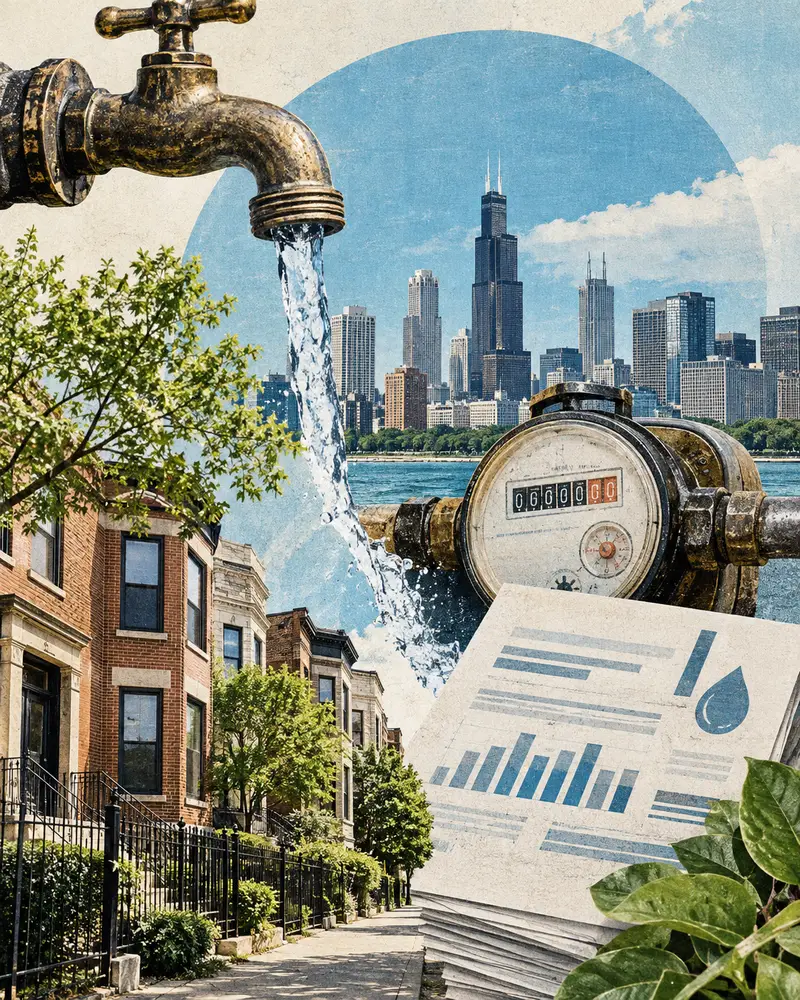
- The Big Reveal: Chicago’s Utility Billing Relief program cuts water, sewer, and water-sewer tax charges by 50% for qualifying homeowners.
- Application Window: The 2026-2027 sign-up period opens October 1 for seniors and people with disabilities, and November 1 for everyone else.
- The Long-Term Payoff: Homeowners who stay current on the reduced bills for 12 straight months get their entire past water debt forgiven.
Chicago homeowners struggling with their water bill have a city program that could quietly slash it in half.
The Utility Billing Relief (UBR) program, run through a partnership with the Community and Economic Development Association of Cook County (CEDA), is designed for low-income owners of single-family homes, 2-flats, and 3-flats inside city limits.
It is not just a discount. Stay enrolled and current for a year, and the city wipes out whatever old water debt you were carrying.
💰 Who Can Qualify and What You Actually Save
To qualify, you have to own and live in the property, and it has to be a single-family home, 2-flat, or 3-flat within Chicago city limits.
Eligibility was recently expanded so that household gross income must fall at or below 300% of the Federal Poverty Guidelines to qualify.
For 2026, that works out to a 30-day gross income of $3,990 or less for one person, $5,410 for two, and $8,250 for a household of four, which lines up with annual limits of $47,880, $64,920, and $99,000.
The program mirrors LIHEAP’s income rules but waives the usual citizenship requirement, so undocumented homeowners can still qualify if they meet the income and property rules.
Once approved, the discount applies to water charges, sewer charges, and the water-sewer tax, but not to garbage or refuse collection fees, which still get billed at the standard rate.


📝 How and When to Apply
Homeowners can apply through the City of Chicago e-Forms Portal or CEDA’s Online Utility Bill Assistance Portal, both open 24/7, or by calling CEDA at (800) 571-2332.
You’ll need a government-issued ID, proof of income for everyone in the household over the last 30 days, proof of residency or homeownership, and your most recent city utility bill.
Importantly, you do not need to be behind on your bill to apply. The city is encouraging anyone who meets the income criteria to submit an application before debt piles up.
Applications open October 1, 2026 for seniors and people with disabilities, and November 1, 2026 for all other income-eligible households, and a complete application can take up to 30 days to process.
While enrolled, no new late-payment penalties get added and all collection activity, including water shut-offs, is paused.
🚰 More Relief for Seniors, Veterans, and Leaky Pipes
There’s extra help outside UBR too. Homeowners 65 and older who own their home with a separate water meter are fully exempt from the sewer service charge, and seniors in condos or co-ops with a shared meter can instead apply for an annual $50 rebate.
Veterans facing overdue water, gas, or electric bills can turn to the Veterans Assistance Commission of Cook County, where qualified veterans can receive up to $550 in emergency assistance for households at or below 250% of the federal poverty level, with at least three months of Cook County residency. The office is at 1100 S. Hamilton Ave., Lower Level.
If a bill spiked because of an underground leak, the Water Leak Relief Pilot Program offers credits for leaks repaired on or after January 1, 2023, and runs through December 31, 2026.
And for lead pipes, low-income homeowners may qualify for a free full lead service line replacement worth between $16,000 and $30,000, while anyone hiring their own contractor can have up to $5,000 in permit fees waived.
For context, water currently runs about $4.98 per 1,000 gallons after a 1.85% rate increase in June 2026, and sewer charges equal 100% of the water charge, so a 50% UBR discount touches both halves of the bill.
The Local’s Guide
- Address: 1100 S. Hamilton Ave., Lower Level, Chicago (Veterans Assistance Commission of Cook County office)
- Insider Tip: Seniors and people with disabilities get priority access starting October 1, 2026, so apply early if you fit that group before the general window opens November 1.
Know a neighbor who could use half off their water bill? Let us know what you think over on the Hey Chicago social pages.