
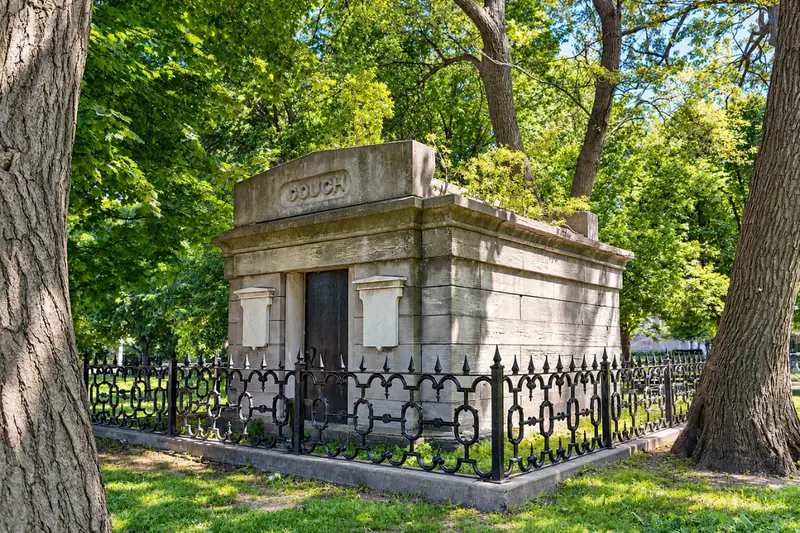
Thousands of joggers blindly stretch their hamstrings every single day against a 50-ton millionaire’s crypt disguised as a park tool shed.
This is a fully documented 19th-century reality, standing as the sole surviving relic of a diseased graveyard that once held 35,000 corpses.
The monolithic stone vault sits in plain sight at the far south end of Lincoln Park, just steps from the Chicago History Museum.
It remains permanently locked in place because of a stubborn real estate loophole, backroom political clout, and a nearly 150-year-old bureaucratic standoff.
A $7,000 Flex in a Doomed Cemetery
Before Lincoln Park was a manicured lakefront playground, it was a massive, swampy graveyard.
High tides routinely washed wooden caskets ashore, triggering massive cholera and smallpox outbreaks that contaminated the local drinking water.
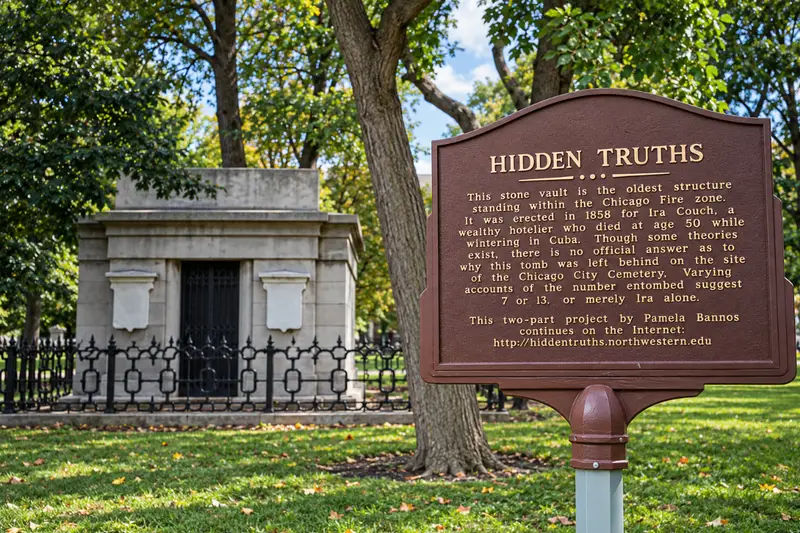
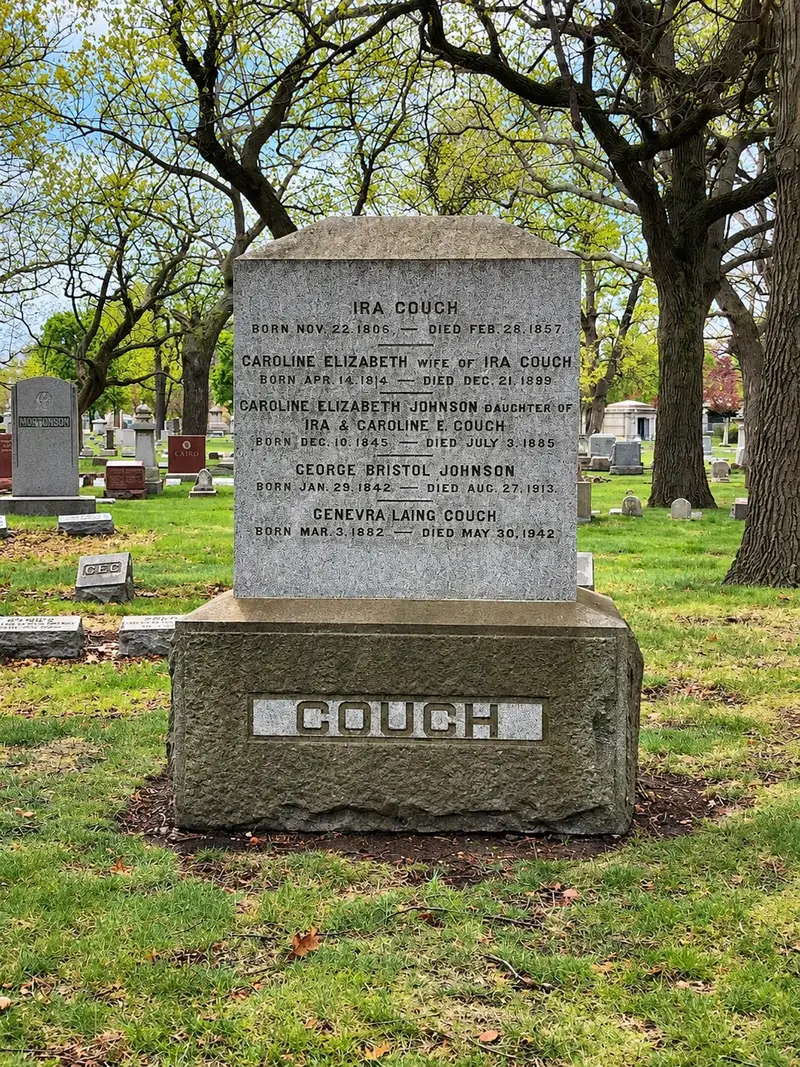
In 1858, the grieving family of Ira Couch decided to build a permanent, impenetrable fortress amidst the muddy chaos.
Couch arrived in Chicago with nothing but a tailor’s background, co-founding the legendary Tremont House hotel and aggressively buying land.
Following his sudden death at age 50, his brother commissioned Chicago’s first professional architect, John M. Van Osdel, to design a grand vault.
The family spent a staggering $7,000 (roughly $250,000 today).
Builders hauled 100 tons of raw Lockport stone from Upstate New York, using an eight-horse team just to drag the massive 16-foot capstone roof into the cemetery.
Surviving the Great Fire and the Bureaucratic Cover-Up
The city officially condemned the toxic cemetery in 1866 and ordered all bodies moved.
Wealthy families quickly relocated their dead to Rosehill or Graceland, but the Couch family stubbornly refused to abandon their legal plot.
When the Great Chicago Fire gutted the area in October 1871, the stone Couch tomb was the only structure left standing in the blazing inferno.
Because the family held an ironclad deed, the city had no clean legal mechanism to bulldoze the crypt.
By 1877, city engineers estimated it would cost a massive $3,000 to dismantle and relocate the structure.
Neither the park politicians nor the wealthy Couch family wanted to pay the massive relocation bill.
Historians heavily suspect that Tremont House political clout kept demolition crews completely at bay, as the hotel was the unofficial headquarters of the Illinois Republican Party.
Unable to destroy the tomb, the city launched a passive-aggressive landscaping campaign.
For nearly a century, park workers intentionally planted dense bushes and un-pruned trees tightly around the vault to physically choke it from public view.


The Midnight Rituals and the Empty Crypt Mystery
By the 1880s, the overgrown tomb fueled a viral urban legend among Chicago youth.
Daredevils believed that visiting the site exactly at midnight and chanting, “The graves belong to the dead, not the living” would trigger a terrifying phenomenon.
Local lore promised the massive stone doors would swing open on their own, releasing a glowing white apparition into the park.
Yet, the ultimate irony of Chicago’s most famous tomb is that nobody definitively knows if anyone is actually inside it.
A 1901 inspection by a park engineer claimed zero bodies remained, asserting they were all secretly removed.
Couch’s grandson vehemently denied this, swearing that eight family members were still securely sealed inside.
Adding to the confusion, early Chicago printer Robert Fergus claimed he once peeked through the outer iron bars and saw exactly one lone, solitary coffin.
Today, thousands of parkgoers completely ignore the structure, amusingly mistaking it for a park storage shed or historic comfort station.
Despite a $100,000 restoration in 1999 to clean the masonry, the crypt remains permanently locked, meaning locals are jogging past a towering monument that might be completely empty.
The Macabre Reality Beneath the Grass
This lone survivor shouldn’t distract from the wider, darker history of the lakefront.
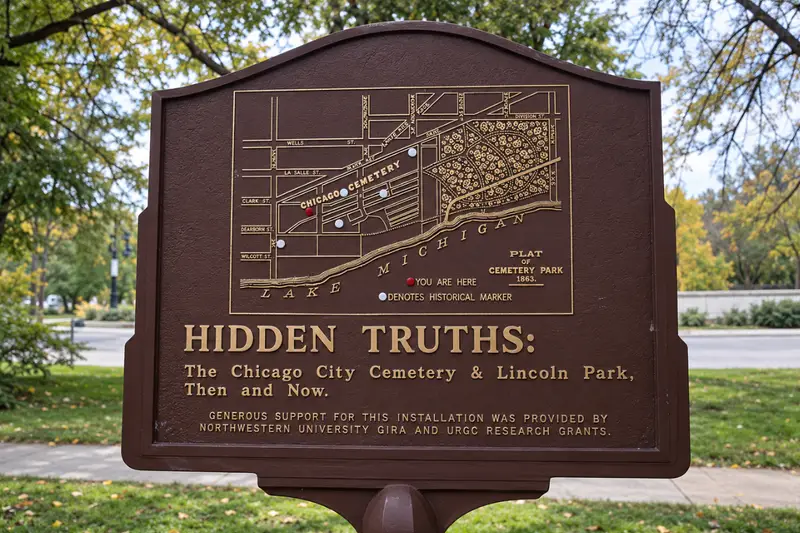
When the city sloppily transitioned the land into a park, they moved the rich but largely left the impoverished potter’s field behind.
Locals know the chilling truth that an estimated 12,000 to 20,000 bodies are still buried right beneath the grass.
As recently as 1998, park workers digging near the Chicago History Museum unearthed the skeletal remains of over 80 people.
Remember that unsettling fact during your next casual afternoon sunbathing session.
Visitor Guide: How to Find the Couch Tomb
- Modern Address: Located at the far south end of Lincoln Park, just behind the Chicago History Museum (1601 N Clark St, Chicago, IL 60614).
- Exact Coordinates: 41° 54.781′ N, 87° 37.885′ W.
- Cross Streets: The tomb sits on a grassy knoll just south of W. LaSalle Drive, aligned on an axis with N. Stockton Drive.
- Transit Directions: Take the CTA Red Line to the Sedgwick station, walk east to Clark Street, and head into the park behind the museum. Alternatively, take the 22 Clark bus directly to North Ave.
- What to Look For: Keep an eye out for the two historical markers. The bilingual marker erected by the Chicago History Museum tells the full story of Ira Couch’s wealth and the mystery of the remaining interments.