
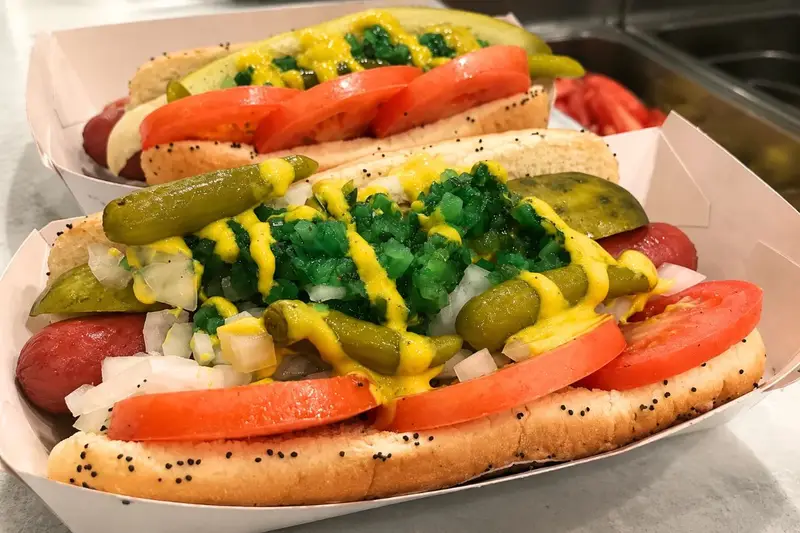
The defining dogma of the Chicago hot dog is a glaring contradiction: you must crown it with two thick wedges of fresh red tomato, but a single drop of red tomato ketchup is an unforgivable sin.
This absolute culinary autocracy is a verified historical mandate, not a neighborhood urban legend.
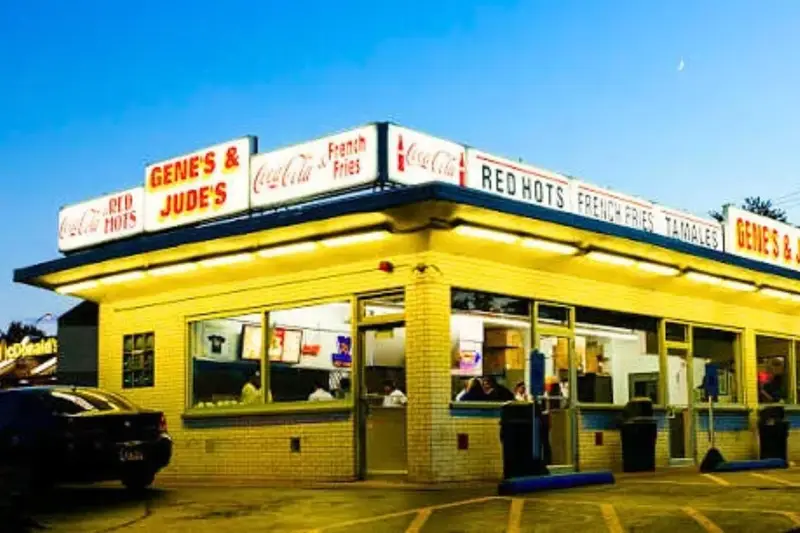
Walk into Gene & Jude’s at 2720 N River Road, and you will see this rule enforced with ruthless efficiency.
Ask the counter staff for the sugary red sauce, and you will be flatly refused, publicly shamed, and ordered to walk across the street to McDonald’s.
The Scent of Spoiled Meat and the 1929 Crash
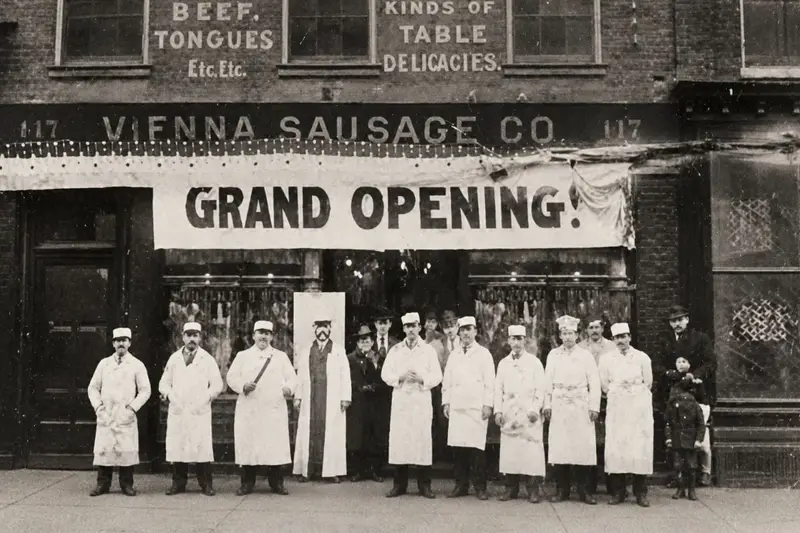
For generations of Chicagoans, the ban on ketchup started as a working-class badge of honor against low-grade butchers.
Early 20th-century meat vendors used high-sugar condiments to mask the foul taste of rotting scraps.
Chicago street carts refused to play that game.
Austro-Hungarian immigrants Emil Reichel and Samuel Ladany debuted their kosher-style franks at the 1893 World’s Columbian Exposition.
Vienna Beef was founded in 1893, setting a standard for premium sausages that required no sugary disguise.
Following the October 1929 stock market crash, Abe “Fluky” Drexler transformed his father’s Maxwell Street vegetable cart into a survival lifeline.
He invented the multi-vegetable “Depression Sandwich” for a mere 5 cents.
Drexler piled the 2.0-ounce frank with fresh vegetables, creating an exact acid-salt balance that ketchup’s cloying sweetness would instantly destroy.
The Seven Essentials of a Working-Class City
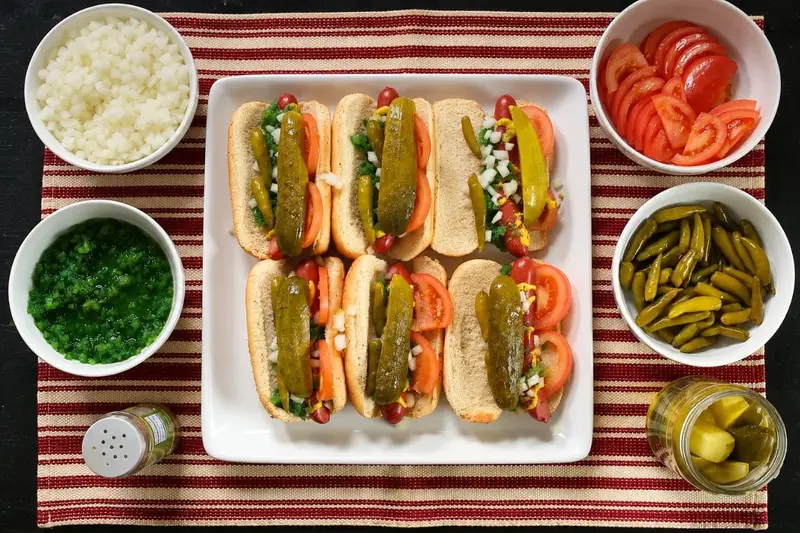
Food historians map the classic Chicago hot dog as a physical timeline of 20th-century immigration.
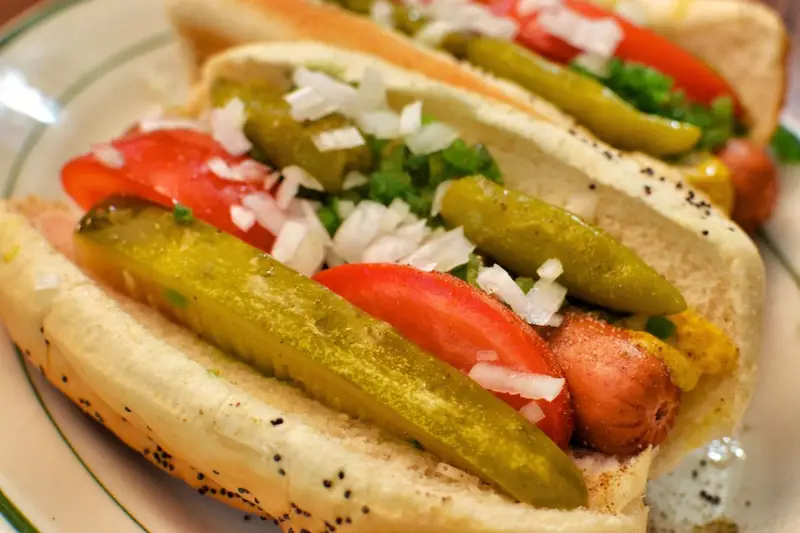
The “Seven Essentials” must be stacked in a highly specific order, starting with an all-beef frank in a natural sheep casing steamed at 160°F to 180°F.
It rests inside a high-gluten, black poppy-seed bun produced by S. Rosen’s Bakery, a staple of Eastern European Jewish immigrants since 1909.
Next comes the zigzag of yellow mustard from German butchers, chopped white Spanish onions, and neon green sweet relish tinted with Blue Dye No. 1.
Greek and Italian greengrocers finished it by dragging it through the garden: two red tomato wedges, one kosher dill pickle spear, two pickled sport peppers, and a heavy shake of celery salt.
Longtime Vienna Beef executive Bob Schwartz documented this exact build in his definitive book, Never Put Ketchup on a Hot Dog.
Today, a bronze plaque hangs in the Vienna Beef Memorial Hall of Fame honoring independent stands that serve it “never ketchup.”
High-Stakes Poker and the River Grove Exile
The ketchup ban survived the Great Depression, but it was codified by gamblers and renegades.
In 1949, vendor Gene Mormino gambled away his original hot dog stand at West Polk and South Western Avenue during a disastrous poker game.
Broke but undefeated, Mormino scraped together enough cash to flee the city limits.
He partnered with Jude DeSantis in 1950 to open a new shack along the Des Plaines River.
They wrapped their signature “Depression Dog” in grease-stained brown butcher paper, burying it under hand-cut russet fries.
They also established the most aggressive anti-ketchup policy in the Midwest.
Local academics call this aggressive gatekeeping “fast food fascism.”
It is a bizarre paradox where a city famous for its democratic spirit enforces an absolute dictatorship at the lunch counter.
At Superdawg Drive-In, opened by Maurie and Flaurie Berman in May 1948, the rule is equally strict.
They refuse to place ketchup directly on their franks, serving it only in tiny cups for fries.
Blood, Sugar, and the Ballpark Fly Trap
Beyond culinary pride, early Chicago vendors faced a brutal environmental enemy.
During the early days of baseball at West Side Park, vendors battled swarms of black flies during humid summer doubleheaders.
The high-fructose corn syrup in open vats of stadium ketchup acted as a massive insect magnet.
Mustard, packed with heavy vinegar and turmeric, acted as a natural insect deterrent for the wooden concession carts.
By the time Pulitzer Prize-winning columnist Mike Royko published his legendary November 1995 manifesto, the practical rule had become moral law.
Royko declared that putting ketchup on a hot dog was a right for “barbarians,” but remained fundamentally “disgusting and perverted.”
Outsiders who test this law face immediate hostility.
On July 19, 2017, Heinz attempted an undercover marketing stunt at The Wieners Circle on Lincoln Avenue, offering a fake product called “Chicago Dog Sauce.”
When neighborhood regulars discovered it was just repackaged Heinz ketchup, they erupted in visible, screaming fury.
Presidential Dictums and Political Scandals
Even the highest offices in the nation cannot escape the mandate.
When visiting Hot Doug’s on the North Side in 2011, President Barack Obama famously declared to the national press corps that no one over the age of 8 should ever put ketchup on a hot dog.
This cemented a specific age cutoff into national political record.
During a televised 2019 Chicago mayoral debate, candidate Amara Enyia confessed to eating ketchup on her hot dogs.
Frontrunner Lori Lightfoot immediately pointed off-camera and commanded, “There’s the exit. Never, never, never.”
Navigating the Ketchup-Free Zone: A Field Guide
Locals know you cannot truly experience Chicago without ordering a dog exactly as intended.
Gene & Jude’s
Address: 2720 N River Rd, River Grove, IL 60171.
The Vibe: Cash only, no seats, and absolutely no ketchup allowed on the premises.
Superdawg Drive-In
Address: 6363 N Milwaukee Ave, Chicago, IL 60646.
The Vibe: A mid-century neon fever dream at the intersection of Milwaukee, Devon, and Nagle Avenues.
Jimmy’s Red Hots
Address: 4000 W Grand Ave, Chicago, IL 60651.
The Vibe: Humboldt Park royalty since 1954, featuring vintage metal signs that warn: “Absolutely No Ketchup – DON’T EVEN ASK.”
The Wieners Circle
Address: 2622 N Clark St, Chicago, IL 60664.
The Vibe: Late-night Lincoln Park chaos where asking for ketchup will get you verbally destroyed.