
The federal safety law written to prevent another Titanic directly caused a ship to capsize and kill more passengers than the Titanic itself.
This isn’t a dark urban legend, but the grim reality of Chicago’s deadliest single-day catastrophe.
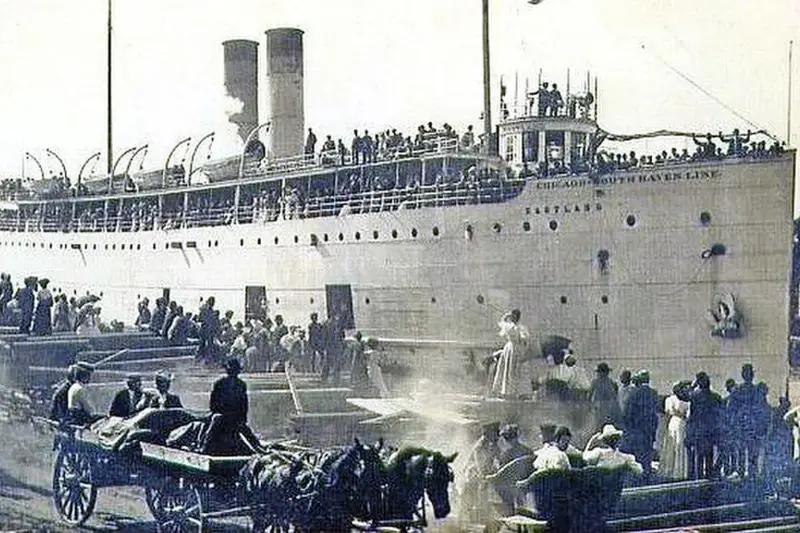
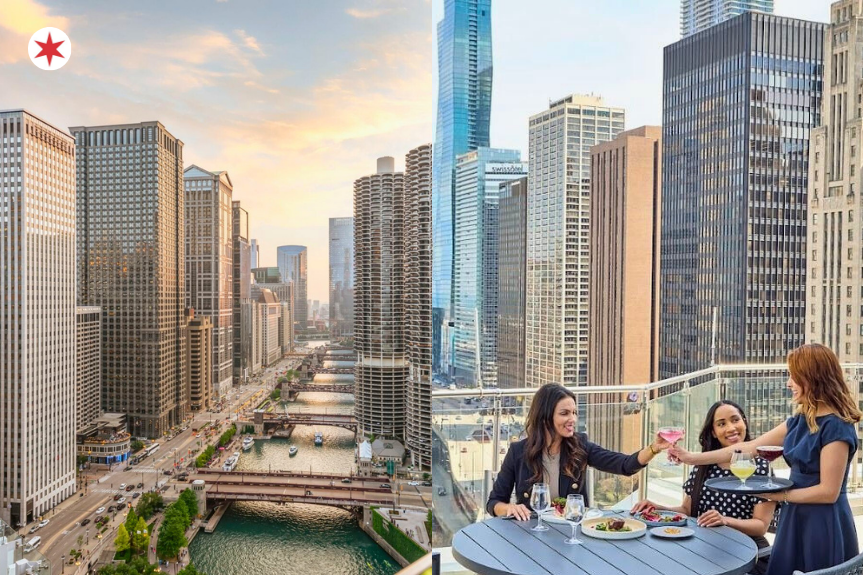
The nightmare unfolded just 19 feet from the wharf on the modern-day Chicago Riverwalk between Clark and LaSalle Streets.
Because of a maritime legal loophole, the grieving families of the 844 dead received absolutely zero financial compensation.
The Fatal Weight of Good Intentions
In March 1915, Congress passed the La Follette Seamen’s Act. They wanted to ensure no ship ever sailed without enough lifeboats again.
To comply, the operators of the SS Eastland strapped 11 lifeboats and 37 life rafts to the upper decks. Each raft weighed roughly 1,100 pounds.
They added 15 tons of top weight to a narrow excursion steamer that lacked a proper keel. The ship already suffered from a dangerously shallow center of gravity.
On July 24, 1915, over 7,000 employees of the Western Electric Hawthorne Works gathered for a massive company picnic. These were fiercely hardworking Bohemian, Polish, and German immigrants from Cicero.
Tragically, 70 percent of the deceased were under the age of 25. By the end of the day, 22 entire families would be completely wiped out.
Drowning Within Arm’s Reach of Land
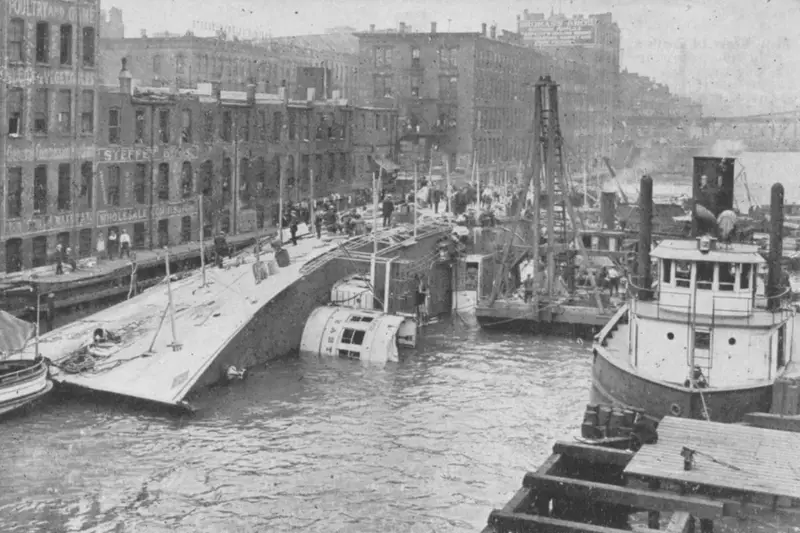
By 7:10 AM, the gangplanks closed with exactly 2,500 passengers packed aboard. The top-heavy ship immediately began to list.
Below deck, Chief Engineer Joseph M. Erickson desperately fought the ballast valves to stabilize the vessel. He manually shut down the steam boilers, preventing a catastrophic explosion that would have scalded hundreds alive.
At 7:28 AM, the Eastland violently rolled onto its port side. It crashed into the river mud in just 20 feet of water.
Half the ship remained above the surface, yet hundreds suffocated inside the flooded lower cabins. They were crushed beneath heavy sliding furniture and thousands of falling bodies.
The fashion of 1915 turned into a deadly trap for the women onboard. Heavy wool skirts and restrictive corsets absorbed the oily river water, acting as literal anchors that dragged them to the bottom.
When rescue welders began cutting through the exposed steel hull to pull trapped survivors out, Captain Harry Pedersen showed zero remorse. He reportedly screamed at the rescue crews, “Stop it! You’ll ruin the ship!”
A 17-year-old motorcycle mechanic named Charles “Reggie” Bowles rushed to the scene. Known as “The Human Frog,” he repeatedly free-dived into the toxic, pitch-black hull to recover bodies when professional divers refused.
Western Electric nurse Helen M. Repa leaped into action from a trailing streetcar. She commandeered nearby transit cars to set up triage stations and organized critical medical supplies.
A young man named William Ballard spent an entire day treading the highly polluted river water to pull victims out. He ultimately destroyed his lungs and died of tuberculosis at age 22.


The Ultimate Corporate Betrayal
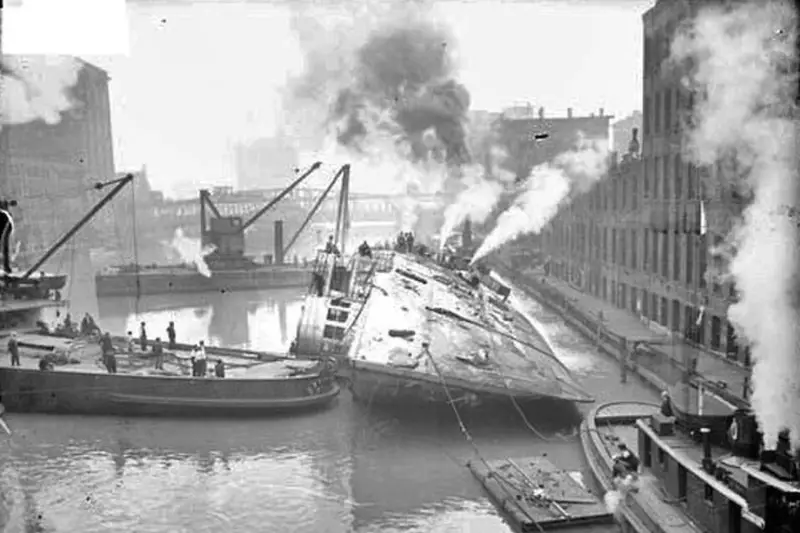
The aftermath of the disaster was a masterclass in corporate evasion. The ship’s owners invoked the 1851 Limitation of Liability Act, an archaic maritime law protecting merchant shipping.
This loophole capped their total financial liability at the post-crash salvage value of the vessel. That number was a pathetic $46,000.
Prior maritime liens exhausted that entire fund immediately. The working-class families who lost 844 loved ones walked away with nothing.
After 20 years of bitter litigation, the federal courts closed the case without a single criminal conviction. Adding insult to injury, the U.S. Navy raised the wreck and commissioned it as the gunboat USS Wilmette.
One famous Chicagoan narrowly escaped this grim fate. Future Chicago Bears founder George Halas was a 20-year-old Western Electric summer worker scheduled to board that morning.
Halas ran late and missed the boarding deadline entirely. His name was even printed on the early casualty lists before friends found him walking off a streetcar, completely unharmed.
Shadows and Phantoms of the West Loop
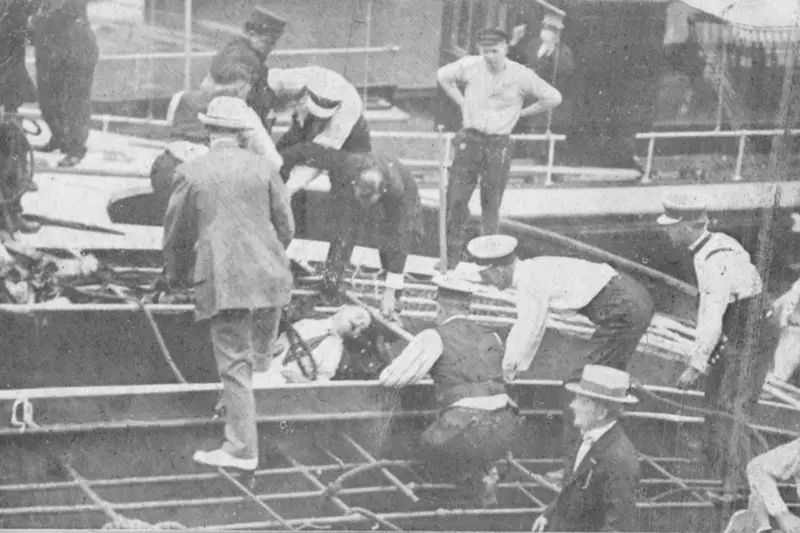
For generations of Chicagoans, the spectral legacy of the Eastland remains embedded in the city grid. The sheer scale of the tragedy required massive makeshift morgues across downtown.
The Reid, Murdoch & Co. Building at 325 N. LaSalle St. served as the primary triage center. Late-night workers in the historic red-brick structure frequently report shadow figures gliding down empty hallways.
Hundreds of victims were later moved to the Second Regiment Armory in the West Loop. Decades later, this building became Harpo Studios, where Oprah Winfrey filmed her legendary talk show.
Security cameras at Harpo famously captured a phantom figure in 1915-era clothing pacing the facility. Staff called her the “Gray Lady” and regularly heard the echoes of unseen children playing in the dark.
Today, paranormal investigators still record electronic voice phenomena at the Clark Street Bridge. When slowed down, the garbled audio often reveals distinct voices speaking in Czech, the native tongue of the doomed Cicero workers.
The Eastland Disaster Visitor Guide
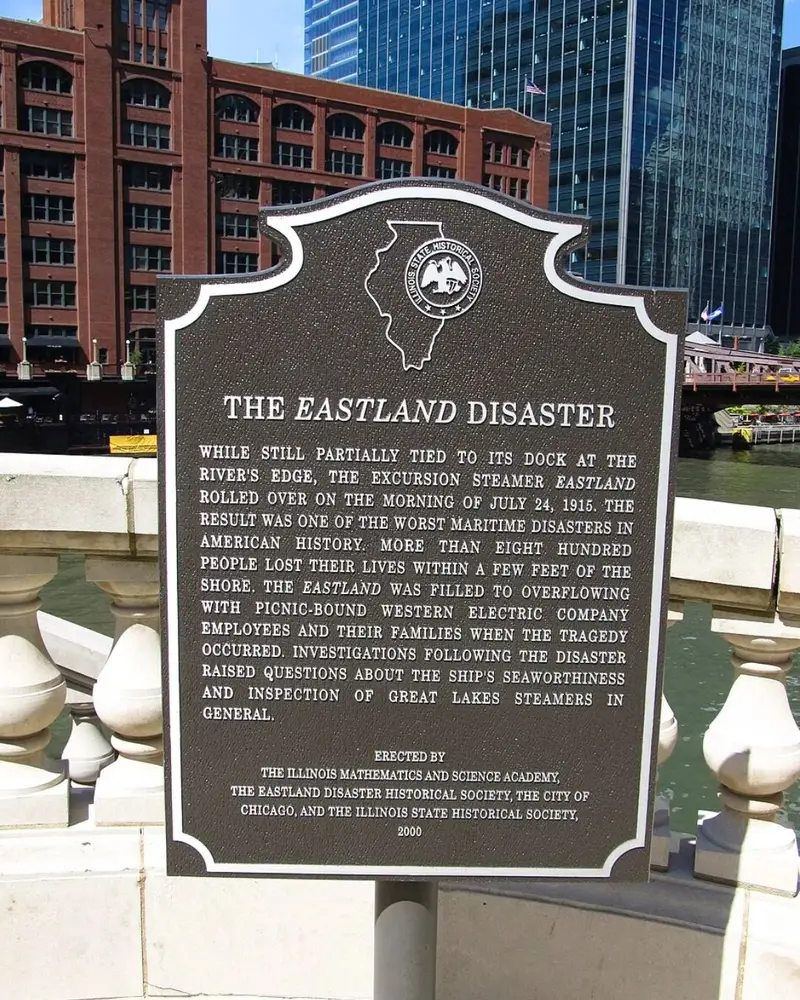
The Capsize Site & Memorial Plaque:
Walk to the southeast corner of LaSalle Street and Wacker Drive. You will find the official bronze commemorative plaque directly on the Chicago Riverwalk.
Cross Streets: W. Wacker Drive and N. LaSalle Street.
Transit: Take the CTA Blue, Orange, Brown, Pink, or Purple Line to the Clark/Lake Station and walk two blocks north.
The First Makeshift Morgue:
Look directly across the river to the north bank to see the Reid, Murdoch & Co. Building at 325 N. LaSalle St. Today, this historic structure houses Encyclopædia Britannica.
The Final Morgue Site (Former Harpo Studios):
Head to the West Loop at Washington Boulevard and North Curtis Street. The original armory is gone, but the grounds now serve as the sprawling McDonald’s Global Headquarters.
Historical details sourced via the Eastland Disaster Historical Society.